Why "AI Personalised" Cold Emails Still Sound Like Templates (And What Actually Works)
TL;DR
Only 5% of senders personalise every email they send. That 5% achieves up to 18% reply rates. The other 95% — most of whom believe they're personalising — achieve the 3.43% industry average. The gap between those numbers is not better tooling. It's whether "personalisation" means inserting a company name into a template or actually researching and writing for a specific person. In 2026, the phrase "AI personalised" covers both — and the two produce completely different outcomes. This piece explains the difference, what the data shows about each approach, and what it looks like when personalisation is real enough to get scored and improved before you ever see it.
Table of Contents
- The Personalisation Illusion
- What the Data Shows About Personalisation Depth
- Why AI Personalisation Is Making the Problem Worse, Not Better
- What Real Personalisation Requires
- Before and After: Template vs Research-First Output
- Why the Quality Review Step Changes the Outcome
- "Won't It Sound AI-Generated?"
- How to Get Real Personalisation at Scale Without Manual Research
- FAQ
The Personalisation Illusion
Most AI cold email tools describe their personalisation feature this way: the AI inserts relevant details about the prospect — their name, company, title, maybe a recent event from their LinkedIn — into your email template.
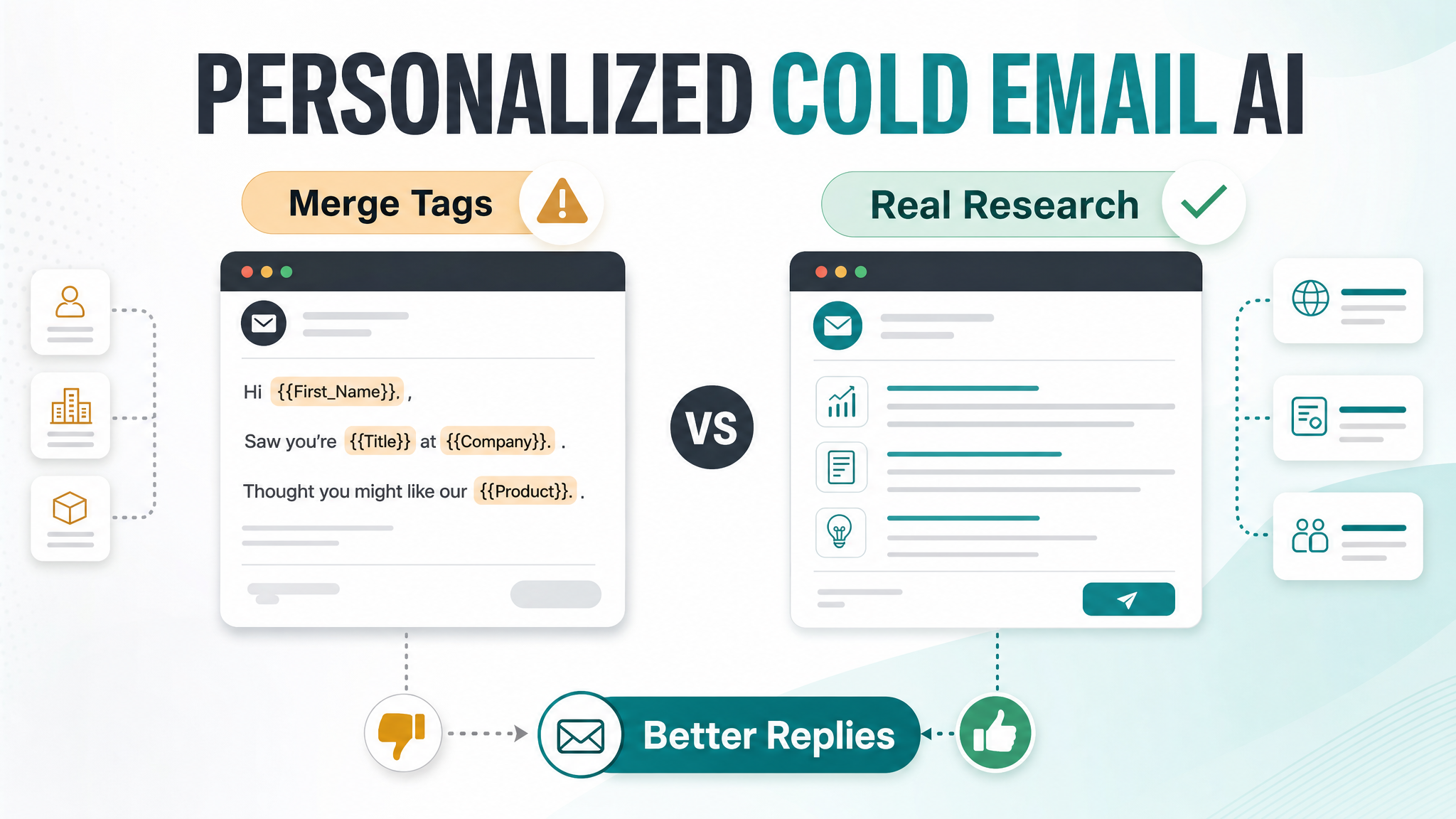
The problem is that this isn't personalisation. It's personalised formatting. The email is still a template. The structure, the argument, the value proposition, and the CTA are identical for every recipient. Only the inserted field changes.
Here's the test: could you send this email to 500 people by swapping out one or two fields without rewriting anything? If yes, it's a template with a personalised opener, not a personalised email.
Recipients know the difference. They receive enough cold outreach — and enough "AI-personalised" cold outreach — to spot the pattern in the first two sentences. Gmail's spam filters in 2026 now assess content relevance and user engagement patterns, not just sender reputation. An email that shares body structure with thousands of other sends gets flagged before the subject line is read. Templates are structurally identical. The email that starts "I noticed you recently joined [Company] as [Title]" is the same email, with the same sentence structure, as the thousand other emails that week that started exactly that way.
What the Data Shows About Personalisation Depth
The performance gap between surface-level and genuine personalisation is documented clearly and consistently.
Campaigns with advanced personalisation achieve up to 18% reply rates — roughly double the 9% average for basic or non-personalised emails. Advanced personalisation means industry-specific pain points, recent visible triggers (a funding round, a product launch, a leadership change, a job posting that signals something about the company's direction), company news — something that could only have been written for this recipient.
Campaigns under 50 recipients average a 5.8% reply rate versus 2.1% for campaigns with 500+ recipients. The smaller the list, the better the results — because smaller lists make real per-lead research feasible. This relationship is not coincidence. It's the personalisation variable expressed through list size.
AI-personalised campaigns (when the AI actually researches and writes from context) outperform templates by 2–3x on positive reply rate, according to analysis of more than 10 million delivered cold emails. Template sequences now average below 1% positive reply rate. The separation between these tiers has been widening, not narrowing.
The performance gap is not about copy quality in a craft sense. It's about relevance. An email that is grammatically perfect and strategically empty gets ignored. An email that demonstrates the sender understood something specific about the prospect's situation gets a reply.
Why AI Personalisation Is Making the Problem Worse, Not Better
Here's the uncomfortable part of this story. The widespread adoption of AI email tools hasn't improved average reply rates — platform-wide reply rates have dropped from 5.1% in 2024 to 3.43% in 2026, driven partly by the flood of AI-generated outreach that prospects are learning to recognise and ignore.
Teams that over-rely on AI for the writing itself see declining reply rates. AI-detectable copy — which follows predictable structural patterns, uses particular sentence constructions, and references the same types of "personalised" details in the same way — is being filtered by spam systems and identified by the humans who receive enough of it.
The pattern is specific. An email that opens with "I came across your profile and noticed you're leading sales at [Company]" is technically personalised. It has a real company name. It has a real job title. It was almost certainly generated by an AI that was given those two fields and told to personalise. The recipient knows immediately, because they've seen the same opener dozens of times this month with different names and companies inserted.
What AI has done to cold email is scale the production of templates that feel like personalisation while creating none of the relevance that personalisation is supposed to produce. The tools that are solving this problem are the ones that give the AI real research context before it writes anything — not the ones that give it a name and title and call it personalised.
What Real Personalisation Requires
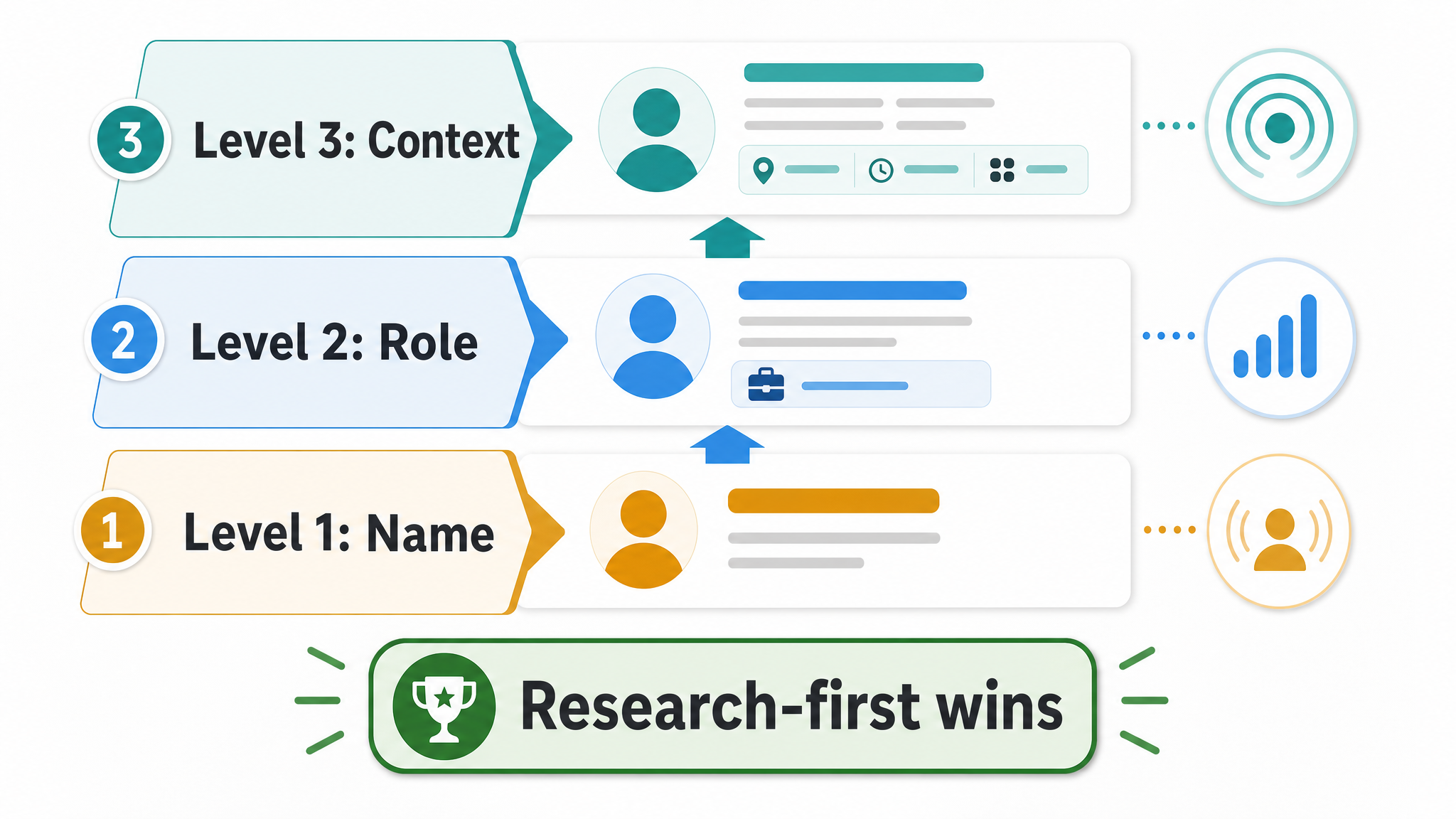
Genuine personalisation requires three things that most AI cold email tools don't build into their architecture.
First, lead-level research before writing. The email has to be written from something that's actually true about this specific person, at this specific company, right now. Not their title. Not their industry. Something specific: their company just announced APAC expansion. Their job listing for three enterprise AEs suggests a sales motion shift. A recent blog post they published about a challenge your product addresses. These are the details that produce emails that read like they were written by someone who spent 15 minutes researching — because something effectively did.
Second, writing from scratch for each lead. Not inserting research findings into a template. Actually generating the message structure, argument, and CTA from the research context, specific to that person. This requires a generative step that starts from the research, not from a pre-written framework with slots to fill.
Third, evaluation of the output before it ships. This is the step nobody builds and nobody talks about. Once the AI generates a sequence, something needs to check whether it achieved genuine personalisation or produced a convincing-looking template. That check has to be structured — specific criteria, not a vague "does this look good?" pass — and it has to be able to send the draft back for revision if it doesn't pass.
Before and After: Template vs Research-First Output
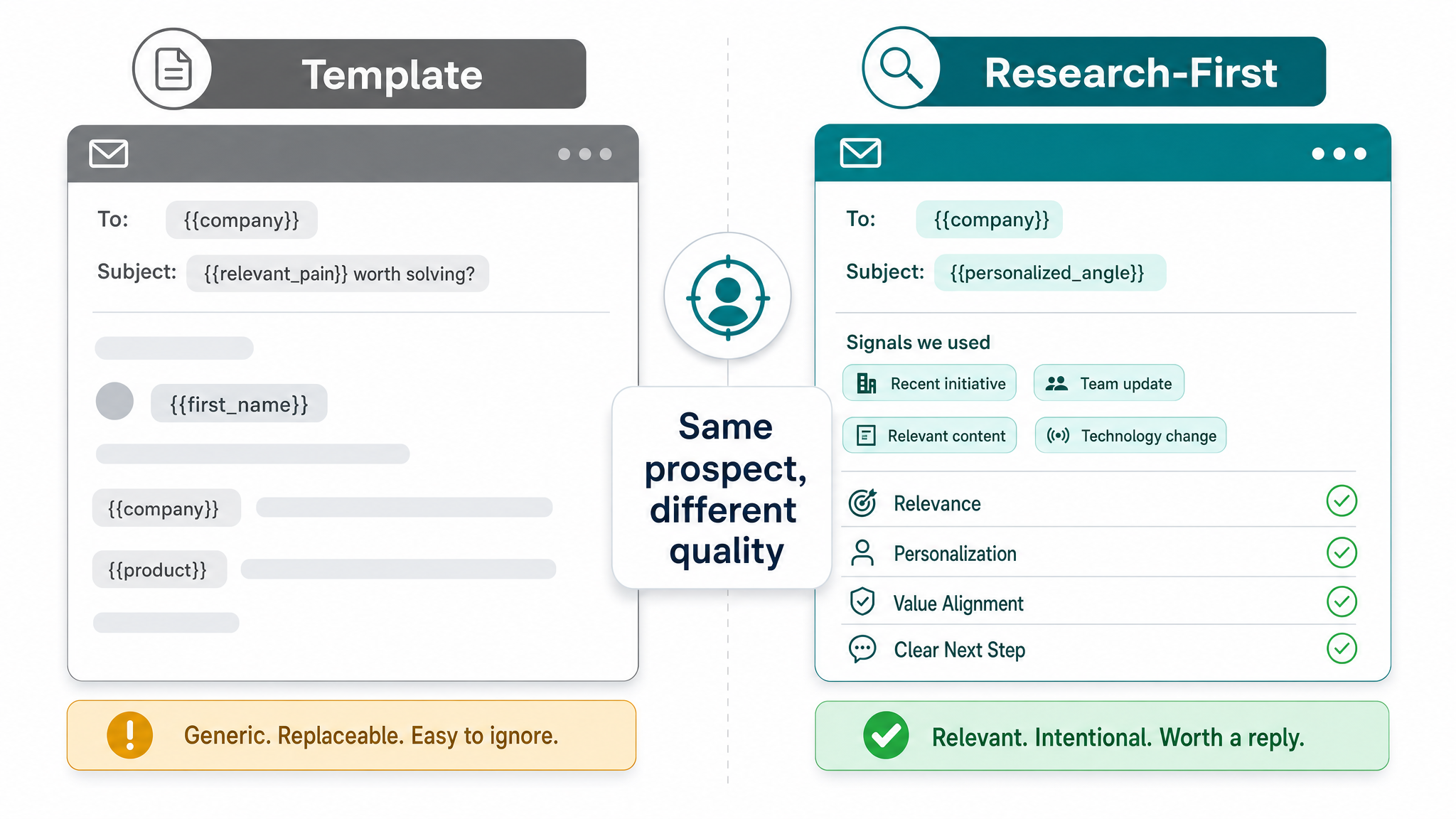
Same prospect. Same value proposition. Two completely different approaches.
Template approach (merge-tag personalisation)
Subject: Quick question about Meridian Labs
Hi Sarah,
I saw you're the Head of Revenue Operations at Meridian Labs — great company.
We help RevOps leaders streamline their data workflows and reduce time spent on manual reporting. Many of our clients in SaaS have seen significant time savings in the first 30 days.
Would you be open to a 15-minute call to explore whether it makes sense?
Best, [Name]
Research-first approach (AmroGen Lead Generator + Orchestrator)
Subject: Meridian Labs + 3-tool CRM problem
Hi Sarah,
Your recent LinkedIn post about syncing Salesforce, HubSpot, and Outreach activity without a dedicated RevOps engineer — that's the exact pain point [Product] was designed for.
We've helped three SaaS RevOps teams at your stage (Series B, 60–200 employees) cut their tool-sync overhead by about 8 hours a week without adding headcount.
Worth 20 minutes to see if the numbers work for you?
The first email is personalised in the way that 95% of "AI personalised" emails are personalised. The second references a specific, checkable public statement Sarah made, draws an inference about her company's current situation, and positions the product in the context of that specific situation. The second one gets replies. The first one has 3.43% company.
Why the Quality Review Step Changes the Outcome
AmroGen's Orchestrator agent reviews every specialist agent's sequence output before it reaches you. It scores on four criteria and sends anything below 7/10 back for revision automatically.
Personalisation depth. Does each message reference something specific and checkable about this lead's role and company — or does it use phrases and arguments that could apply to anyone in a similar title?
Factual accuracy. Are the references to company events, job listings, or public statements accurate and current? A "personalised" email that references something that happened 18 months ago is worse than no personalisation at all.
Format compliance. SMS sequences must be 160 characters. LinkedIn connection requests under 300. Email subject lines under 50 characters. These aren't style guidelines — they're operational constraints that affect whether the message gets delivered and whether it gets read.
Content quality. Would a thoughtful person send this? Does it open in a way that doesn't immediately read as automated? Does the CTA ask for something reasonable, with a clear reason to say yes?
Sequences that don't pass these checks get sent back for revision before you see them. You're reviewing output that already cleared a bar — not first-draft AI output that may or may not be any good.
"Won't It Sound AI-Generated?"
This is the right question to ask, and it deserves a direct answer rather than a reassurance.
Elite outbound teams in 2026 use AI for roughly 80% of research and sequencing work while keeping human effort focused on messaging strategy and live reply handling. The teams achieving 15%+ reply rates are not writing every email by hand — they're using AI that's well-enough informed to write at a quality level that reads as researched.
The emails that read as AI-generated share identifiable patterns: certain opening constructions, certain sentence rhythms, a particular way of inserting "personalised" details that reads as inserted rather than integrated. The Orchestrator's review criteria are specifically designed to catch these patterns — the "I noticed you recently..." openers, the generic pain-point references, the copy that sounds like a slightly modified version of what five other companies sent this week.
The goal isn't to hide that AI wrote the email. The goal is to write an email that demonstrates actual research about the prospect — which is what personalisation is supposed to accomplish in the first place. If the AI did real research and wrote from that context, the email reads like real research. If it pattern-matched a template and inserted some fields, it reads like that too.
How to Get Real Personalisation at Scale Without Manual Research
The workflow that actually produces the 15–18% end of the reply rate range:
1. Start with a company URL, not a contact list. This forces lead-level research rather than database-field personalisation. The research has to happen before the writing can happen.
2. Use an agent that browses live sources at campaign time. A company's current job listings, their recent LinkedIn posts, their blog, their public announcements — this is the research context that produces genuinely specific emails.
3. Generate sequences from the research, not from a template. The email should be written from what was found, not around a pre-existing structure with research inserted into specific slots.
4. Score the output before it reaches you. If the AI produced a generic opener, that's the time to catch it — not after you've approved and sent it.
5. Keep lists small and targeted. Campaigns under 50 recipients consistently outperform larger lists. The relationship between list size and reply rate is essentially the relationship between personalisation depth and reply rate. Smaller lists make real research feasible. Research makes real personalisation possible.
AmroGen's pipeline runs all five of these steps in a single workflow — from URL to quality-reviewed, lead-specific sequences — without manual research, manual writing, or a separate review pass from you before the quality check has already run.
→ See how the Lead Generator and review loop work together
FAQ
How do I personalise cold emails automatically? Real automatic personalisation requires an agent that researches each lead's specific context — job, company situation, recent events — and generates copy from that research rather than inserting research findings into a template. Tools that claim AI personalisation but generate from a template with merge tags are producing personalised formatting, not personalised emails.
What is the best AI for cold email personalisation? Tools that use research-first lead sourcing (browsing live sources rather than querying a database) and generate sequences from that research context tend to produce more genuine personalisation than tools that assist you in writing a template. The review step — whether anything scores the output before it ships — is the second key differentiator.
Does AI personalisation actually improve reply rates? Yes, when it's real personalisation. Advanced personalisation achieves up to 18% reply rates versus 9% for basic templates. The caveat is that "AI personalisation" covers both genuine research-based writing and template-with-merge-tags, which produce completely different results. The 18% figure reflects actual research-driven personalisation.
What data does AI use for cold email personalisation? The most effective approach uses live research at the time of the campaign: job listings (which reveal company priorities and hiring direction), recent LinkedIn posts and announcements (which reveal what the person is working on and thinking about), company website and blog (which reveal strategic direction), and enriched contact data (title, location, seniority). Static database fields (industry, company size) produce the 9% end. Live research produces the 18% end.
Can AI write truly personalised sales emails? Yes, if it has real research to write from. The quality of an AI-written email is limited by the quality of the context it's given. An AI writing from "VP of Sales at a SaaS company" produces a template. An AI writing from "VP of Sales at a 60-person Series B SaaS company that just posted three enterprise AE roles and published a LinkedIn post about their APAC expansion challenge" produces something that reads specific.
What happens if the AI produces a bad draft? In most cold email tools, a human reviews and catches it — or doesn't. In AmroGen, the Orchestrator scores every draft against specific criteria before it reaches you and sends anything below the quality threshold back for automatic revision. This catches the generic openers, the template-sounding arguments, and the format violations before they become your problem to fix.
Data reflects publicly available sources as of June 2026.
Internal links: /features/ai-sequences · /features/lead-generation · /ai-sdr-tools