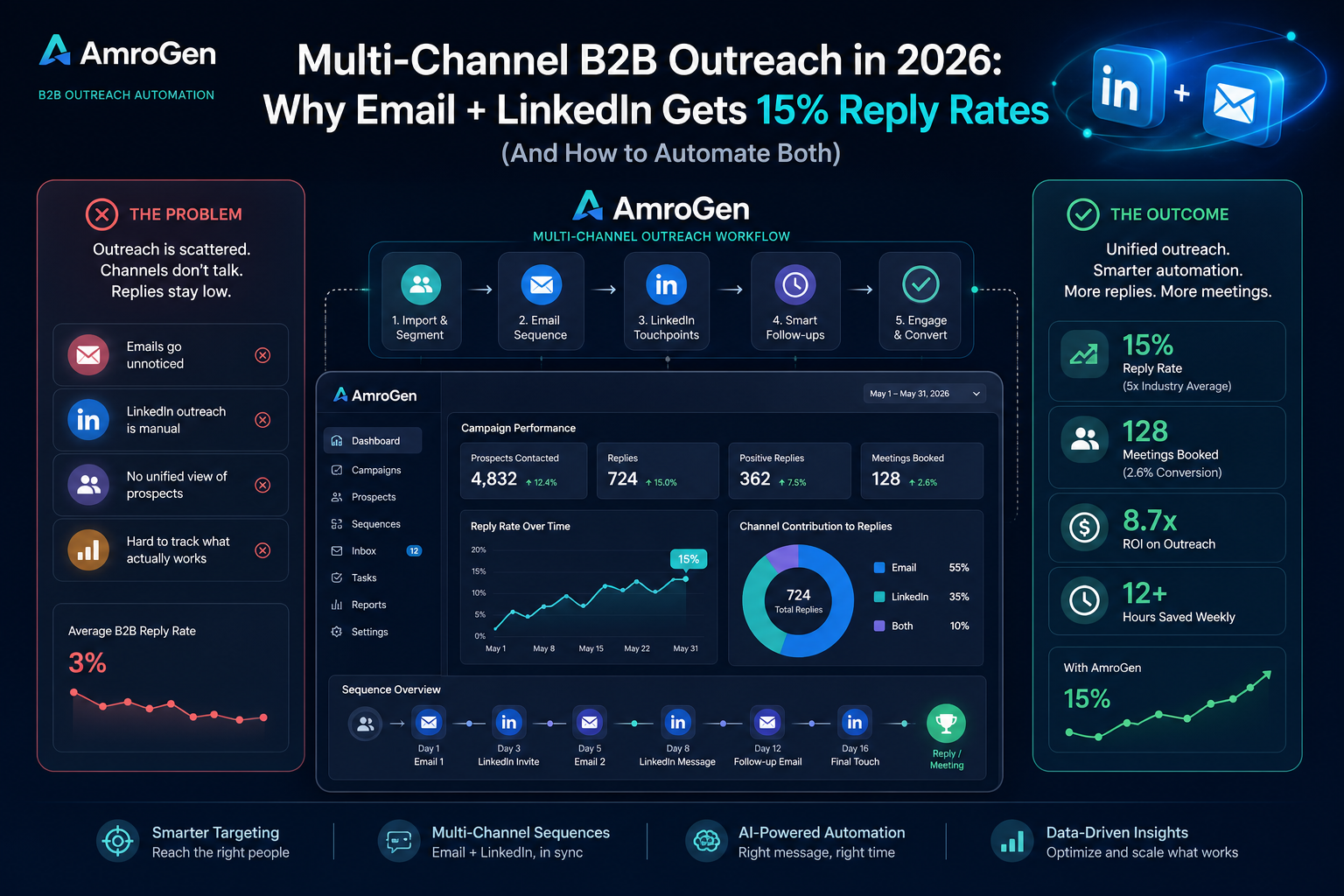
Multi-Channel B2B Outreach in 2026: Why Email + LinkedIn Gets 15% Reply Rates (And How to Automate Both)
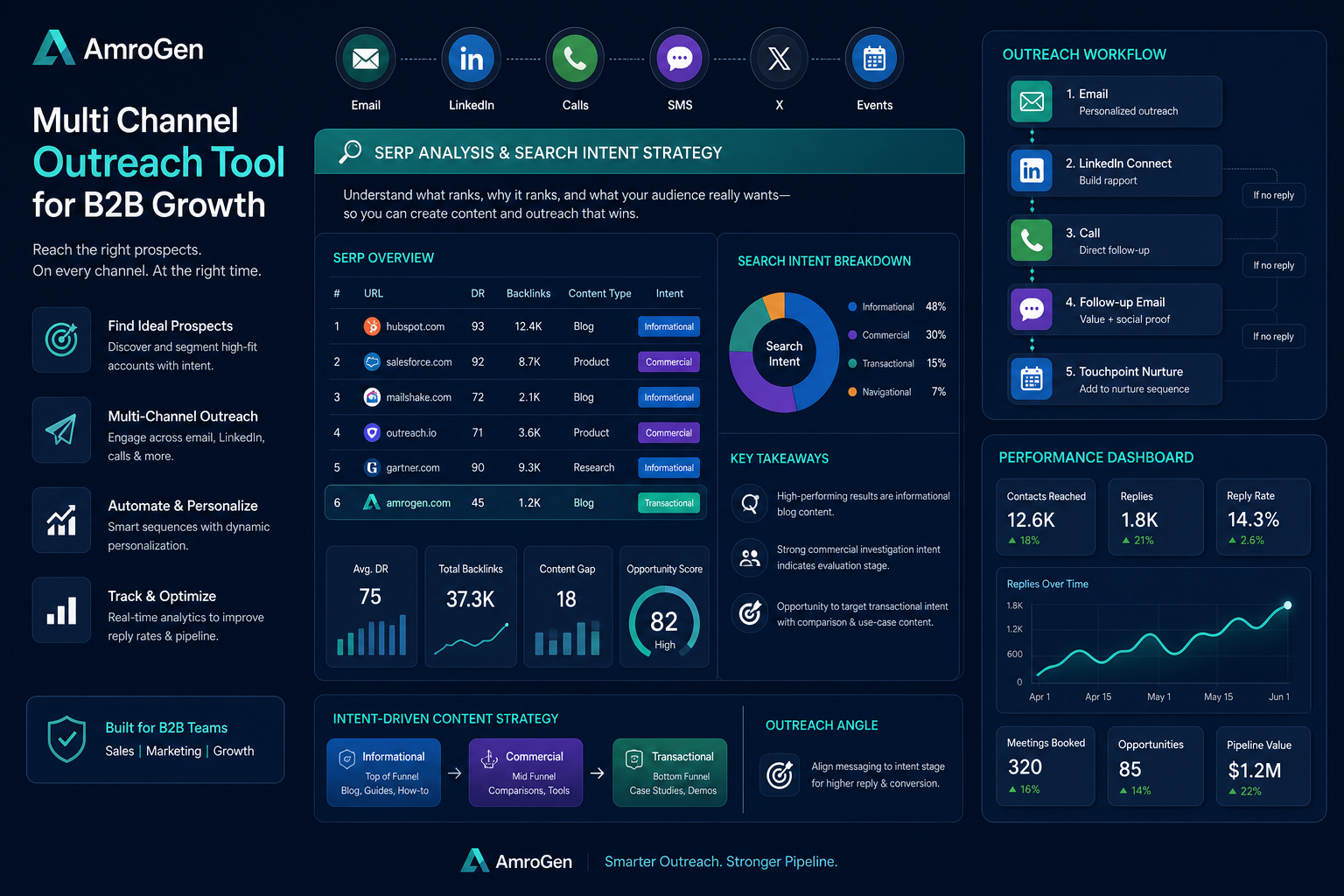
SERP Analysis & Search Intent Strategy
To position AmroGen effectively for the primary keyword “multi channel outreach tool b2b” (KD: 58, Volume: 1,900), we must directly address the evolving search intent of B2B revenue leaders in 2026.
Search Intent: The intent is mixed Informational/Commercial. Searchers—typically Heads of Sales, RevOps leaders, and Founders—are looking for data validating the ROI of multi-channel outreach, followed immediately by software solutions that prevent them from having to stitch together five different platforms. They are acutely aware that single-channel email outreach is failing, but they are overwhelmed by the operational complexity of coordinating email, LinkedIn, and SMS.
Competitor Patterns: Top-ranking pages from competitors like La Growth Machine, Enginy, SalesRobot, and GetReplies average 2,500 to 3,500 words. They heavily feature benchmark data (often citing the 287% response rate lift of multi-channel campaigns) and focus on the mechanics of sequencing. However, these competitors share a fatal flaw in their product positioning: they solve the sequencing problem, but they do not solve the copywriting problem. Their platforms rely on users bringing their own lead lists and plugging them into static templates with mail-merge tags.
The Differentiation Opportunity: AmroGen’s content strategy capitalizes on this gap. We lead with the hard data: email averages 3.8%, LinkedIn averages 10.3%, and combined campaigns hit 15%. Then, we pivot to the core differentiator. While legacy tools just send the same template across multiple channels, AmroGen is a true AI SDR. It takes a single URL, finds the decision-makers, and uses a 6-agent AI review loop to autonomously write hyper-personalised outreach for email, LinkedIn, and SMS through the reviewed agent pipeline. We position AmroGen not just as a sender, but as a complete pipeline generator that eliminates manual research and template writing entirely.
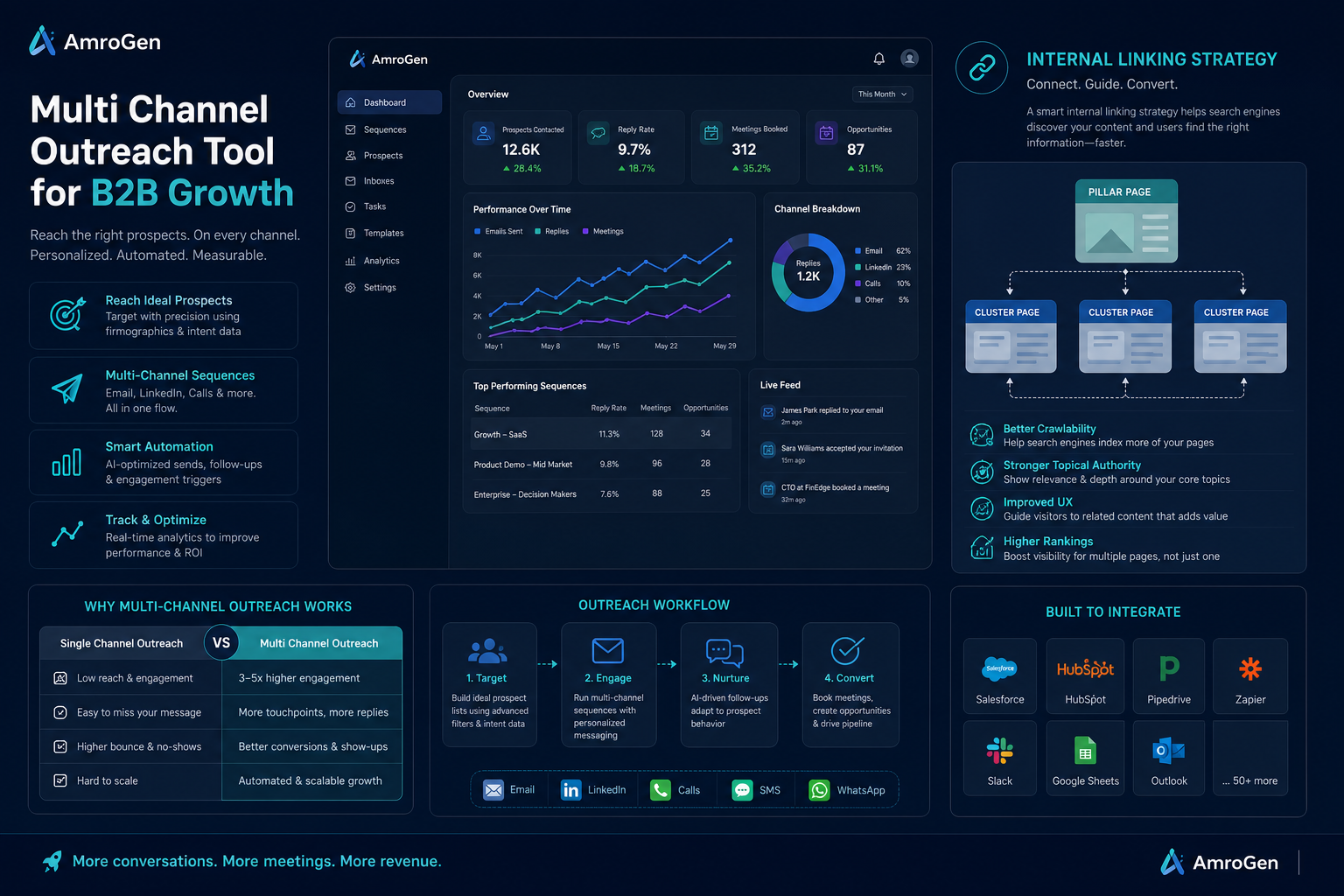
Internal Linking Strategy
To build topical authority and guide users through the AmroGen marketing funnel, this article utilizes a strategic internal linking framework:
- Top-of-Funnel (Education): Links to →
/ai-sdr-toolswhen discussing the broader landscape of sales automation and how AI is replacing traditional manual SDR research. - Middle-of-Funnel (Feature Deep Dives): Links to →
/features/multi-channel-outreachwhen breaking down the specific mechanics of combining email, LinkedIn, and SMS into a single cohesive campaign. - Middle-of-Funnel (Differentiation): Links to →
/features/ai-sequenceswhen explaining AmroGen’s 6-agent AI review loop and how the Orchestrator scores personalisation depth (1–10). - Bottom-of-Funnel (Conversion): Links to →
/pricingwhen demonstrating the ROI of AmroGen (e.g., ~$2.80 per pipeline run) compared to the $80,000+ fully loaded cost of a human SDR.
(Note: These internal links are naturally integrated into the body text below to ensure maximum SEO value and smooth user experience).
The State of B2B Outreach in 2026: The Math Behind Multi-Channel
If you are running B2B sales in 2026, you already know that the old playbooks are broken. The days of loading 5,000 unresearched contacts into a sequencer, applying a basic A/B tested template, and waiting for the meetings to roll in are over.
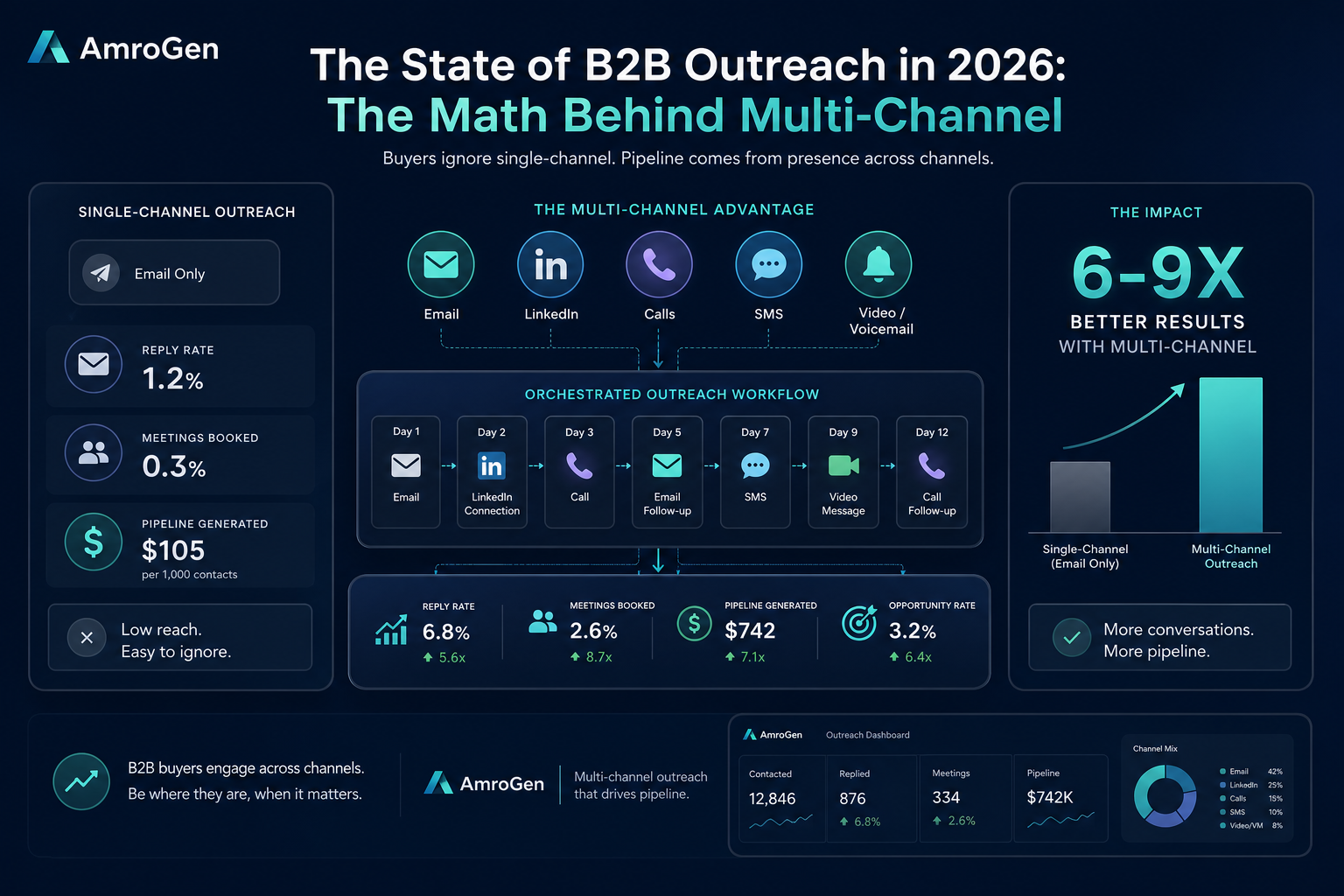
Inbox providers have drastically tightened their spam filters. Buyers are fatigued by generic, AI-generated fluff. And the data paints a stark picture for teams relying on a single channel. According to Instantly's 2026 Benchmark Report, the average cold email reply rate has plummeted to roughly 3.43%. Even when we look at broader datasets, the average cold email reply rate hovers around 3.7%.
But when you zoom out and look at teams executing coordinated, hyper-personalised campaigns across multiple touchpoints, the math changes entirely.
Here is what the 2026 benchmark data reveals about B2B reply rates:
- Email Alone: 3.43% – 3.8%
- LinkedIn Alone: 8% – 12% (averaging 10.3% for well-targeted campaigns)
- Combined (Email + LinkedIn): 15% – 25% for top-performing campaigns
- The Multi-Channel Multiplier: Campaigns utilizing three or more channels (Email, LinkedIn, Phone/SMS) see a 287% higher response rate than single-channel efforts.
Why does this happen? It comes down to human psychology and the mere-exposure effect.
A prospect might ignore three emails in a row. But if they see a LinkedIn connection request from you on Tuesday, they suddenly recognize your name when your fourth email lands in their primary inbox on Thursday. The friction of the "cold" interaction is removed. The outreach no longer feels like an automated blast from a faceless corporation; it feels like a persistent, genuine attempt by one professional trying to reach another.
The problem is not whether multi-channel outreach works. The problem is that executing it genuinely, at scale, is a logistical nightmare.
Most sales teams are stuck in a painful dichotomy. They can either hire an army of SDRs at $80,000 to $100,000 a year to spend four hours a day manually researching accounts and writing custom emails. Or, they can stitch together five different tools—Apollo for data, Clay for enrichment, ChatGPT for copy, and Lemlist for sending—and still end up with outreach that feels robotic and disjointed.
There is a better way. In this guide, we will break down exactly how modern B2B buyers consume outreach across Email, LinkedIn, and SMS. We will expose the flaws in legacy outreach tools. Finally, we will show you how to use a native AI SDR tool to turn any company URL into researched leads and hyper-personalised multi-channel sequences from a company URL through lead and sequence review.
The Three Pillars of B2B Multi-Channel Outreach
To understand how to automate a multi-channel sequence, you first need to understand the distinct role each channel plays in the modern B2B buyer's journey. You cannot simply copy and paste an email into a LinkedIn DM and expect it to convert. Each platform has its own rules of engagement, technical constraints, and social norms.
1. Cold Email: The Foundation
Email remains the foundational layer of B2B outbound. It offers the highest volume capacity, the lowest cost per send, and the most direct path to a decision-maker's calendar.
However, the barrier to entry for the inbox has never been higher. In 2024 and 2025, major inbox providers like Google and Yahoo rolled out strict sender requirements. If you send generic templates that generate high spam complaint rates, your domain reputation will tank, and your emails will be silently routed to the spam folder.
The 2026 Rules of B2B Email:
- Relevance over personalization: It is no longer enough to say, "I saw you went to the University of Michigan." True personalization means referencing the prospect's specific role, recent company news, or industry shifts.
- Short and punchy: The best emails are under 100 words. They state an observation, highlight a specific problem, and ask for a low-friction response (e.g., "Are you currently handling X internally?").
- Infrastructure matters: Sending from secondary, warmed-up cold domains used to be mandatory. But today, if you are sending low-volume, hyper-personalised emails, sending directly from your own primary Gmail account yields significantly higher deliverability. Because the volume is low and the quality is high, it bypasses the promotional filters that catch mass-sending tools.
2. LinkedIn: The Relationship Accelerator
LinkedIn is where B2B professionals live, network, and validate their peers. The reply rates here are naturally higher—averaging 10.3%—because the platform inherently provides social proof. When a prospect receives a LinkedIn message, they can immediately see your face, your title, your mutual connections, and your company's legitimacy.
The 2026 Rules of LinkedIn Outreach:
- Strict volume limits: LinkedIn aggressively penalizes accounts that use mass-automation tools. The platform restricts users to roughly 100 to 200 connection requests per week. This means every single request must count. You cannot afford to waste your weekly allowance on unresearched leads or generic pitches.
- The "No-Pitch" Connection: The highest converting LinkedIn sequences do not pitch in the connection request. They offer a connection based on shared industry context, wait for the prospect to accept, and then follow up with a highly tailored observation.
- Cross-channel synergy: LinkedIn works best when it references your email outreach. A simple message like, "Hey Sarah, just sent you a note via email about your recent product launch, but wanted to connect here as well," dramatically increases the open rate of the corresponding email.
3. SMS: The High-Risk, High-Reward Closer
SMS is the most intimate channel in B2B sales. A text message goes straight to a prospect's pocket, bypassing spam filters and gatekeepers. Because of this intimacy, it boasts open rates near 98%.
However, B2B SMS outreach is a minefield. If used incorrectly, it will irritate prospects and violate compliance laws.
The 2026 Rules of B2B SMS:
- Never use SMS as a first touch: Cold texting a B2B decision-maker who has never heard of you is intrusive and often illegal under regulations like 10DLC and TCPA.
- Use it for late-stage follow-ups: SMS should only be deployed as a gentle nudge after a prospect has already engaged with your brand, or as a late-stage sequence step for highly qualified, high-intent leads.
- Keep it conversational: B2B texts should read like a message from a colleague, not a marketing blast. "Hi John, left you a voicemail earlier regarding the Q3 pipeline report. Let me know if you have 5 mins tomorrow to chat."
The Problem with Legacy Multi-Channel Tools
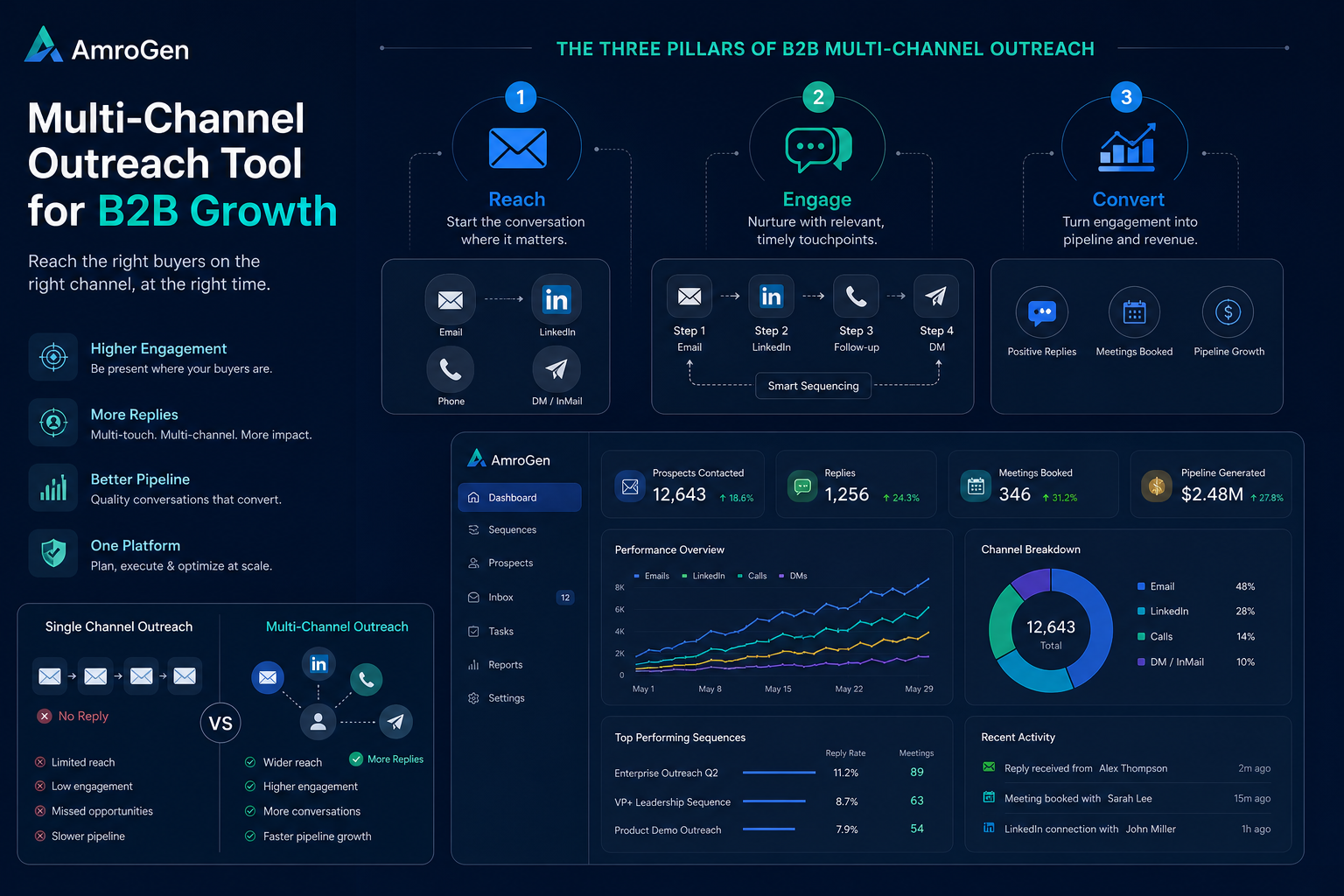
If multi-channel outreach is so effective, why do so many sales teams fail at it? The answer lies in the limitations of the software they are using.
For the past five years, the GTM (Go-To-Market) tech stack has been highly fragmented. Revenue Operations leads and SDR managers have been forced to play software engineer, stitching together disparate tools that were never designed to communicate seamlessly.
Let's look at why the standard playbook falls short in 2026.
The Database Tools (Apollo, ZoomInfo)
Platforms like Apollo and ZoomInfo are incredible repositories of B2B contact data. They allow you to filter millions of contacts by title, industry, and revenue. Where they fail: They do not write personalised copy. Their built-in sequencers rely on static templates and mail-merge variables (e.g., {{first_name}}, {{company_name}}). In 2026, buyers can spot a templated email from a mile away. The result? You get access to great data, but your outreach still gets ignored because it isn't genuinely personalised. Furthermore, contact data decays rapidly; a prospect might have left their job three months ago, but the database hasn't updated yet.
The Sequencing Tools (Outreach, Salesloft, Lemlist)
These platforms perfected the art of the multi-step cadence. They allow you to build complex logic trees (e.g., If email is opened, send LinkedIn request; if no reply in 3 days, send follow-up email). Where they fail: They are empty vessels. You still have to bring your own lead list, and more importantly, you still have to write all the copy yourself. A sequencing tool does not save your SDRs from spending three hours a day researching target accounts and attempting to craft clever subject lines. It just automates the sending of whatever you put into it.
The Data Waterfall Tools (Clay)
Clay is an incredibly powerful enrichment tool. It allows advanced growth marketers to scrape the web, run data waterfalls to find emails, and use AI prompts to generate custom snippets of text. Where they fail: Complexity and friction. Setting up a Clay table requires a deep understanding of APIs, data structuring, and prompt engineering. It is not built for the average Account Executive or Founder. Furthermore, Clay is not a sending platform. Once you generate the data and the copy, you still have to export it and load it into a sequencer like Lemlist or Smartlead.
The Real Cost of the "Franken-Stack"
When you combine these tools, you create a fragile, expensive process.
- You pay $1,000/year for data.
- You pay $1,500/year for enrichment.
- You pay $1,000/year for sequencing.
- Your SDR still spends 80% of their day managing CSV uploads, mapping fields, writing prompts, and checking for errors instead of actually talking to prospects.
The core tension is obvious: Personalised outbound at scale is either expensive (hiring human SDRs) or impersonal (using templates).
Until now.
How AmroGen Automates the Entire Pipeline
AmroGen was built specifically to solve the fragmentation of the modern sales stack. We looked at the jobs to be done by an SDR—researching target companies, finding decision-maker contacts, writing personalized cold outreach, and managing a multi-channel cadence—and built an AI architecture that does it all in one seamless flow.
AmroGen is not a template sequencer. It is an AI-powered B2B sales automation platform that takes a single input and generates a complete, ready-to-send multi-channel campaign.
The reviewed agent pipeline
Here is what the workflow looks like when you stop stitching tools together and start using a native AI SDR:
Step 1: The Input You do not need to upload a CSV. You do not need to build a complex search query. You simply give AmroGen a target company website URL.
Step 2: Discovery and Enrichment Within seconds, AmroGen scans the target company, understands its business model, and identifies the real decision-makers based on your Ideal Customer Profile (ICP). It then enriches these leads with contact details where available (email addresses, LinkedIn profiles, and phone numbers). It assigns an ICP Fit Score (High, Medium, Low) to ensure you are only reaching out to the right people.
Step 3: The 6-Agent AI Quality Review Loop This is where AmroGen completely separates itself from legacy tools and basic ChatGPT wrappers. Instead of using a single AI prompt to write an email, AmroGen deploys a coordinated team of six purpose-built Anthropic Managed Agents.
- The Researcher: Analyzes the lead's LinkedIn, company news, and industry trends.
- The Copywriter (Email): Drafts a hyper-personalised 5-step email sequence referencing the specific research.
- The LinkedIn Specialist: Drafts a cohesive LinkedIn connection request and follow-up sequence that aligns with the email messaging.
- The SMS Specialist: Drafts a compliant, context-aware 3-step SMS follow-up.
- The Reviewer: Checks the drafts for spam trigger words, tone consistency, and brevity.
- The Orchestrator: This agent acts like a senior sales manager. It reviews the output of all the other agents and scores the personalization depth on a scale of 1 to 10.
The Quality Guarantee: If the Orchestrator scores the generated AI sequences below a 7, it automatically rejects the copy and sends it back to the agents for revision. It will retry up to 3 times before the sequences ever reach your dashboard. This ensures that you never send robotic, generic AI copy. The output reads like a thoughtful human wrote it for that specific person.
Step 4: Approval and Native Sending The entire process—from pasting the URL to generating reviewed, multi-channel sequences for up to 100 leads—takes between 3 and 8 minutes. You simply review the sequences in your dashboard, hit approve, and the campaign is live.
Crucially, AmroGen sends directly from your own connected Gmail account. Because the copy is highly personalized and the volume is controlled (typically ~10 leads per pipeline run), there is no need to set up complex cold-sending domains or worry about domain warm-up. Your emails land directly in the prospect's primary inbox.
Built for the AI-Native Builder: The MCP Server
For RevOps leaders and power users, AmroGen is the only outreach platform on the market with a built-in MCP (Model Context Protocol) server. This means you can call AmroGen as a tool directly from Claude Desktop or other AI agents. You can seamlessly embed AmroGen into your existing AI workflows, triggering comprehensive lead gen and outreach sequences via natural language or API calls.
Decision Framework: Choosing the Right Multi-Channel Tool
With so many tools on the market, how do you know which approach is right for your business? The answer depends on your company size, your technical resources, and your outbound strategy.
Here is a pragmatic decision framework for 2026:
1. When to use Enterprise CRMs (Outreach / Salesloft)
Best for: Enterprise companies with 50+ SDRs, complex 12-month deal cycles, and strict requirements for bi-directional Salesforce/HubSpot syncing. Why: These platforms are highly robust systems of record. They offer advanced governance, team performance analytics, and deep CRM integrations. The Catch: They are incredibly expensive, require months of implementation, and still require your SDRs to write all the copy manually or rely on generic templates.
2. When to use Data Waterfalls (Clay)
Best for: Deeply technical growth marketing teams who want to build complex, bespoke outbound engines based on obscure data signals (e.g., "Find me companies hiring for a specific engineering role in Austin, cross-reference with their tech stack, and generate a webhook"). Why: Unmatched flexibility in data enrichment. The Catch: High learning curve. You need dedicated operations personnel to manage the workflows, and you still have to pay for a separate sending tool.
3. When to use AmroGen
Best for: Series A–C SaaS companies, agencies, consultancies, solo founders, and lean sales teams (1–5 reps) who want the output of a full SDR team without the headcount. Why: AmroGen is the ultimate consolidation tool. It replaces the database, the copywriter, and the sequencer. You don't need to be a prompt engineer or a RevOps wizard. You just need to know who you want to sell to. The Catch: AmroGen is not built for massive, un-targeted bulk blasting. If your strategy is to send 10,000 identical emails a day to unverified lists, AmroGen is not for you (and in 2026, that strategy will destroy your domain reputation anyway).
The ROI of AI-Automated Outreach
Let's look at the economics. The fully loaded cost of a human SDR is roughly $80,000 to $100,000 per year. They require a 3-month ramp period, and they spend 3 to 4 hours a day just doing research.
AmroGen operates on a credits-based subscription model. A standard pipeline run (discovering and generating sequences for ~10 decision-maker leads) consumes 8 credits.
- Starter Plan: $29/month (100 credits) – Perfect for founders testing founder-led sales.
- Growth Plan: $99/month (500 credits) – Ideal for small teams scaling their outbound.
- Scale Plan: $299/month (2,000 credits) – For established teams running continuous ABM campaigns.
- Pay-as-you-go: $0.35 per credit.
At full utilization on the Pay-as-you-go tier, a pipeline run costs approximately $2.80. For less than three dollars and 8 minutes of waiting, you receive hyper-personalised, multi-channel outreach for a target account that would take a human SDR half a day to produce. You can view our full pricing breakdown to see how it scales with your team.
Step-by-Step: Running a High-Converting Multi-Channel Campaign
If you are ready to implement a multi-channel strategy, here is the exact blueprint for running a campaign that hits the 15% reply rate benchmark.
Step 1: Identify the Trigger Event (Signal)
Do not reach out to accounts randomly. Look for buying signals.
- Did they just raise funding?
- Are they hiring for a role relevant to your product?
- Did their VP of Sales just post on LinkedIn about pipeline struggles?
- Are you following up on a list of attendees from a recent conference?
Step 2: Input the URL into AmroGen
Take the company URL associated with that buying signal and drop it into AmroGen.
Step 3: Let the Orchestrator Map the Account
AmroGen will identify the relevant decision-makers. For example, if you sell marketing software, it will find the CMO, the VP of Marketing, and the Demand Gen Lead. It will verify their emails and LinkedIn profiles instantly.
Step 4: Review the Multi-Channel Cadence
The AI will generate a coordinated sequence. A best-in-class cadence looks like this:
- Day 1 (Email 1): A highly personalized observation based on the company's recent news, ending with a soft, low-friction question.
- Day 1 (LinkedIn): A connection request sent 2 hours after the email. No pitch. Just a note referencing shared industry space.
- Day 3 (Email 2): A short reply to the first email, providing a specific piece of value or a micro-case study relevant to the prospect's exact role.
- Day 5 (LinkedIn): If the connection was accepted, a brief voice note or text DM referencing the email thread.
- Day 8 (Email 3): The breakup or pivot email. Offering a different angle or asking if there is a better person on their team to speak with.
- Day 10 (SMS): (Optional, for highly qualified leads only). A brief, professional text confirming if they received the previous communications.
Step 5: Approve and Send
Because AmroGen's Orchestrator has already scored the personalization (rejecting anything below a 7), your review process takes seconds. You approve the sequences, and AmroGen natively dispatches them from your Gmail account according to the optimized schedule.
Frequently Asked Questions (People Also Ask)
What is multi-channel outreach? Multi-channel outreach is a sales strategy that engages potential B2B buyers across two or more communication platforms—typically email, LinkedIn, and phone/SMS. Instead of treating these channels as separate silos, a true multi-channel campaign coordinates the messaging so that a prospect's experience feels seamless and persistent, ultimately increasing the likelihood of a response.
Which outreach channel works best for B2B? There is no single "best" channel, as they serve different purposes. Email is best for scale and direct calendar booking. LinkedIn is best for relationship building and social proof (boasting an average reply rate of 10.3%). Phone and SMS are best for urgent, late-stage follow-ups. The highest ROI comes from combining them; multi-channel campaigns achieve up to a 287% higher response rate than single-channel efforts.
Is LinkedIn or email better for B2B outreach? Email provides better reach and is less susceptible to platform-specific connection limits. LinkedIn provides better conversion rates per message because of the built-in trust and visibility of professional profiles. In 2026, relying on just one is a mistake. You should use email as the primary delivery mechanism and LinkedIn as a secondary touchpoint to build familiarity.
How do I automate multi-channel B2B outreach? Historically, automating multi-channel outreach required buying a data provider (like Apollo), a sequencer (like Lemlist), and a LinkedIn automation tool, then connecting them via Zapier. Today, you can use an AI SDR platform like AmroGen to automate the entire process. You simply input a company URL, and the platform discovers the leads, writes the copy across all channels using AI agents, and sends the messages natively.
What is the best multi-channel outreach tool? The best tool depends on your team's size and technical expertise. For large enterprises needing deep Salesforce integration, Salesloft or Outreach are standard. For highly technical growth marketers building complex data waterfalls, Clay is preferred. For founders, SDRs, and lean sales teams who want a completely automated pipeline—from URL to AI-written, multi-channel sequences sent via Gmail—AmroGen is the premier choice.
Does SMS work for B2B outreach? Yes, but it must be used with extreme caution. SMS is highly effective for late-stage follow-ups (e.g., reminding a prospect about a meeting or following up on an active conversation). However, using SMS for cold, top-of-funnel prospecting is generally discouraged in B2B due to compliance risks (like 10DLC regulations) and the likelihood of irritating prospects.
How many touchpoints before a B2B prospect responds? In 2026, it takes an average of 5 to 8 touchpoints to generate a response from a cold B2B prospect. This is why multi-channel sequences are critical; sending 8 emails in a row feels like spam, but sending 3 emails, 2 LinkedIn interactions, and 1 phone call over a three-week period feels like professional persistence.
Conclusion: Stop Stitching, Start Selling
The data from 2026 is definitive. Single-channel, templated outreach is a fast track to burned domain reputations and empty pipelines. Buyers demand relevance, and they expect to be engaged across the platforms where they actually spend their time.
Achieving a 15% reply rate is no longer a matter of guessing the right subject line. It is a matter of executing deep, signal-based personalization across Email, LinkedIn, and SMS simultaneously.
You can continue to pay for five different tools, manage complex CSV uploads, and force your sales team to act like copywriters. Or, you can leverage a platform that actually does the work for you.
With AmroGen, you point the AI at a company URL, let the 6-agent Orchestrator build and review your sequences, and watch as hyper-personalised, multi-channel outreach is deployed directly from your own inbox.
Ready to turn any URL into qualified pipeline from a company URL through lead and sequence review? Sign up and create your first AmroGen campaign today.