Cold Outreach Automation That Does the Research and Writing — Not Just the Sending
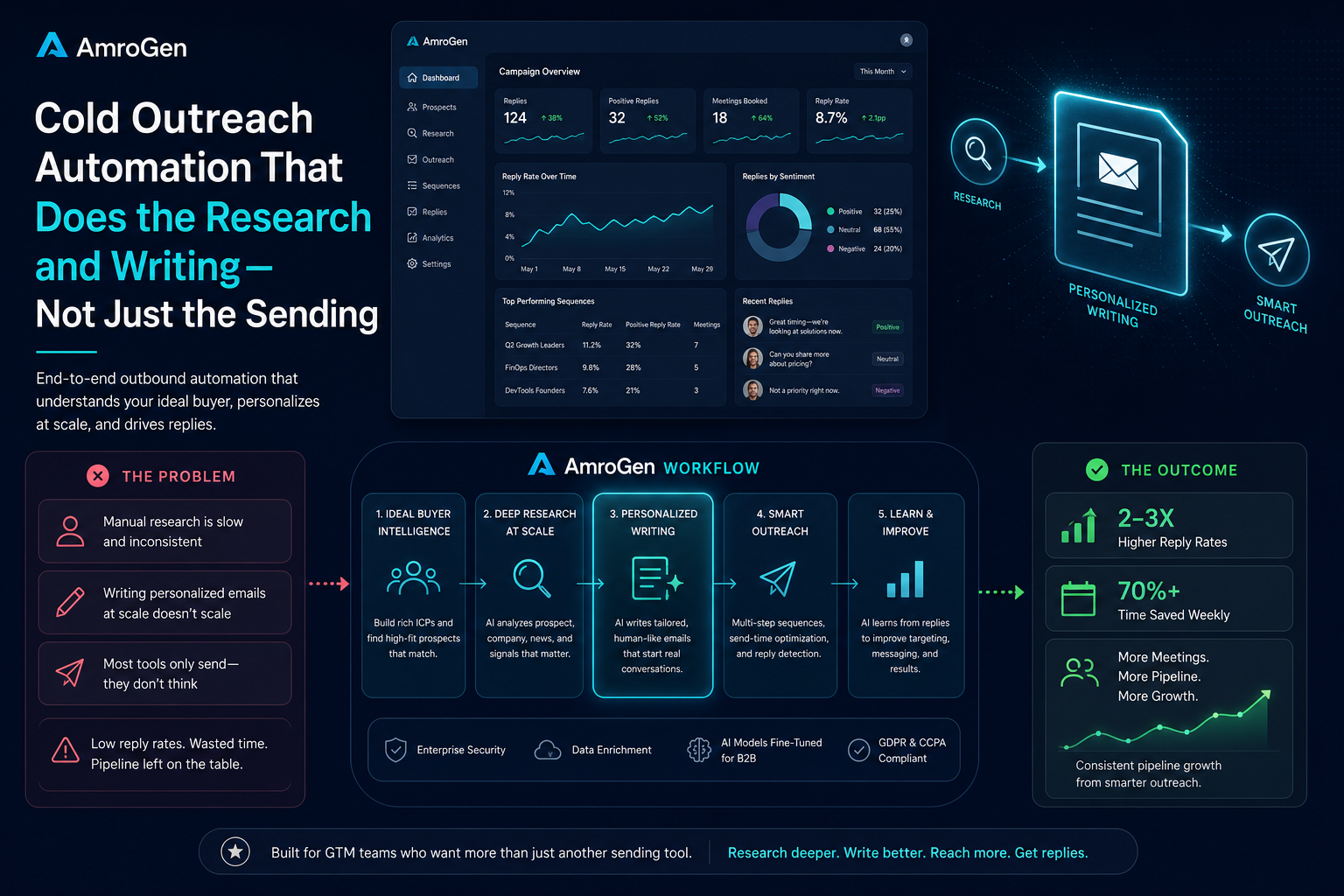
SERP Analysis & Strategic Insight
Before diving into the core guide, it is critical to understand the current search landscape for "cold outreach automation b2b." A deep dive into the Search Engine Results Pages (SERPs) reveals a significant gap in how the industry discusses sales automation.
Search Intent: The primary intent is Commercial/Informational. Searchers are looking for tools to solve their pipeline generation problems, but they are also seeking frameworks to understand how to automate effectively without landing in spam or sounding robotic.
Competitor Patterns: The top-ranking pages (Saleshandy, Findymail, SalesCaptain, Guideflow) predominantly feature listicles formatted as "Best Cold Outreach Tools 2026." These articles average 2,500 words and focus almost entirely on sending automation—tools that take a pre-written email and a pre-built CSV list and send them at scale. The AI Overviews currently highlight deliverability and basic sequencing, citing legacy database tools like Apollo and volume senders like Instantly.
The Differentiation Opportunity: The current SERP fails to distinguish between sending automation and full-pipeline automation. Most content assumes the user already has a highly targeted lead list and perfectly crafted copy. AmroGen’s strategic opportunity is to redefine the category. By positioning AmroGen as the only tool that automates the entire pipeline—from raw company URL to deeply researched, dynamically written, and quality-reviewed multi-channel sequences—this article establishes a new paradigm. We are not just another sender; we are replacing the manual research and copywriting phases that traditional tools ignore.
Internal Linking Strategy
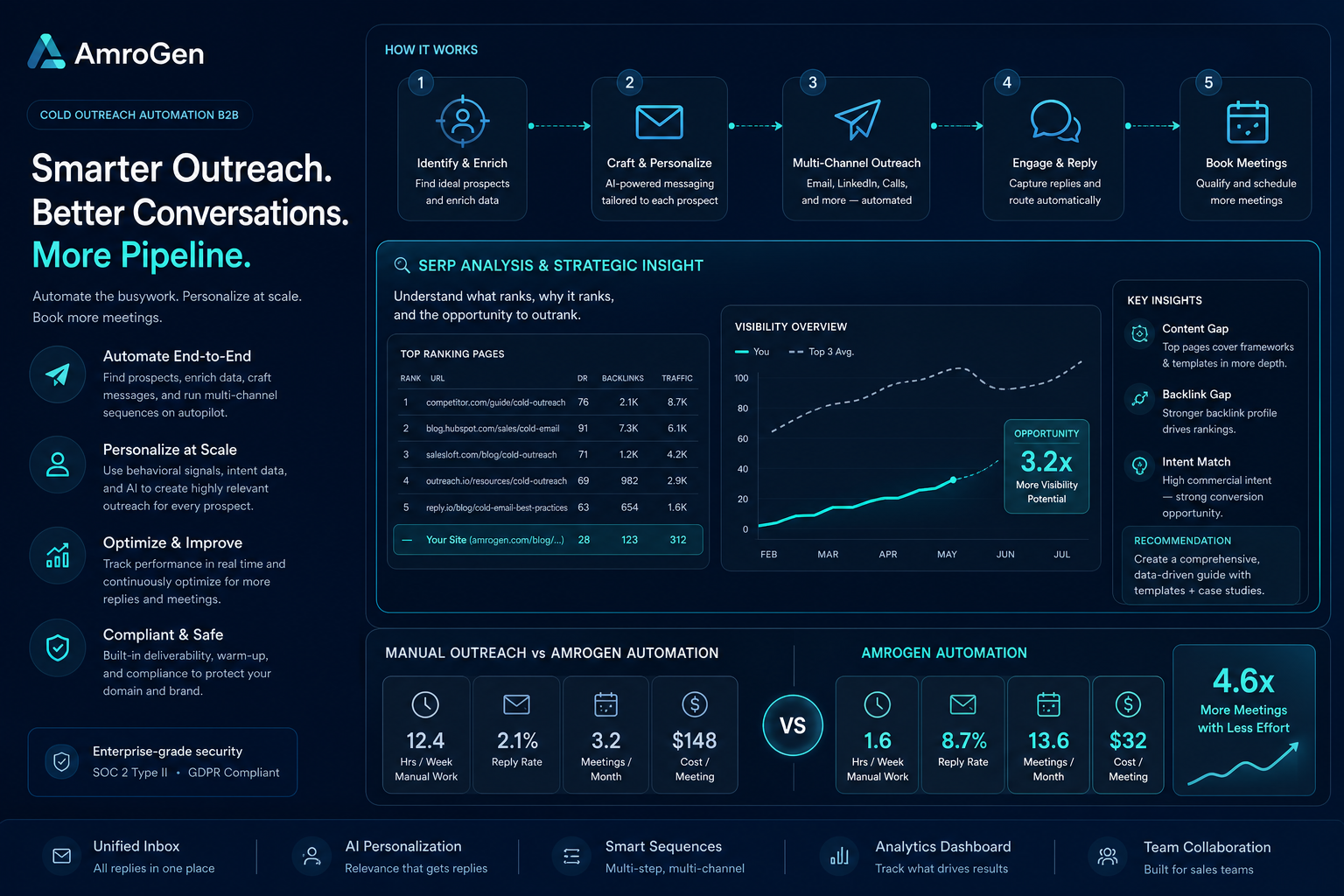
To maximize SEO equity and guide the user journey, this article employs a deliberate internal linking structure:
- AI sequences: Linked when discussing the 6-agent quality review loop and the Orchestrator's 1-10 scoring system, driving users to learn how our AI avoids generic, robotic copy.
- Multi-channel outreach: Linked in the section detailing the execution of campaigns across Email, LinkedIn, and SMS, capturing users interested in unified omni-channel strategies.
- Instantly alternative: Linked during the comparison of sending automation vs. full-pipeline automation, capturing bottom-of-funnel comparative search intent.
- Pricing: Linked in the economic breakdown comparing the fully loaded cost of a human SDR to AmroGen's credit-based consumption model.
What is Cold Outreach Automation?
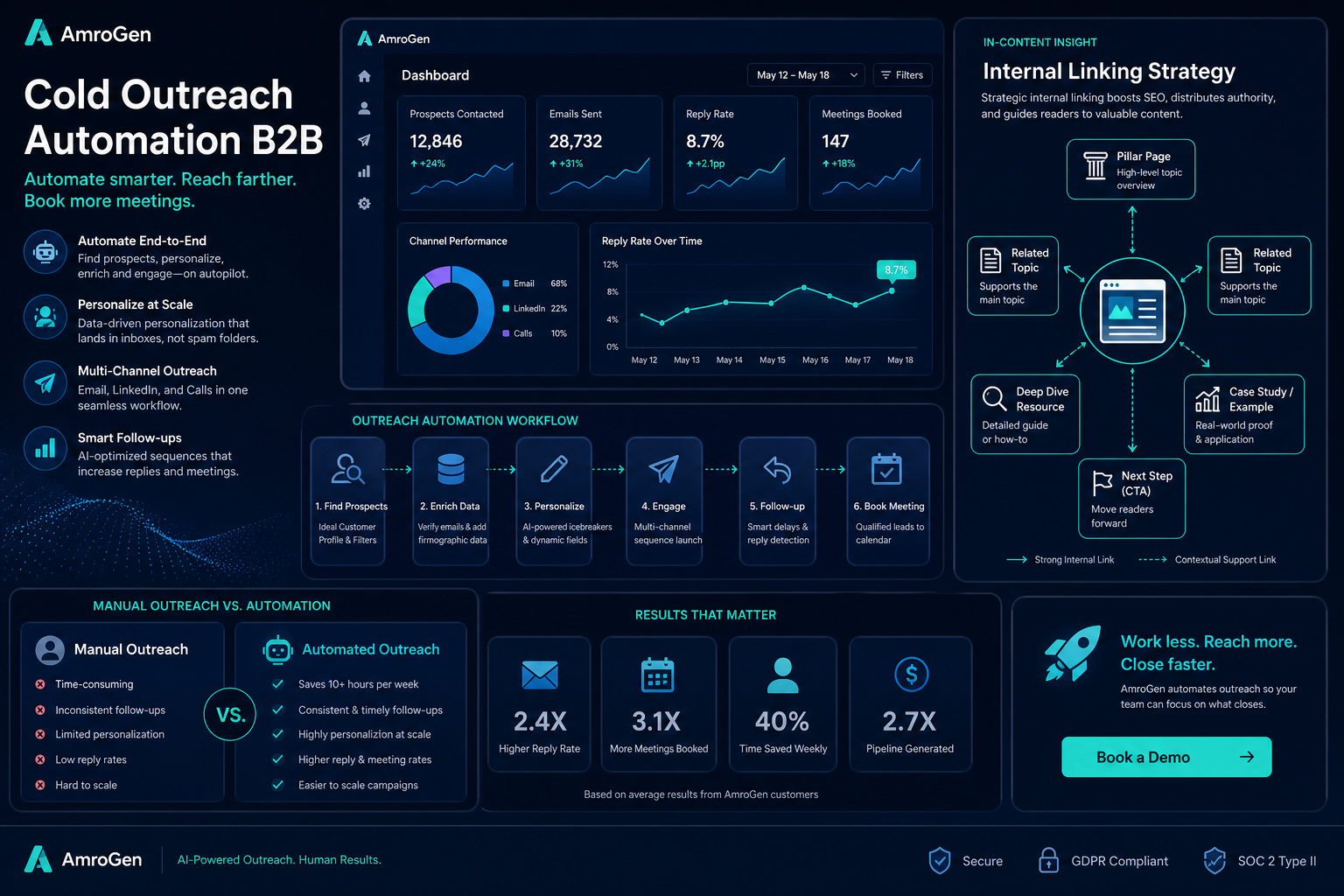
If you are looking for a definitive answer to how modern sales teams scale their outbound efforts, here is the core definition.
What can cold outreach automation do?
- Target Account Discovery: Automatically identifying ideal companies based on specific criteria or URLs.
- Lead Identification and Enrichment: Finding researched decision-makers and extracting their current contact data.
- Deep Account Research: Scraping recent company news, funding rounds, and executive interviews to gather context.
- Personalized Copywriting: Using AI to write individualized emails and messages that reference the lead's specific context.
- Multi-Channel Sequencing: Scheduling and executing coordinated touchpoints across email, LinkedIn, and SMS.
- Quality Control Routing: Utilizing AI agent loops to review, score, and rewrite copy before it reaches a human for final approval.
- Deliverability Management: Ensuring emails land in the primary inbox rather than the spam folder through proper technical setup.
Historically, "cold outreach automation b2b" only referred to the sending part of this list. Today, true automation covers the entire pipeline.
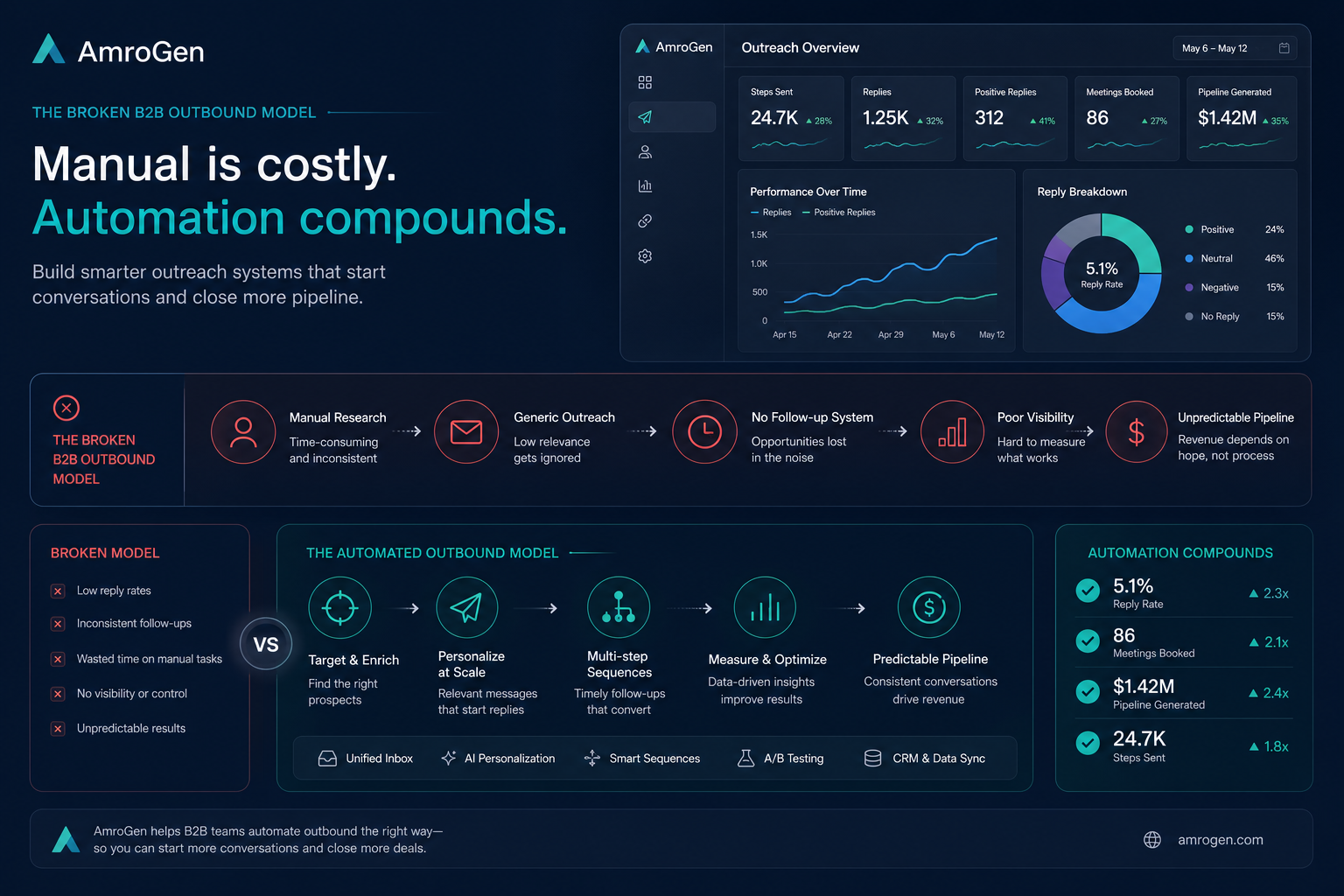
The Broken B2B Outbound Model
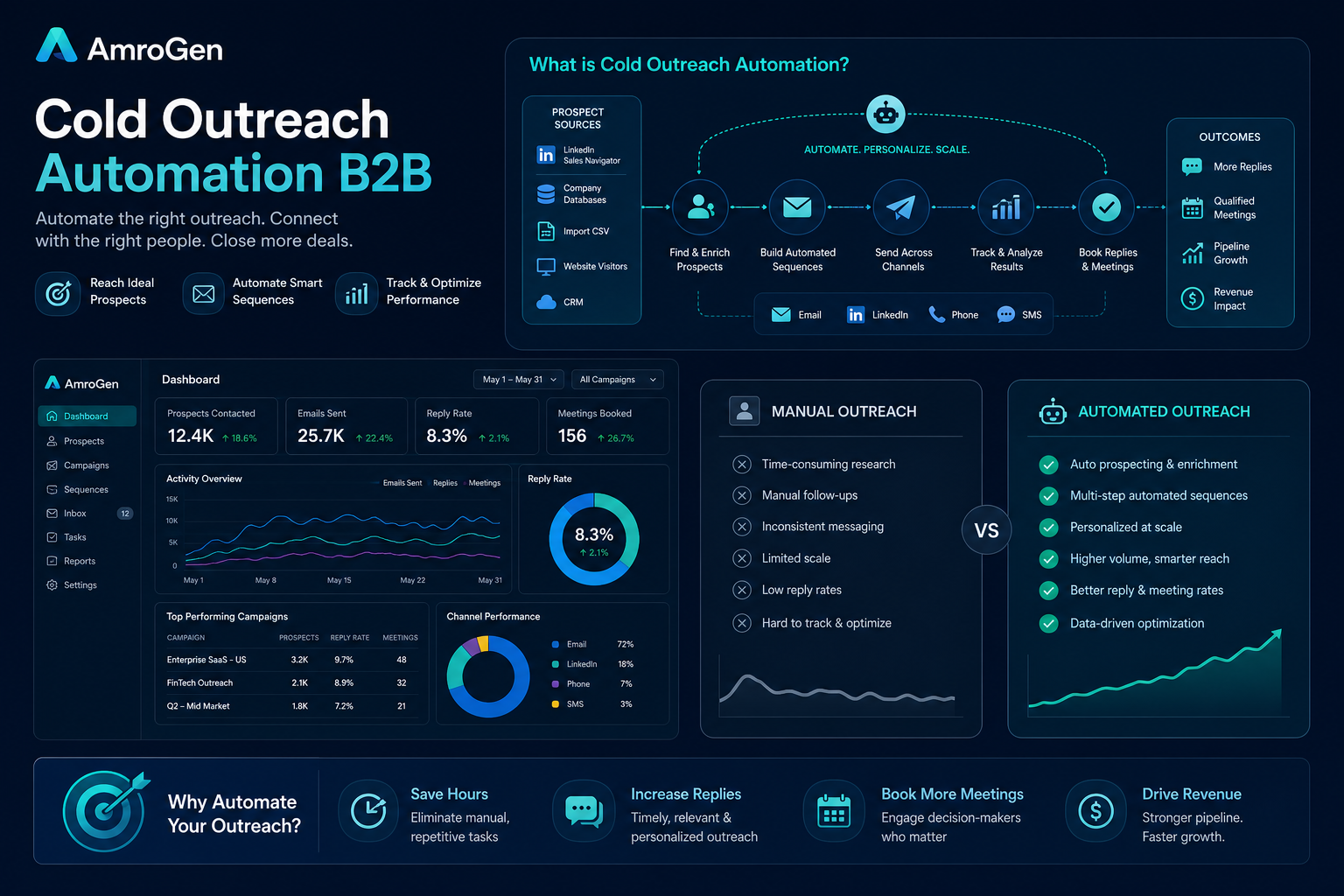
The traditional B2B outbound sales motion is in crisis. For the last decade, the playbook was simple: buy a list of 10,000 contacts from a data provider, load them into a sequencing tool, write a generic four-step email template, and hit send.
When reply rates dropped, the industry's response was to simply increase the volume. If a 3% reply rate dropped to 1%, sales leaders told their Sales Development Representatives (SDRs) to send three times as many emails. This brute-force approach led to the creation of complex "burner domain" infrastructures, where companies buy dozens of secondary domains just to burn through them as they inevitably get blacklisted by Google and Microsoft.
According to research from Gartner on B2B buying behavior, modern buyers are overwhelmed by digital noise. They can spot an automated, templated email in milliseconds. The personalization tokens that used to work—like {{Company_Name}} or {{First_Name}}—are now the bare minimum, and often serve as immediate red flags that an email is part of a mass blast.
The Cost of Manual Personalization
Recognizing that templates no longer work, the pendulum swung the other way: hyper-personalization. Sales leaders began instructing SDRs to research every single prospect.
The workflow looks like this:
- Find a target account.
- Search LinkedIn for the VP of Sales.
- Read the VP's recent posts.
- Listen to a podcast the CEO was on.
- Check the company's recent funding news.
- Spend 20 minutes crafting a highly tailored email.
This works. Highly personalized emails routinely see reply rates of 8% to 15%. But there is a massive problem: it is mathematically unscalable.
An SDR spending 20 minutes per lead can only reach out to about 20-25 prospects a day. They are spending 80% of their time doing research and copywriting, and only 20% of their time actually having conversations with interested buyers. When you factor in the fully loaded cost of an SDR—which the Bridge Group reports averages around $80,000 to $100,000 annually—paying a human being to manually scrape the internet for context is a terrible allocation of capital.
This is the exact problem cold outreach automation must solve in 2026.
The Evolution of Cold Outreach Automation
To understand why current tools fall short, we have to look at how the sales technology stack has evolved over the last fifteen years.
Era 1: Mail Merge (The Early 2010s)
The first wave of automation was simply taking a spreadsheet of names and emails and merging them into a single email draft. It saved time but offered zero follow-up capabilities. You sent the email, and if they didn't reply, you had to manually remember to follow up.
Era 2: Sales Engagement Platforms (The Mid 2010s)
Tools like Outreach and Salesloft revolutionized the industry by introducing sequences. You could build a multi-step campaign: Email on Day 1, LinkedIn connection on Day 3, Call on Day 5. However, these tools were empty shells. You still had to bring your own data, and you still had to write your own templates.
Era 3: The All-in-One Database (The Early 2020s)
Platforms like Apollo combined the database with the sequencer. This was a massive leap forward. You could filter for "VP of Marketing in New York," select 1,000 people, and drop them straight into a sequence.
However, the ease of use became its downfall. Because it was so easy to blast 1,000 people, everyone did it. The quality of the copy plummeted. Furthermore, Apollo’s database, while massive, suffers from data decay. If a contact isn't in their database, or if they recently changed jobs, you miss out on that pipeline.
Era 4: Volume Senders and Burner Domains (2023-2025)
As spam filters got smarter, tools like Instantly and Smartlead emerged. They didn't focus on data or personalization; they focused on deliverability infrastructure. They allowed users to connect 50 different inboxes across 10 different domains, warming them up automatically and rotating the sending to avoid spam filters.
These tools are incredibly powerful for pure volume, but they represent a surrender. They assume your emails will get marked as spam, so they give you the infrastructure to keep sending anyway.
Era 5: Full-Pipeline AI Automation (Present)
This is where AmroGen enters the picture. The next evolution isn't about sending more emails; it's about sending better emails, automatically. Full-pipeline automation means handing the software a company URL and letting AI handle the discovery, the research, the copywriting, and the sending.
Sending Automation vs. Full-Pipeline Automation
If you are evaluating B2B sales automation tools today, the most important distinction you must make is between sending automation and full-pipeline automation.
What is Sending Automation?
Sending automation tools (like Instantly, Smartlead, or Lemlist) are delivery mechanisms. They are FedEx. They do not care what is in the box; their only job is to get the box to the destination.
The Workflow:
- You use a tool like Apollo or Clay to build a list of leads.
- You clean the list and export it as a CSV.
- You write a template with merge tags (e.g., "Hi
{{first_name}}, saw you work at{{company}}"). - You upload the CSV to the sending tool.
- The tool rotates through your inboxes and sends the emails.
The Flaw: You are still doing all the heavy lifting. If you want true personalization, you have to write it yourself or build incredibly complex, multi-tool workflows (like stitching together Clay, ChatGPT APIs, Google Sheets, and Instantly via Zapier).
What is Full-Pipeline Automation?
Full-pipeline automation replaces the entire workflow of an SDR doing research and copywriting. It is not just the delivery mechanism; it is the intelligence gathering and the creative execution.
The Workflow with AmroGen:
- You input a target company URL (e.g.,
acmecorp.com). - You wait a full agent run (runtime varies).
- You review deeply personalized, multi-channel sequences written specifically for the actual decision-makers at Acme Corp.
- You click approve, and the sequences send directly from your primary Gmail account.
If you are tired of managing complex tech stacks, AmroGen is a powerful Instantly alternative that shifts the focus from volume sending to high-quality, high-conversion pipeline generation.
Inside AmroGen: The 4 Phases of Full-Pipeline Automation
To understand how AmroGen can turn a single URL into a fully booked meeting, we need to break down the four distinct phases of the platform's architecture. This isn't a simple GPT wrapper; it is a coordinated system of AI agents working in tandem.
Phase 1: Target Discovery and Verification
The pipeline begins the moment you input a target company's URL.
Most sales teams rely on static databases. The problem with static databases is that B2B data decays at a rate of roughly 30% per year. People change jobs, companies pivot, and tech stacks evolve.
When you give AmroGen a URL, it doesn't just query a static, outdated database. It actively crawls the target company's web presence. It identifies the company's current positioning, their recent product launches, and their target audience.
Next, it identifies the decision-makers. Based on your Ideal Customer Profile (ICP), AmroGen discovers the real, current leaders at the company. If you sell marketing software, it finds the Head of Growth or VP of Marketing. It then enriches these profiles with verified, real-time contact details.
The Result: You get a list of accurate, researched leads who actually work at the company today, not six months ago.
Phase 2: Deep Contextual Research
Personalization is only as good as the research behind it. If your AI only knows the lead's job title, the resulting email will read like this: "As the VP of Sales, I know you care about revenue." This is generic fluff, and buyers ignore it.
During Phase 2, AmroGen's research agents dig deep. They look at:
- Company Context: Did they just raise a Series B? Did they recently acquire a smaller competitor? Are they hiring aggressively for specific roles?
- Personal Context: What is this specific lead's background? Have they recently been promoted? What do they talk about publicly?
- Industry Context: What macro trends are affecting their specific vertical right now?
The AI assigns an "ICP Fit Score" (High, Medium, or Low) based on how well the lead matches your criteria, ensuring you don't waste time on unqualified prospects.
Phase 3: Multi-Channel Sequence Generation
With the research complete, the system moves to copywriting. Relying on a single channel is a guaranteed way to leave money on the table. Modern outreach requires a coordinated approach.
AmroGen generates hyper-personalized multi-channel outreach sequences tailored to each individual lead.
- Email: A typical 5-step email sequence is generated. Every single email is unique to the recipient. There are no templates. The AI weaves the Phase 2 research into the opening lines, the value proposition, and the call to action.
- LinkedIn: The system generates connection request notes and follow-up direct messages that match the tone of the platform—shorter, more conversational, and less formal than email.
- SMS: For high-touch campaigns where mobile numbers are verified, AmroGen can generate succinct, professional 3-step SMS sequences.
The entire pipeline—from URL to fully written 7-step multi-channel sequences for up to 100 leads—runs through six managed AI agents with human review gates.
Phase 4: The 6-Agent Quality Review Loop
This is where AmroGen fundamentally separates itself from DIY ChatGPT workflows and basic AI writers.
The biggest fear sales leaders have with AI is that it will hallucinate, sound robotic, or embarrass the brand. To solve this, AmroGen utilizes a sophisticated AI sequences architecture built on Anthropic's managed agents.
AmroGen employs 6 purpose-built AI agents in a coordinated pipeline. The most important of these is the Orchestrator.
Think of the Orchestrator as a ruthless, highly experienced VP of Sales. Its job is to review the output of the writing agents before you ever see it.
- The writing agent drafts the sequence based on the research.
- The Orchestrator reviews the sequence and scores it on a scale of 1 to 10 for personalization depth, tone, and relevance.
- If the score is below a 7, the Orchestrator rejects the draft and sends it back to the writing agent with specific feedback on how to improve it.
- The system will retry up to 3 times to ensure the copy meets the highest standards.
Bad output never reaches the user. You only see the copy that has survived the Orchestrator's rigorous grading system.
Deliverability: How to Avoid Spam Filters with Cold Outreach
A major objection to any cold outreach automation is the fear of ruining domain reputation. If you send too many emails and get marked as spam, your company's primary domain could be blacklisted, meaning even emails to your own colleagues or current customers could end up in the junk folder.
As of early 2024, Google and Yahoo implemented strict new sender guidelines. They mandate strict authentication (SPF, DKIM, and DMARC) and enforce a spam complaint rate threshold of 0.3%.
The Burner Domain Fallacy
To get around these rules, the industry standard has been to buy "burner domains" (e.g., if your company is acme.com, you buy getacme.com, tryacme.io, etc.). You set up separate Google Workspace accounts, warm them up for weeks, and use them to blast generic emails. If one gets burned, you throw it away and spin up another.
This is expensive, time-consuming, and technically complex. More importantly, it is a band-aid over the real problem: your emails are bad.
The AmroGen Approach: Quality Over Volume
Because AmroGen writes genuinely personalized emails, your spam complaint rates drop to near zero. When an email looks like it was thoughtfully written by a human being who did their research, the recipient is highly unlikely to click the "Report Spam" button—even if they aren't interested. They will simply reply, "No thanks," or ignore it.
Because the quality is so high, AmroGen is designed to send directly from your own Gmail account.
- No separate domains to buy.
- No 4-week warm-up periods.
- No complex DNS records to manage endlessly.
You connect your Gmail, you review the AI-generated sequences, and you click approve. The emails go out natively, landing in the primary inbox because they are sent from an established, highly reputable domain. You maintain complete control, reviewing and approving every sequence before a single email is dispatched.
Developer-First Outreach: The MCP Server Advantage
While AmroGen is built for sales leaders and SDRs, it is also designed for the next generation of AI-native builders and power users.
Most existing sales tools have closed ecosystems or clunky, outdated REST APIs. They were built for an era of point-and-click software, not the era of AI agents.
AmroGen is the only outreach platform on the market with a built-in MCP (Model Context Protocol) server.
What is MCP?
The Model Context Protocol is an open standard that allows AI assistants (like Claude Desktop) to connect securely to external data sources and tools.
Because AmroGen features an MCP server integration, developers and Revenue Operations (RevOps) leaders can plug AmroGen directly into their own AI workflows.
- You can open Claude Desktop and type: "Find the VP of Engineering at Vercel, use AmroGen to research them, and generate a sequence."
- Claude can natively call the AmroGen pipeline, execute the run, and return the results directly into your workflow.
This API-first, agent-friendly interface means AmroGen isn't just a standalone web app; it is an infrastructure layer for automated outbound that you can embed anywhere.
What Can Be Automated vs. What Still Needs Humans
Despite the power of a 6-agent AI pipeline, it is crucial to be pragmatic about what AI should and shouldn't do. AmroGen is not designed to replace the human element of sales; it is designed to replace the robotic, repetitive parts of the job so humans can focus on relationships.
What AI Should Automate:
- Data Entry and CRM Hygiene: Stitching together tools to move leads from Apollo to Salesforce to Outreach is a waste of human potential.
- Initial Research: Reading through 10 pages of a company website to figure out what they sell.
- First Draft Copywriting: Staring at a blank page trying to think of a clever subject line.
- Follow-up Scheduling: Remembering to send the day-4 follow-up email.
What Humans Must Still Do:
- Strategic Approvals: AmroGen requires human approval before emails send. You are the final safeguard. You know your brand voice better than any AI.
- Complex LinkedIn Social Selling: While AmroGen can generate the copy for LinkedIn connection requests and messages, the actual platform execution (commenting on posts, building long-term social rapport) often requires a human touch to comply with the LinkedIn User Agreement regarding automated software.
- The Actual Conversation: Once a lead replies, the automation stops. The AI has done its job by booking the meeting or generating the reply. It is now up to the Account Executive or Founder to get on the Zoom call, handle objections, and close the deal.
Cost Analysis: Human SDR vs. AI Automation
When evaluating B2B sales automation, the ultimate metric is Customer Acquisition Cost (CAC). How much does it cost you to generate a qualified pipeline?
Let's look at the economics of a traditional outbound motion versus an AmroGen-powered motion.
The Traditional Human SDR Model
- Base Salary: $50,000 - $60,000
- On-Target Earnings (OTE): $80,000 - $100,000
- Software Stack: Apollo ($1,200/yr) + Outreach ($1,600/yr) + LinkedIn Sales Navigator ($1,200/yr) = ~$4,000/yr
- Management & Taxes: ~$15,000/yr
- Total Cost: ~$100,000 - $119,000 per year.
Furthermore, it takes an average of 3 months for a new SDR to ramp up and hit full quota, and the turnover rate for the role is notoriously high.
The AmroGen Economic Model
AmroGen operates on a credits-based subscription. Credits are consumed per pipeline run (8 credits per run of ~10 leads). Let's look at the pricing tiers:
- Starter: $29/month for 100 credits (~12 pipeline runs). Ideal for solo founders testing outbound.
- Growth: $99/month for 500 credits (~62 pipeline runs). Ideal for small teams.
- Scale: $299/month for 2,000 credits (~250 pipeline runs). Ideal for scaling agencies and SaaS companies.
- Pay-as-you-go: $0.35/credit, which equals roughly $2.80 per pipeline run (at 10 leads).
The Math: To generate a fully researched, deeply personalized outreach campaign for 10 decision-makers at a target account, it costs you roughly $2.80 and takes 8 minutes.
To have a human SDR do that same exact work, it would take them approximately 3 to 4 hours of manual labor, costing you roughly $150 to $200 in fully loaded hourly costs.
AmroGen allows founders, Growth Leads, and Account Executives to run their own full-scale outbound motions without needing to hire a massive SDR team. It delivers the output of a specialized outbound team at a fraction of the cost.
Choosing the Right Cold Outreach Tool for B2B
Not every tool is right for every team. To be completely transparent, there are scenarios where AmroGen might not be the best fit, and scenarios where it is the undisputed champion.
Choose Instantly or Smartlead if:
- You already have a perfectly enriched list of 50,000 leads.
- You are selling a highly commoditized product where personalization doesn't matter (e.g., cheap SEO services).
- You want to run a massive volume play across 50 burner domains.
Choose Clay if:
- You have a dedicated RevOps engineer who can spend weeks building complex API waterfalls.
- You need to pull data from 15 different obscure databases simultaneously.
- You have a massive budget (Clay contracts can run into the 5-figures annually) and already have a separate tool like Outreach to handle the actual sending.
Choose AmroGen if:
- You want to double your pipeline without adding headcount.
- You don't have time to build lead lists; you just want to point software at a company URL and get results.
- You demand high-quality, human-sounding copy that has been reviewed by an AI Orchestrator.
- You want an all-in-one platform that handles the discovery, the writing, and the sending from your own Gmail account.
- You are a builder who wants to integrate outreach into your own workflows via an MCP server.
Frequently Asked Questions
What is cold outreach automation? Cold outreach automation refers to software tools that streamline the process of contacting potential B2B buyers who have no prior relationship with your company. While legacy tools only automated the sending of emails, modern platforms like AmroGen automate the lead research, personalization, copywriting, and multi-channel sequencing.
What is the best B2B cold outreach tool? The "best" tool depends on your strategy. For pure volume and burner domains, Instantly is highly rated. For complex data enrichment workflows, Clay is powerful. For end-to-end pipeline automation—where you go from a target company URL to fully written, reviewed sequences through the agent pipeline—AmroGen is the leading AI-native platform.
How do I automate my outreach process? To automate effectively without losing quality, move away from CSV uploads and generic templates. Use an AI platform where you input target criteria (like a company URL), allow the AI to discover the decision-makers, let the AI agent research the prospects, and have the system auto-generate the copy. You should only have to step in to click "approve" before the messages send.
What is a cold outreach sequence? A sequence (or cadence) is a scheduled series of touchpoints designed to engage a prospect. A typical B2B sequence might span 14 days and include 4 emails, 2 LinkedIn steps (connection request and message), and an SMS. Automation ensures these steps happen on schedule without manual intervention.
Can I automate LinkedIn outreach? Yes, but with caution. Generating the copy for LinkedIn outreach can and should be automated using AI. However, using software to automatically simulate clicks and send messages on LinkedIn violates their terms of service and can result in account bans. AmroGen safely generates the highly personalized copy for you to use in your social selling efforts.
How do I avoid spam filters with cold outreach automation? Three rules:
- Authenticate your domain (SPF, DKIM, DMARC).
- Keep your volume low and your quality high.
- Stop sending generic templates.
Spam filters are triggered by high volumes of identical emails and high user complaint rates. By using AmroGen's 6-agent loop to generate deeply personalized, unique emails for every single lead, you bypass the patterns that spam filters look for, allowing you to send safely from your primary inbox.
Conclusion
The era of "spray and pray" B2B sales is over. Buyers are too smart, spam filters are too strict, and the cost of human labor is too high to justify SDRs spending their days doing manual data entry and generic copywriting.
The future of outbound belongs to teams that leverage full-pipeline automation. By utilizing coordinated AI agents to handle lead discovery, deep account research, and dynamic sequence generation, sales professionals can finally get back to doing what they do best: building relationships and closing revenue.
With a built-in quality review loop, Resend or Gmail sending, and a developer-friendly MCP server, AmroGen isn't just an outreach tool. It is your ultimate AI sales partner—turning target URLs into reviewed pipeline through the agent pipeline, not hours of manual work.