The Cold Email Tool That Writes and Reviews Its Own Outreach Before You See It
TL;DR
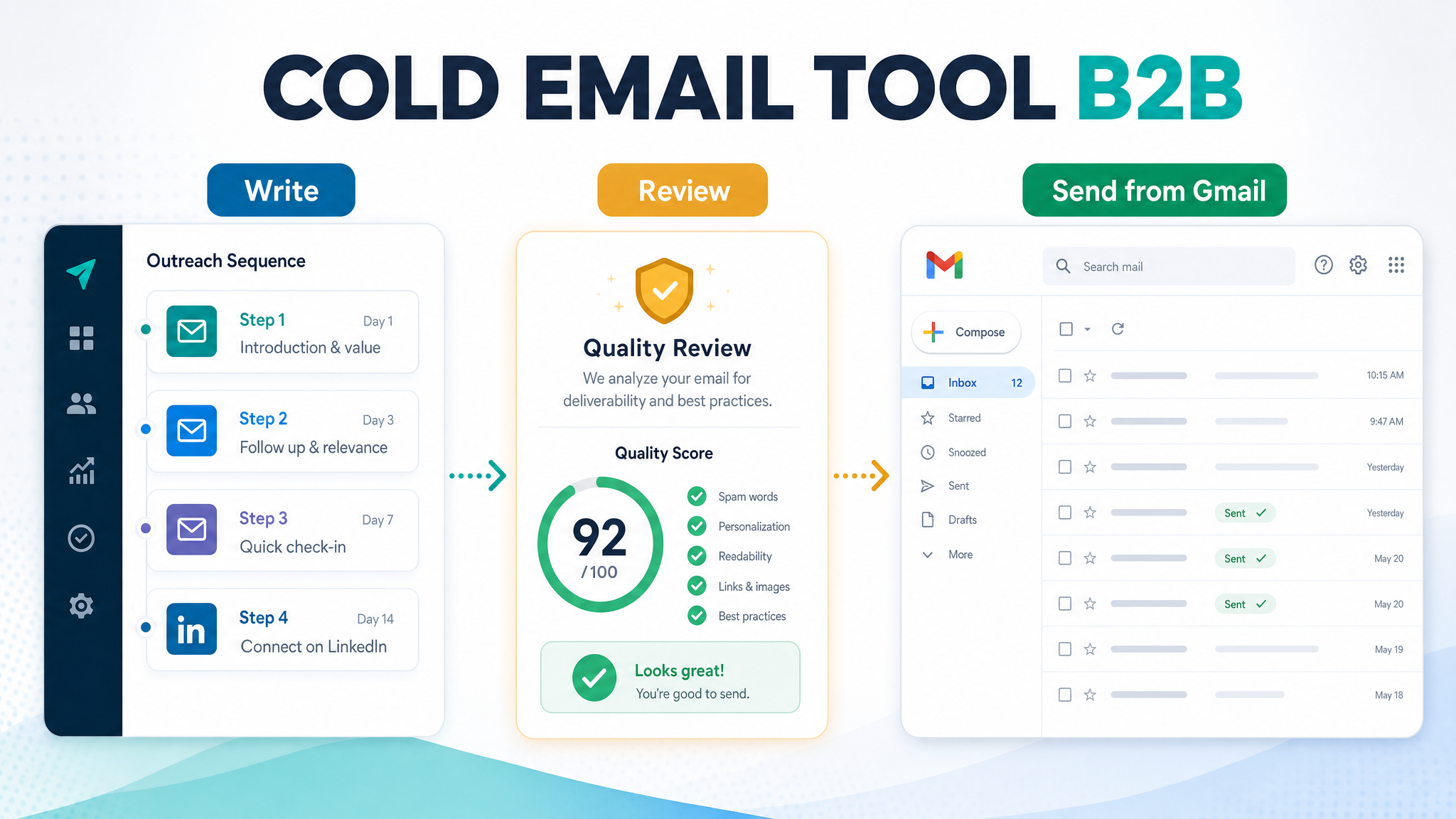
The average cold email reply rate across all platforms is now 3.43%. The top 5% of senders — the ones who fully personalise every email — achieve 15–18% on advanced campaigns. That gap is not explained by the sending tool. It's explained by the quality of what's being sent. Yet every "best cold email tool" article from 2026 ranks platforms on deliverability infrastructure, inbox count, and warmup speed — not on whether the tool actually writes something worth reading, or whether anything checks the output before it goes to a real person. This guide cuts the category differently: sending tools vs writing-first tools, and the one that does both with a review loop in between.
Table of Contents
- How Cold Email Tools Split Into Two Very Different Products
- The Sending-First Tools: What They Do Well
- The Writing-First Gap: Why Nobody Talks About What Gets Generated
- The Review Layer Nobody Has (Except One)
- Full Tool Comparison by Category
- What a Quality-Reviewed Sequence Actually Looks Like
- The Deliverability Angle — Sending from Your Own Gmail
- Which Tool for Which Team
- FAQ
How Cold Email Tools Split Into Two Very Different Products
Ask ten cold email tool vendors to describe their product and nine will say some version of: AI-powered personalisation, unlimited sending accounts, built-in warmup, inbox placement testing, automated follow-ups.
These are real features. They matter. But they're all infrastructure features — they describe how emails get delivered, not how they get written or whether the writing is any good.
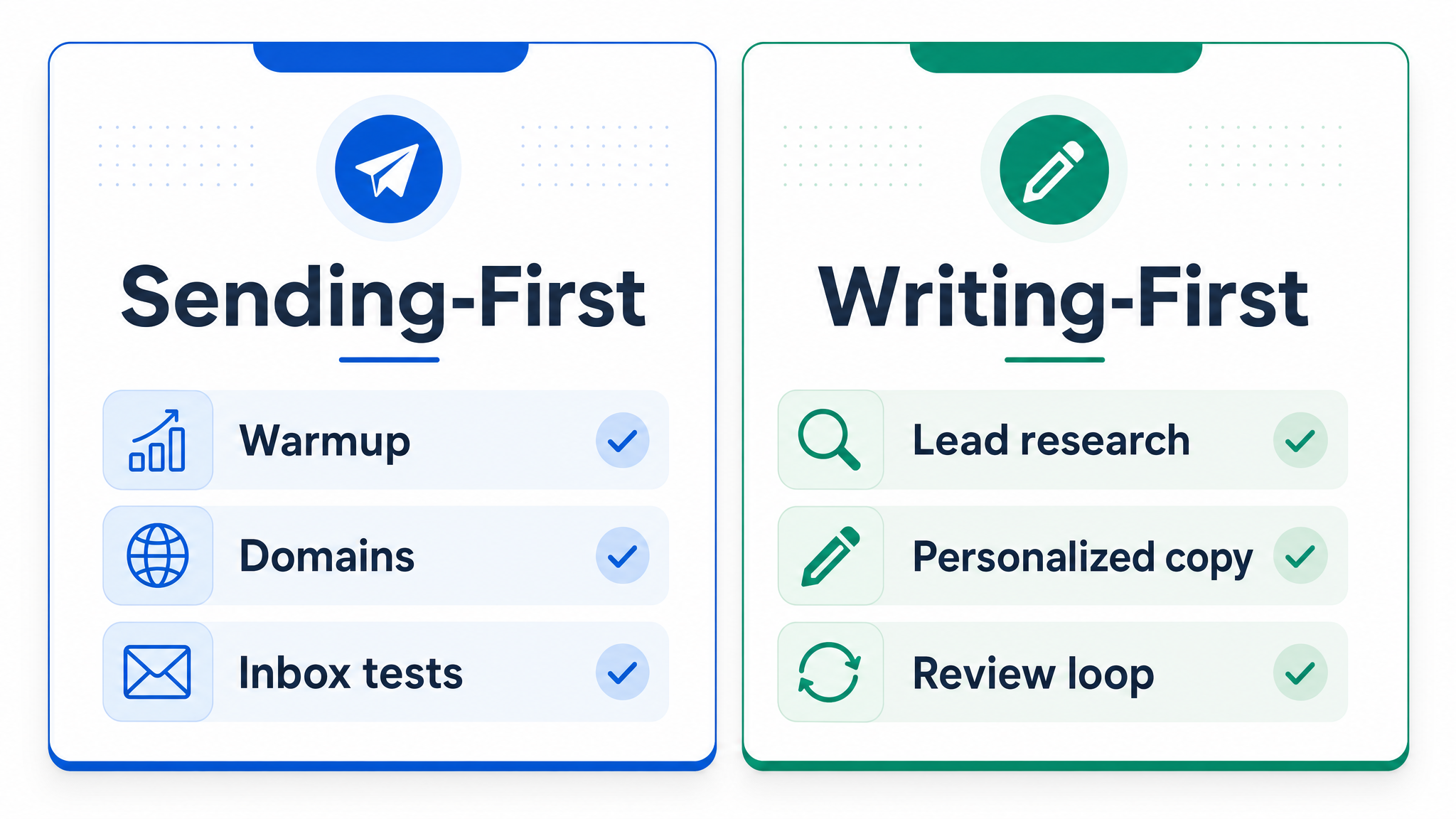
The cold email tool market splits cleanly into two product categories that rarely get distinguished in comparison articles.
Sending-first tools are optimised for deliverability at scale. They manage domain rotation, inbox warmup, sender reputation monitoring, and sequence automation. The assumption is that you arrive with a list of contacts and a copy brief — or that you'll use an AI assistant to generate a first draft. The tool executes the send. Instantly, Smartlead, and Woodpecker are the clearest examples of this category.
Writing-first tools start with the lead, research their context, and generate the outreach from that research — rather than waiting for you to provide copy. This is a smaller category and a harder technical problem. Most tools that claim to do this generate a first draft and hand it to a human for review. Very few generate a draft, score it against personalisation criteria, and automatically iterate if it falls short.
AmroGen is in the second category — specifically the subset that closes the loop with an automatic review and retry step.
The Sending-First Tools: What They Do Well
The sending-first tools in this comparison are genuinely excellent at what they're designed for. Being clear about that is more useful than dismissing them.
Instantly runs the largest email warmup network in the category — 4.2M+ accounts — and supports unlimited sending accounts on a flat fee. It's the infrastructure tool of choice for agencies running high-volume campaigns across multiple client domains. Their own 2026 benchmark report puts the platform-wide average reply rate at 3.43%, a useful honest baseline. From $37/month.
Smartlead builds its reputation on domain and mailbox rotation with inbox health monitoring — what one guide described as "one of the most widely used cold email tools on the market, with 87,000+ businesses relying on it". It manages sender reputation at scale and has strong agency-tier white-labelling. From $39/month.
Saleshandy is the closest to a full-stack tool in the sending-first camp: 852M+ contact database, unlimited email accounts, built-in CRM, and an AI Sequence Copilot that generates sequences from a prompt. The Copilot writes a first draft — a human reviews before sending. From $25/month.
Woodpecker keeps it simple: a clean deliverability-focused tool for B2B outreach, sends directly from your connected inbox, good for teams that want automation without overwhelming feature overhead. From $20/month.
None of these generate copy that's researched at the individual lead level. They all assume the writing is coming from somewhere else — the human, the Copilot you prompt, or an AI writing add-on plugged in via integration.
The Writing-First Gap: Why Nobody Talks About What Gets Generated
Most cold email tool comparison articles score platforms on features, pricing, database size, and deliverability. Almost none of them score what the AI actually generates.
This is a significant gap, because the generated copy is what either gets a reply or goes to spam. And the data on this is stark.
Advanced personalisation achieves up to 18% reply rates versus roughly 9% for basic templates — Woodpecker's benchmark across more than 20 million emails. Only 5% of senders personalise every email. The other 95% are sending some variation of a template with a first name and company name swapped in, achieving results that reflect it.
The reason most tools don't solve this is that solving it is genuinely difficult. Writing a personalised cold email requires knowing something specific and current about the recipient — their role, their company's current situation, a relevant trigger — and generating copy that incorporates that context naturally rather than inserting it awkwardly. "I saw you recently joined [Company] as VP of Sales — congrats!" is technically personalised and reads like a template. Referencing that the company just expanded into APAC and asking a specific question about the sales coverage challenge that creates is actually personalised.
The distinction requires real research at the lead level, not just database fields. And research at scale requires an agent, not a human.
The Review Layer Nobody Has (Except One)
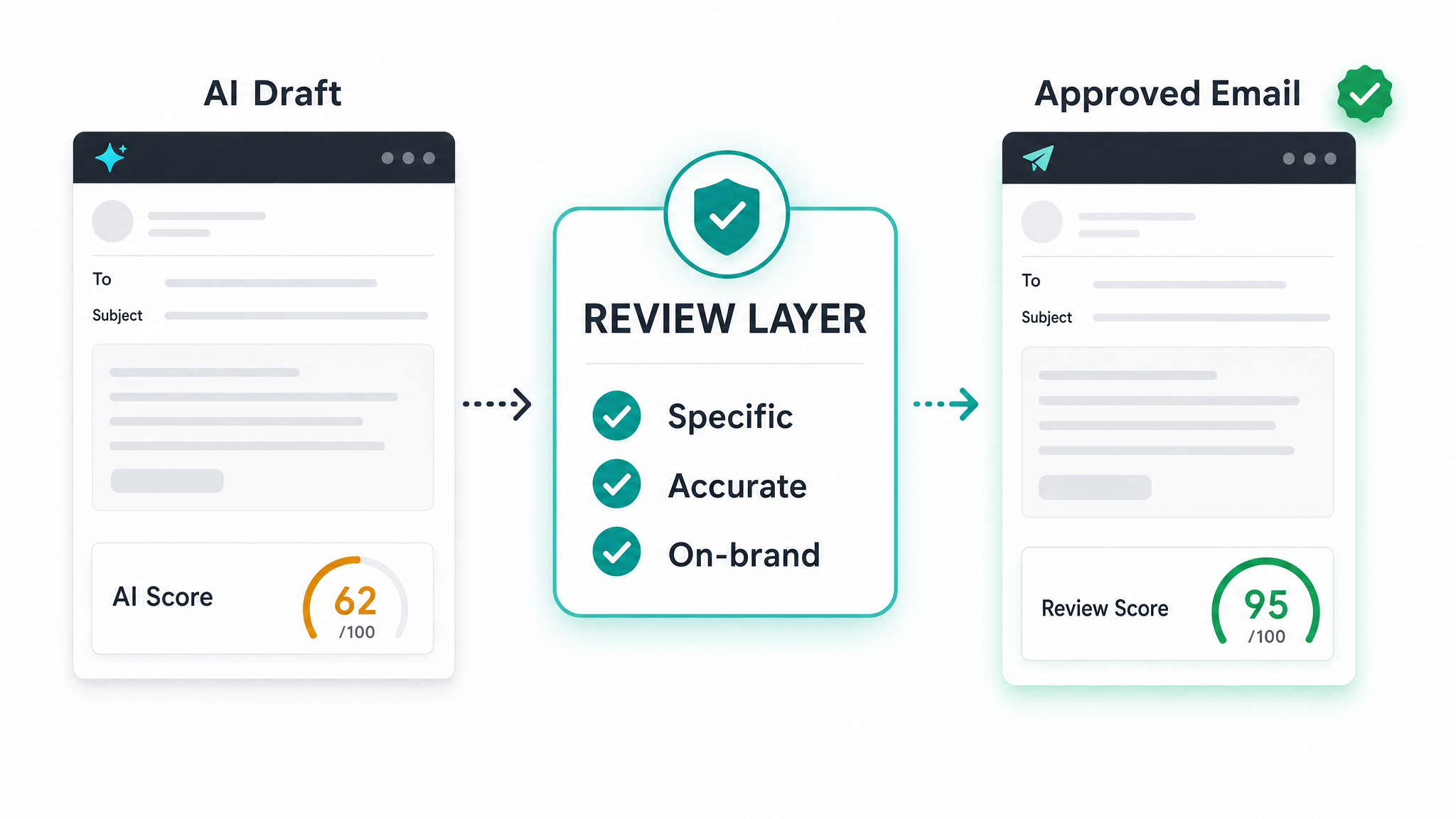
Even among the tools that claim AI-generated personalisation, almost none document what happens between "AI generated this" and "this went to a prospect."
Here's why that matters. The teams that over-rely on AI for the writing itself see declining reply rates — AI-detectable copy is being filtered by spam systems and recognised by prospects who receive enough of it to spot the pattern. The solution isn't to stop using AI for writing — it's to have something that evaluates the output before it ships.
AmroGen's architecture closes this loop explicitly. The pipeline runs: Lead Generator researches a target company and surfaces decision-maker contacts → Orchestrator plans the outreach strategy per lead → specialist agents (Email, Outreach, SMS) write channel-specific sequences from the lead's actual context → Orchestrator scores every sequence on personalisation depth, factual accuracy, and format compliance → anything below 7/10 goes back for revision automatically → you approve what passed.
You're not reviewing raw AI output. You're reviewing output that already cleared a quality bar. The difference in what you see — and what eventually reaches a prospect's inbox — is the difference between first-draft AI and reviewed AI.
Full Tool Comparison by Category
| Tool | Category | Writes per-lead from research? | Review step before send? | Sends from | Entry price |
|---|---|---|---|---|---|
| AmroGen | Writing-first pipeline | Yes — Lead Generator browses live sources | Yes — automated scoring + retry | Your connected Gmail | $29/mo (~$2.80/run) |
| Saleshandy | Sending-first + Copilot | No — Copilot writes from a prompt, not lead research | Human review | Unlimited sending accounts | $25/mo |
| Instantly | Sending-first | No — AI Copilot assists writing, doesn't research | Human review | Unlimited sending accounts (cold domains) | $37/mo |
| Smartlead | Sending-first | No | Human review | Unlimited sending accounts | $39/mo |
| Lemlist | Sending-first + creative personalisation | No — template-based with visual personalisation | Human review | Sending domains | $59/mo |
| Woodpecker | Sending-first | No | Human review | Your connected inbox | $20/mo |
| Artisan (Ava) | Autonomous agent | Yes — sources and researches leads | Not documented | Artisan's infrastructure | $250/mo |
| Coldreach | Research-first autonomous | Yes — signal-qualified before drafting | Signal-qualification gate | Coldreach's infrastructure | $899/mo |
The structural difference between AmroGen and every sending-first tool is where the human review step sits. In sending-first tools, you review the AI's first draft. In AmroGen, you review output that has already been scored and iterated. The human effort is the same — approving sequences — but the quality floor of what you're approving is different.
What a Quality-Reviewed Sequence Actually Looks Like
To make this concrete, here's what the Orchestrator's review step checks and what gets caught.
A draft gets sent back if it:
- Opens with a phrase that could apply to anyone ("I hope this finds you well," "I wanted to reach out," "I was doing research and found your profile")
- References company data that isn't lead-specific (generic industry trends, standard pain points that aren't tied to anything observable about this company)
- Uses a subject line that reads like a template ("Quick question about [Company]")
- Exceeds character limits for the channel (SMS must be 160 characters; LinkedIn connection requests under 300; subject lines under 50)
- Fails to include a single concrete, checkable detail about the lead's role or company
A draft gets accepted if it:
- Opens with something specific to this lead's context (their company's current situation, a visible trigger, something from their professional presence)
- Has a value proposition that references their role specifically, not just their industry
- Has a CTA that requires a yes/no, not a commitment
- Reads as something a thoughtful person would send, not something an automated system would generate
The Orchestrator runs this review on every batch, scores 1–10, and retries automatically up to three times if the score is below 7. This is not magic — it's structured evaluation of the thing most cold email tools skip.
The Deliverability Angle — Sending from Your Own Gmail
There's a separate deliverability difference that deserves its own note. Every sending-first tool in this comparison uses a cold sending domain — a domain you purchase, configure, and warm up specifically for outbound. Your primary business domain stays clean; the cold domain absorbs the reputation risk.
AmroGen works differently. Sequences send from your connected Gmail account — the inbox you use every day, with its existing sender reputation and the trust signals that come with a domain your prospects might already recognise.
The trade-off: sending at scale from a primary inbox isn't right for every team. If you're sending thousands of emails a month to cold lists, a cold domain is the right choice — protecting your primary domain from reputation damage is a real concern. But for teams running targeted outbound to a few hundred qualified accounts, the deliverability benefit of a trusted, established sender reputation often outweighs the volume limitations. Your emails don't have to fight through "this is from a 3-week-old domain" signals. They arrive looking like emails from a real person's real inbox — because they are.
Which Tool for Which Team
You want to send high volume to large contact lists and need sending infrastructure: Instantly or Smartlead.
You want database + sequencing + AI writing assistance in one tool at low cost: Saleshandy.
You want visual personalisation and creative differentiation: Lemlist.
You want a clean, simple sending tool with no overhead: Woodpecker.
You want lead research, AI-generated per-lead sequences, a quality review loop, and Resend or Gmail sending — and you don't have or need a lead list first: AmroGen.
You want fully autonomous outbound with signal-based targeting at higher budget: Coldreach.
FAQ
What is the best cold email tool in 2026? Depends on where your bottleneck is. If deliverability and sending volume are the problem: Instantly or Smartlead. If writing quality is the problem — and the data suggests it usually is — a writing-first tool that generates and reviews per-lead sequences matters more than the sending infrastructure.
Is cold email legal for B2B? Yes in most markets, with compliance requirements. CAN-SPAM in the US requires a valid physical address, no deceptive headers, and a clear opt-out. GDPR in the EU permits cold email under legitimate interest but requires an easy opt-out and a genuine business reason. CASL in Canada is the most restrictive, generally requiring express consent. All platforms in this comparison support opt-out management.
How many cold emails should I send per day? Campaigns under 50 recipients average a 5.8% reply rate versus 2.1% for campaigns over 500 recipients. More volume with less personalisation produces worse outcomes. The shift the data consistently supports is smaller, sharper campaigns with deeper personalisation — not higher volume.
What is a good reply rate for cold email? The platform-wide average is 3.43%. Advanced personalisation campaigns hit 15–18%. Top performers on well-targeted campaigns reach 10.7%+. If you're below 2%, the problem is usually deliverability or targeting before it's copy.
How do I personalise cold emails at scale? The approaches that actually work combine real lead-level research (not database fields) with AI writing that incorporates that research, and a review step that catches generic output before it ships. The tools that do this — rather than just assisting you in writing a template — are the ones achieving the 15–18% end of the reply rate range.
What cold email tool sends from Gmail? AmroGen sends from your connected Gmail account. Woodpecker also supports Gmail and Outlook connection for sending through your own inbox. Most other tools in this comparison use separate sending domains.
Which cold email tool has the best deliverability? For pure sending infrastructure — warmup, domain rotation, inbox placement monitoring — Instantly and Smartlead lead the category. For deliverability that comes from sender reputation rather than infrastructure, sending from an established Gmail account (AmroGen) carries different advantages.
Data reflects publicly available sources as of June 2026.
Internal links: /features/ai-sequences · /alternatives/instantly-alternative · /alternatives/lemlist-alternative · /pricing