Cold Email Software 2026: Which Tools Actually Write the Email (vs Which Just Send It)
***
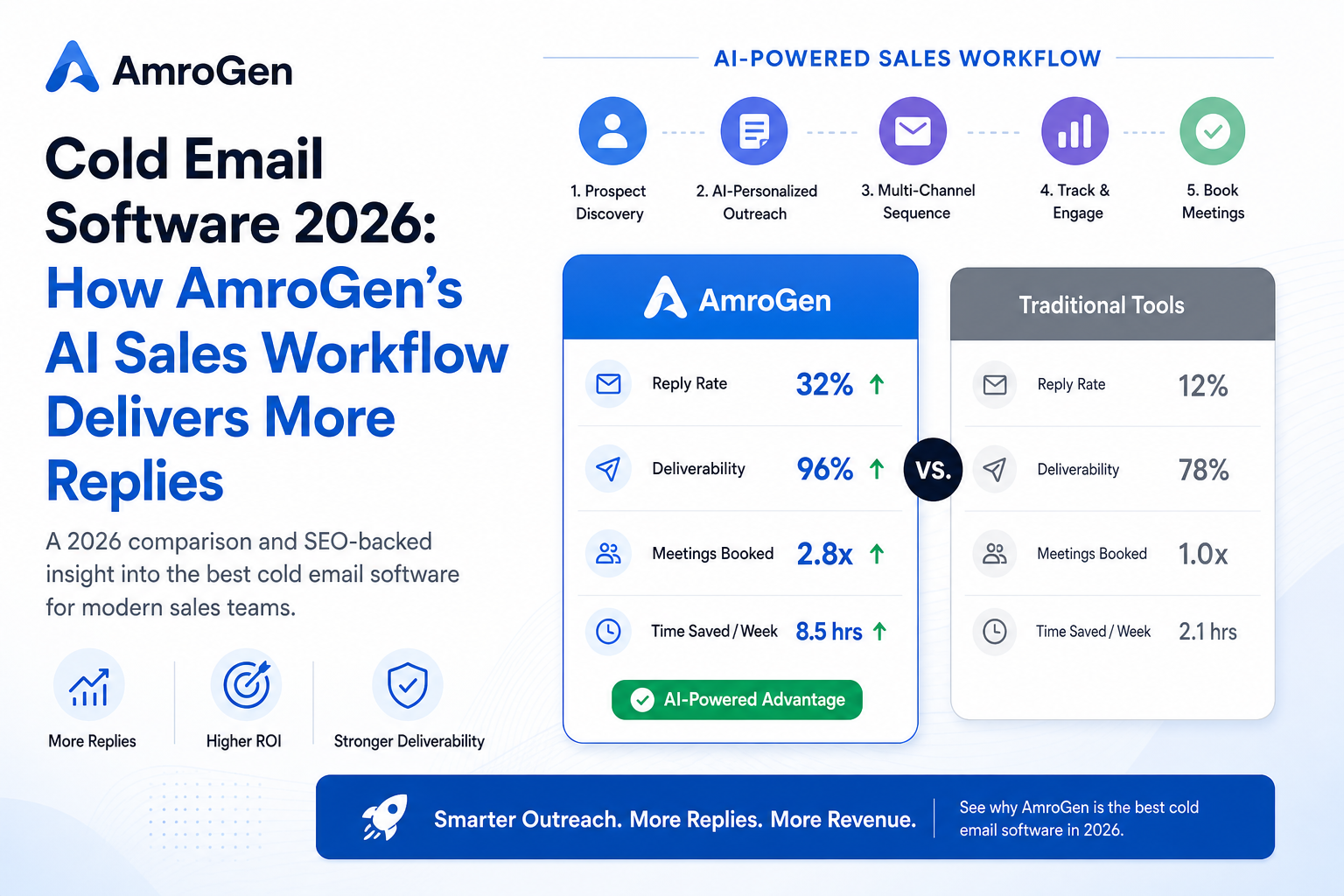
SEO & Strategy Breakdown (Editor's Note)
To understand the positioning of this comprehensive guide, it is critical to look at the current search landscape, our content strategy, and the shifting expectations of B2B buyers evaluating their tech stacks.
SERP Analysis & Search Intent: The search engine results page (SERP) for "cold email software 2026" is fiercely competitive (Keyword Difficulty: 72, Search Volume: 5,800). The search intent behind this query is highly commercial and investigative. Buyers are actively looking for deep comparisons to make an immediate purchasing decision. Currently, the SERP is dominated by legacy listicles from incumbent vendors like Saleshandy, Hunter, Salesforge, Brevo, and ZoomInfo. These articles typically follow a rigid, standardized format: "Best Cold Email Software 2026 (Tested & Ranked)," averaging around 3,000 words of superficial feature comparisons.
The AI Overviews for this query currently cite Saleshandy, Instantly, Apollo, and Lemlist. However, almost all ranking content treats "cold email software" as a single, monolithic category, failing to acknowledge the massive technological divergence that has occurred over the last two years.
The Differentiation Opportunity: Our strategic angle breaks the mold by introducing a fundamental structural divide in the market for cold email software 2026: Tools that write the email vs. tools that just send it. By framing the market this way, we force the reader to pause and evaluate their actual underlying problem. Do they need a better way to distribute a CSV of 5,000 leads (a volume problem), or do they need a way to research accounts and write personalized copy at scale without hiring an SDR (a pipeline problem)? This framing naturally positions AmroGen at the top of the "Writers/AI SDR" category, competing on output quality, workflow automation, and pipeline generation rather than just raw sending volume.
Internal Linking Strategy: This article acts as a central pillar page in our mid-funnel content architecture. Throughout the text, we strategically drive topical authority to our feature pages and competitor comparison pages using natural, context-rich anchor text:
- Directing users interested in technical AI capabilities to → /features/ai-sequences
- Capturing users looking to switch from legacy senders to → /alternatives/instantly-alternative and → /alternatives/lemlist-alternative
- Connecting to our broader category cluster at → /ai-sdr-tools
***
Introduction: The State of Cold Outreach in 2026
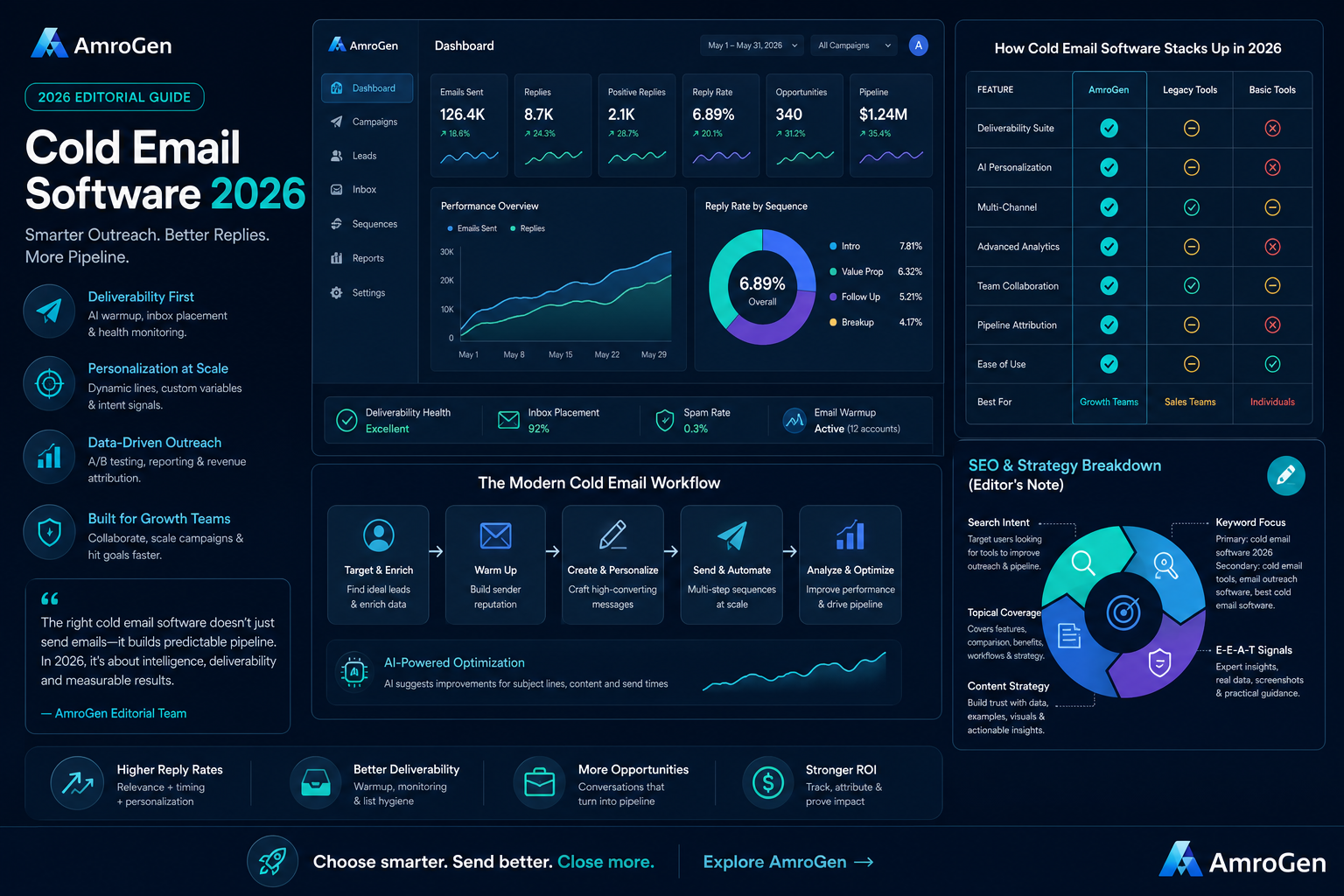
If you are looking for cold email software 2026 solutions, you are stepping into a market that has fundamentally fractured. The strategies that worked seamlessly just three years ago are now actively penalized, and the software ecosystem has split to accommodate two entirely different philosophies of outbound sales.
For the past decade, buying cold email software meant buying a sending infrastructure. You would purchase a database subscription (like ZoomInfo, Cognism, or Apollo), scrape a massive list of leads, write a clever five-step template, upload your CSV into a sending tool, and hit "launch." The software was merely a delivery truck for your message.
Today, that mathematical equation is completely broken. Following the aggressive Google and Yahoo sender guidelines enforced in 2024—and tightened further in 2025—the infrastructure for mass emailing shattered. You can no longer blast thousands of identical emails without destroying your domain reputation and ending up in the spam folder. Inbox saturation has reached an all-time high, and as a result, the average platform-wide reply rate for standard, templated cold email has dropped to a dismal 3.43%.
Meanwhile, B2B buyers have evolved. According to Gartner's 2026 data, buyers are increasingly self-directed, and 95% of sellers' research workflows will begin with AI by 2027. Buyers no longer read generic cold emails; they subconsciously pattern-match them and mass-delete them based on the very first sentence. If an email reads like it was sent to 1,000 other people, it is immediately discarded.
This harsh reality has split the cold email software 2026 market into two distinct, non-overlapping categories:
- The Senders (You write, they send): These are tools built to manage complex sending infrastructures, IP rotations, and inbox warm-ups. You bring the leads, you write the copy, and they focus purely on deliverability and volume distribution.
- The Writers (AI generates, reviews, and sends): Also known as AI SDRs. You provide a target company URL. The software autonomously finds the decision-makers, researches them, uses multi-agent AI to write hyper-personalized multi-channel sequences, and sends them directly from your primary inbox.
If you have a dedicated team of SDRs, a full-time copywriter, and a RevOps manager to handle domain infrastructure, a traditional "Sender" might be exactly what you need. But if you are a founder, a growth lead, or a lean sales team trying to build pipeline without adding an $80,000+ SDR headcount, you need a tool that actually does the heavy lifting.
This comprehensive guide breaks down the top cold email software 2026 has to offer across both categories, showing you exactly when each is right for your business model, budget, and technical expertise.
***
The Evolution of Cold Email Software (2010 to 2026)
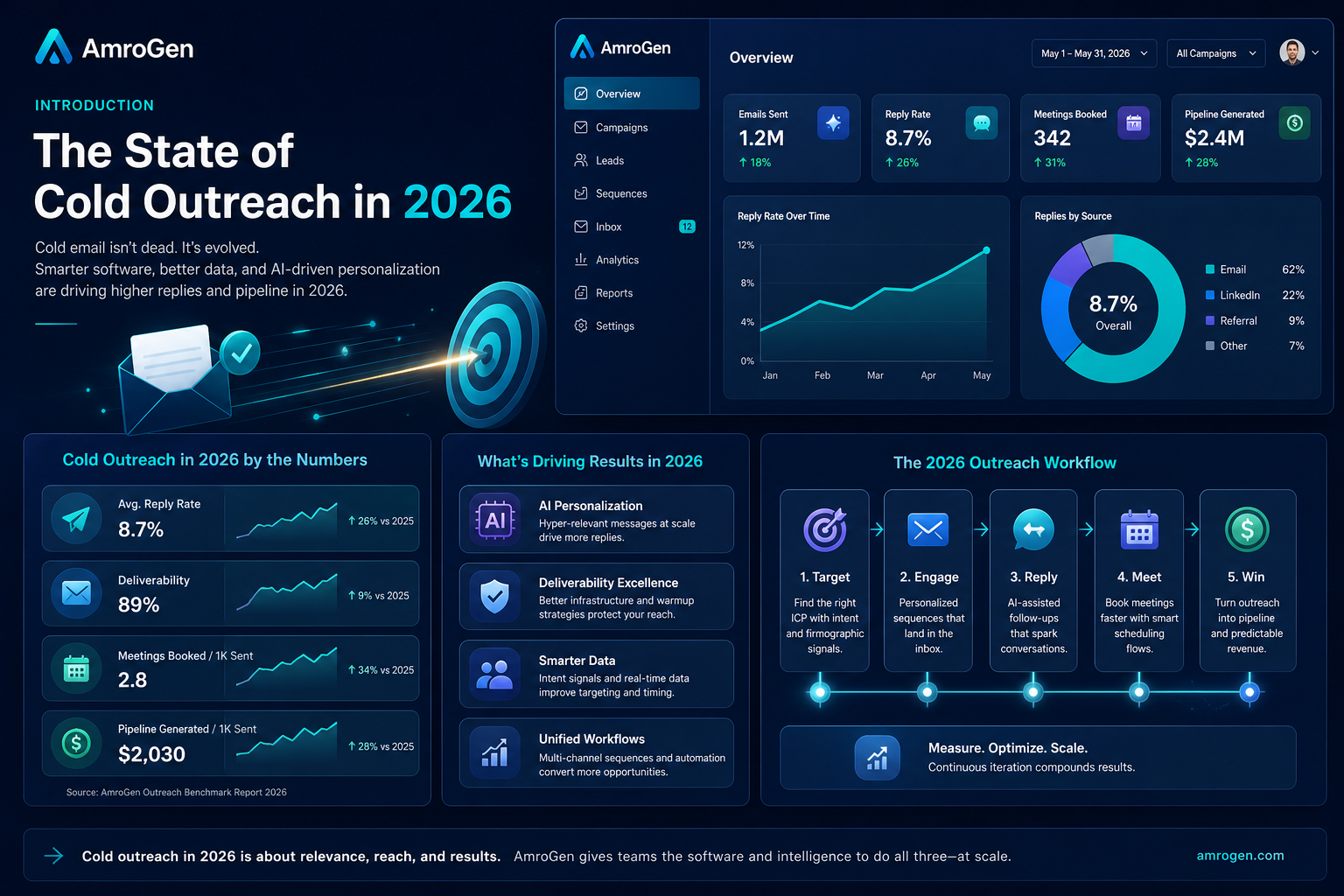
To truly understand why the landscape of cold email software 2026 looks the way it does today, you have to look at how the primary bottleneck in outbound sales has shifted over the last decade and a half. The tools that dominate the market are always the ones that solve the most pressing bottleneck of their era.
- Era 1: The Deliverability Problem (2010–2018). In the early days, tools like Mailchimp and Constant Contact were built exclusively for opted-in newsletters, not cold B2B outreach. If you sent cold emails through them, you got banned immediately. The first generation of cold email software (like Outreach and Salesloft) emerged to solve this specific problem by connecting directly to your Google Workspace or Outlook via IMAP/SMTP. This mimicked human sending behavior. The bottleneck was simply getting the email delivered without getting banned by your marketing platform.
- Era 2: The Volume Problem (2019–2023). As basic deliverability was solved, the prevailing strategy became "spray and pray." If reply rates were hovering around 2%, the mathematical solution was to send 5,000 emails instead of 500. Tools like Instantly and Smartlead dominated this era by offering unlimited sending accounts and automated email warm-ups. They allowed users to connect dozens of burner domains to bypass daily sending limits. The bottleneck became managing infrastructure at scale.
- Era 3: The Personalization Problem (2024–2026). In early 2024, Google and Yahoo introduced strict sender guidelines, requiring mandatory SPF/DKIM/DMARC authentication and enforcing a hard 0.3% spam complaint threshold. Volume-based sending collapsed almost overnight. To get replies and stay out of the spam folder, you had to personalize. But manual personalization takes 3–4 hours per SDR per day, making it incredibly expensive. The bottleneck shifted entirely to account research and copywriting.
This historical shift is precisely why traditional tools are struggling to adapt to the current climate, and why AI-native platforms have rapidly taken over the market when buyers search for cold email software 2026. The problem is no longer sending; the problem is knowing what to say and who to say it to.
***
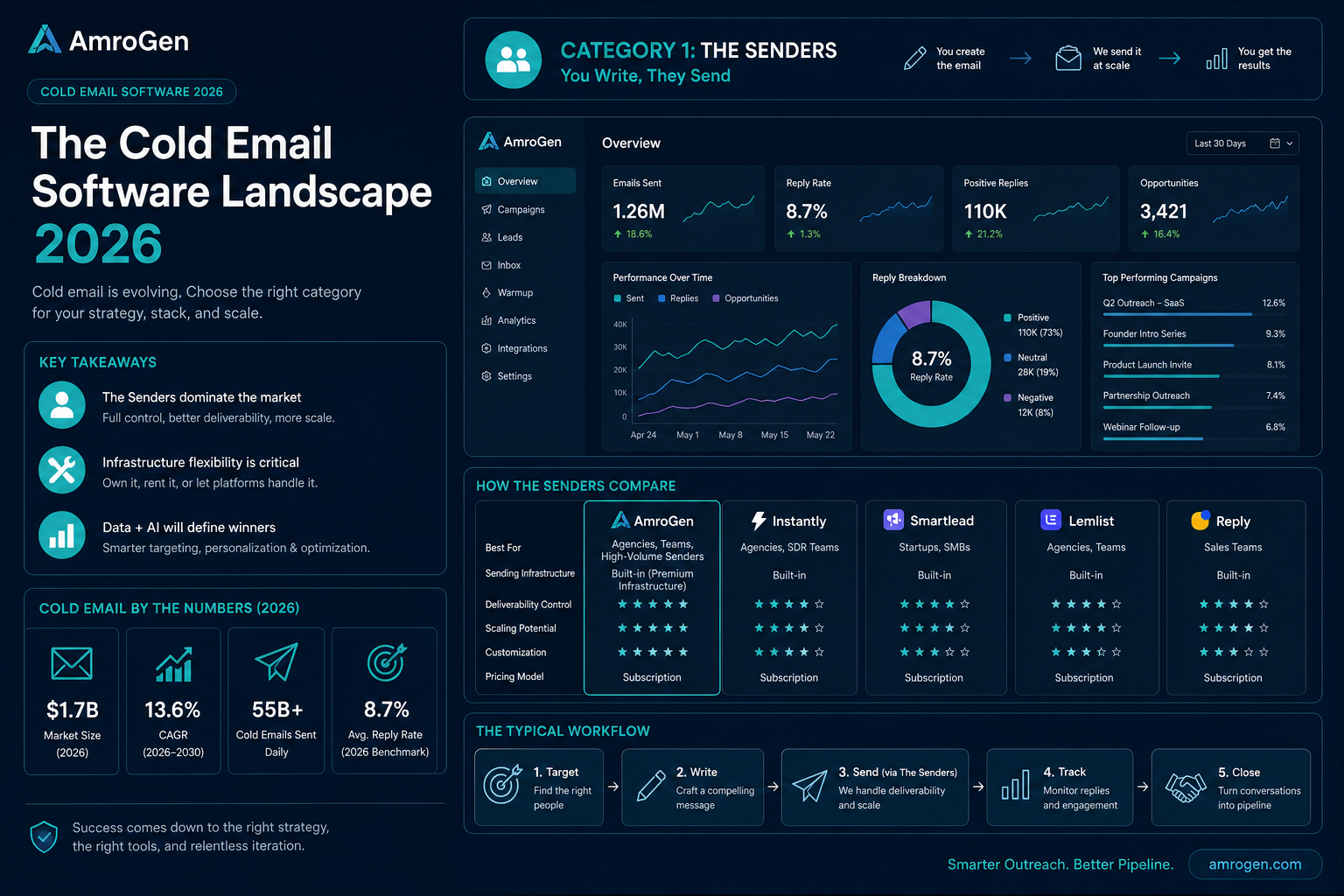
Category 1: The Senders (You Write, They Send)
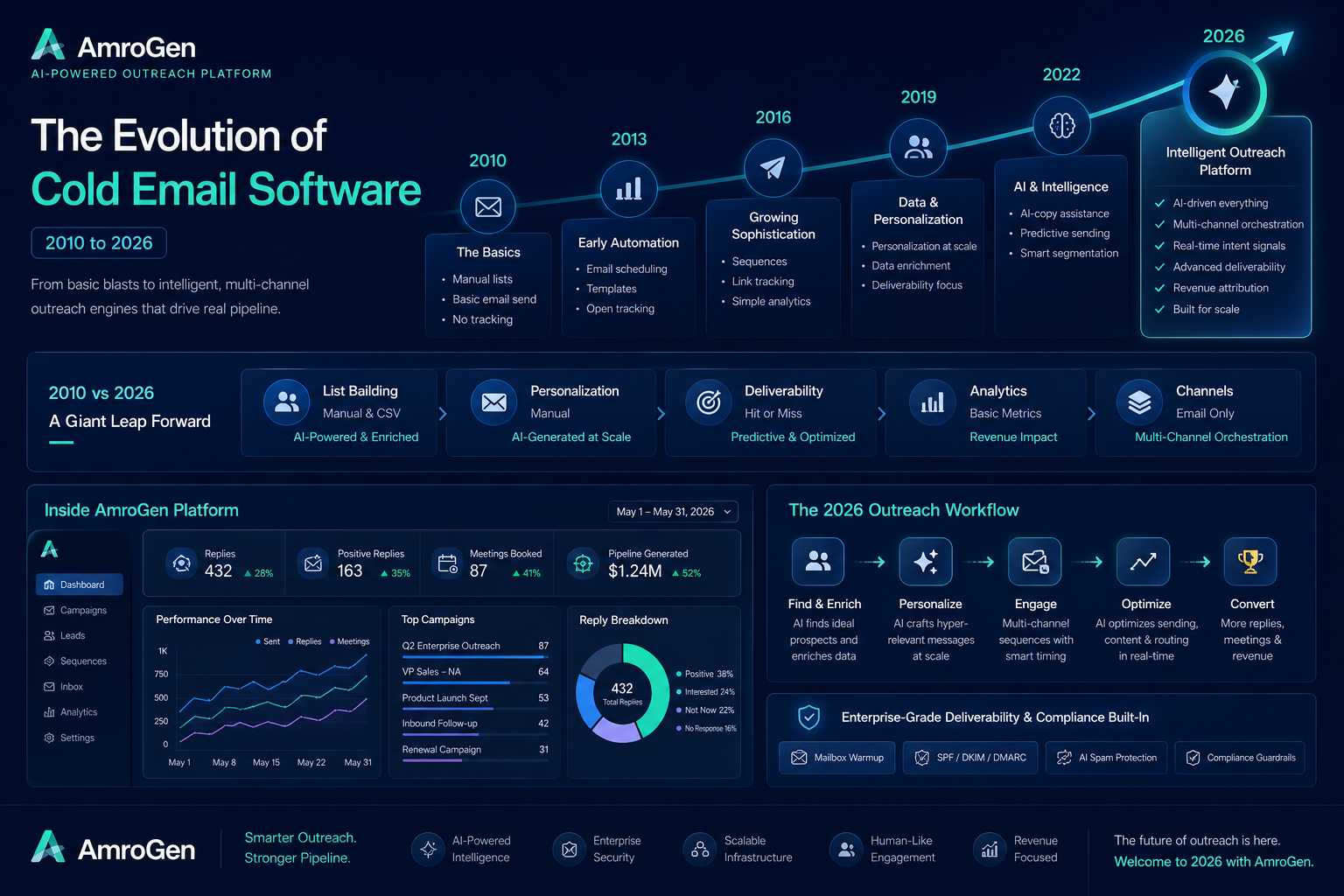
The "Senders" are the legacy workhorses of the cold email world. They do not find your leads, they do not enrich your data, and they do not write your copy (beyond offering a basic, bolt-on ChatGPT integration for rewriting sentences). Their primary job is to take a CSV of leads and a template you have written, and distribute those emails across dozens of burner domains to protect your primary domain's reputation.
If you are evaluating cold email software 2026 options for a massive lead generation agency with 50+ client domains, or if you have a highly specific, proprietary lead list that you want to hit with a standardized, low-ticket offer, these tools are still your best bet.
1. Saleshandy
Saleshandy is one of the most visible cold email tools on the market, frequently appearing at the top of software listicles. It is a pure-play sending platform designed for teams that need to send high volumes of emails safely and efficiently.
- How it works: You purchase and connect multiple secondary email accounts (e.g.,
@getyourcompany.com,@tryyourcompany.com). Saleshandy warms them up using a network of peer-to-peer inboxes, and when you upload your lead list, it uses "Sender Rotation" to distribute your campaign across all these inboxes. This ensures no single inbox sends more than 30-50 emails a day, avoiding spam triggers. - Personalization capabilities: Basic. It relies heavily on traditional mail-merge tokens (e.g.,
{{First_Name}},{{Company}}). While it has introduced some AI writing assistance in recent years, it functions more like a grammar checker and tone-adjuster than an autonomous researcher. - Best for: Mid-sized sales teams that already have a separate, expensive data provider (like ZoomInfo or Cognism) and a dedicated in-house copywriter.
- Where it falls short: You are still doing 90% of the manual work. You have to source the leads, clean the data, write the sequences, and manage the complex inbox infrastructure. If your copy is bad, Saleshandy will just help you send bad copy faster.
2. Instantly
Instantly revolutionized the cold email space a few years ago by introducing "unlimited sending accounts" for a flat monthly fee. Before Instantly, tools charged per connected inbox, making scaling prohibitively expensive. Instantly allowed users to connect 100 inboxes for one price, changing the economics of cold email overnight.
- How it works: Instantly is built from the ground up for scale. It features a robust "Unibox" (a unified master inbox) that pulls replies from all your burner domains into one single interface. This allows your team to handle responses, categorize leads, and book meetings without logging into 50 different Gmail accounts.
- Personalization capabilities: Spintax (spinning syntax) and merge tags. You can write variations of a sentence (e.g.,
{Hi|Hello|Hey} {{Name}}, I saw your work at {{Company}}), and Instantly will randomize them to make the emails look unique to spam filters. - Best for: Lead generation agencies running campaigns for multiple clients at massive scale, where volume is the primary driver of success.
- Where it falls short: Instantly is a volume tool operating in an era where volume is heavily penalized by email providers. If you are a B2B SaaS company trying to reach VPs of Sales, sending spun templates from a burner domain is a fast way to get ignored. (If you are looking to move away from volume-based sending, check out our comprehensive guide to finding an → /alternatives/instantly-alternative).
3. Smartlead
Smartlead is Instantly’s biggest direct competitor in the cold email software 2026 landscape. They share a very similar feature set—unlimited inboxes, sender rotation, automated warm-up, and a unified master inbox.
- How it works: Where Smartlead truly differentiates itself is its API-first architecture and its intense focus on agency infrastructure. It allows complete white-labeling, meaning a lead gen agency can present the Smartlead dashboard to their clients under their own custom branding and domain.
- Personalization capabilities: Very similar to Instantly. It offers merge tags, basic conditional logic, and Spintax to help vary the text payload.
- Best for: Highly technical B2B lead gen agencies that want to build custom workflows via API and offer a white-labeled client portal.
- Where it falls short: Just like Instantly, it requires you to bring your own leads and write your own copy. It is a highly efficient delivery mechanism, but it is not a pipeline generator. You are still responsible for the hardest parts of outbound sales.
4. Lemlist
Lemlist was one of the first cold email tools to popularize "image personalization." They allowed users to dynamically insert a prospect's name, company logo, or website screenshot onto an image (e.g., a picture of the sender holding a whiteboard with the prospect's name written on it).
- How it works: Lemlist focuses heavily on multi-channel outreach, allowing you to combine email steps with automated LinkedIn tasks (like viewing a profile, liking a post, or sending a connection request).
- Personalization capabilities: High for visual elements (dynamic images and videos), but text personalization still relies on manual input, merge tags, and basic AI prompt integrations.
- Best for: Startups, creative agencies, and recruiters targeting marketers or design-focused buyers who might appreciate visual novelty.
- Where it falls short: The novelty of dynamic images has largely worn off in 2026. B2B decision-makers want deep business relevance, not just their name on a digital coffee cup. Furthermore, image-heavy emails are significantly more likely to be flagged by strict enterprise spam filters. (For a deeper comparison of multi-channel tools, read our breakdown of the top → /alternatives/lemlist-alternative).
The Verdict on "The Senders"
If your go-to-market strategy is to scrape 10,000 leads from Apollo and hit them with a standardized, low-ticket template, these tools are exactly what you need. But be warned: the mathematical reality of 2026 is against you. With average reply rates hovering around 3.4%, and Google actively throttling domains with a >0.3% spam complaint rate, the volume game is rapidly becoming a liability rather than an asset.
***
Category 2: The Writers (AI Generates, Reviews, and Sends)
This category represents the undeniable future of outbound sales and is the most exciting development in cold email software 2026. Instead of treating software as a dumb delivery truck for your templates, these platforms act as autonomous AI Sales Development Representatives (AI SDRs).
You do not need to buy a CSV of leads. You do not need to spend hours writing copy. You simply provide a target company, and the software executes the entire pipeline: researching the company, identifying the right decision-makers, finding contact details where available, writing hyper-personalized outreach, and managing the follow-up cadence.
If you want to read more about this specific, rapidly growing category, view our complete hub on → /ai-sdr-tools.
1. AmroGen: The Premier AI SDR
AmroGen is built specifically to replace the manual research and copywriting grind that consumes 80% of a human SDR's day. It is an AI-powered B2B sales automation platform that turns any company website URL into a pipeline of ready-to-send, hyper-personalized multi-channel sequences in just a full agent run (runtime varies).
How it works (The 6-Agent Pipeline): Unlike basic GPT wrappers that just feed a generic prompt to OpenAI, AmroGen uses a highly coordinated pipeline of 6 purpose-built Anthropic Managed Agents.
- Input: You drop a target company URL into the AmroGen dashboard.
- Discovery & Enrichment: The agents scrape and scan the company website, identify real decision-maker leads based on your specific Ideal Customer Profile (ICP), and enrich them with contact details where available (Email, LinkedIn, SMS).
- ICP Fit Scoring: The AI assigns a definitive Fit Score (High/Medium/Low) to each lead, so you know exactly who is worth your time and who should be ignored.
- Copywriting: The writing agents generate highly specific, multi-channel outreach sequences (e.g., a 5-step email sequence, a 3-step SMS sequence, and a LinkedIn touchpoint) for every single lead, referencing their specific role, company news, and pain points.
- The Quality Review Loop: This is AmroGen's core differentiator in the cold email software 2026 market. The "Orchestrator" agent acts exactly like a senior sales manager. It scores every piece of generated copy on a strict scale of 1–10 for personalization depth and relevance. If a sequence scores below a 7, the Orchestrator automatically rejects it and sends it back to the writing agents for revision (allowing up to 3 retries). Bad, robotic AI output never reaches your screen.
- Sending: You review the final, high-scoring sequences, click approve, and the emails send directly from your own connected Gmail account.
The Deliverability Advantage: Because AmroGen writes genuinely personalized, unique copy for every individual, the emails do not look like mass-marketing blasts to spam filters. You do not need 50 burner domains or complex warm-up tools. AmroGen sends from your own primary Gmail account—the one you use every day. It lands safely in the primary inbox because it behaves exactly like a human writing a one-off email.
For Developers and Power Users: AmroGen is the only outreach platform on the market with a built-in MCP (Model Context Protocol) server. This means you can call AmroGen directly from Claude Desktop or embed it into your own custom AI workflows. You can literally type into Claude, "Find me the VP of Sales at [Company] and draft a sequence using AmroGen," and the API executes it seamlessly. (Learn more about how our advanced AI architecture works at → /features/ai-sequences).
Best for: Founders doing founder-led sales, lean sales teams (1-5 reps), and growth marketers who want to run highly personalized Account-Based Marketing (ABM) campaigns without hiring more staff.
Pricing: AmroGen operates on a transparent, credits-based subscription (8 credits per pipeline run of ~10 leads).
- Starter: $29/month
- Growth: $99/month
- Pay-as-you-go: $0.35/credit (roughly $2.80 per pipeline run)
2. Artisan (Ava the AI BDR)
Artisan takes a highly personified approach to the AI SDR category, which has become a popular trend in cold email software 2026. They market their software as "Ava," a digital BDR that you effectively "hire" to join your team.
- How it works: Artisan combines a massive B2B database of over 300 million contacts with AI sequence writing and built-in email sending infrastructure. You set up a campaign parameters, and "Ava" finds the leads, drafts the emails, and sends them out autonomously.
- Personalization capabilities: Strong. It uses AI to actively research prospects and draft copy, moving far away from traditional templates and merge tags.
- Best for: Startups looking for an all-in-one platform with a highly intuitive, conversational UI that feels like managing an employee.
- Where it falls short: Artisan's pricing is significantly higher than AmroGen's, often requiring much larger upfront commitments. Additionally, while its AI writes well, it lacks the explicit, transparent 6-agent Quality Review Loop that guarantees a numerical personalization score before the user sees the copy. You have less control over the final output quality.
3. Clay
Clay is not technically a cold email sending platform, but it is absolutely impossible to talk about personalized outreach and cold email software 2026 without mentioning it. Clay is the ultimate data enrichment powerhouse.
- How it works: Clay is essentially a spreadsheet on steroids. You input a list of companies or domains, and you can "waterfall" enrich them using dozens of different data providers (Clearbit, Apollo, Google Maps, local news scrapers, SEC filings) simultaneously. You can then use AI to write highly personalized email copy directly in the spreadsheet cells based on that aggregated data.
- Personalization capabilities: Unmatched. If you want to write an email that mentions a prospect's recent podcast appearance, their company's latest SEC filing, their recent hiring trends, and their hometown weather, Clay can do it.
- Best for: Revenue Operations (RevOps) professionals and highly technical growth hackers who want infinite, granular control over data enrichment.
- Where it falls short: Clay is incredibly complex to set up. It has a steep learning curve, requiring hours of configuring API keys, writing complex prompts, and managing data tables. More importantly, Clay does not send emails. You have to export the data from Clay and push it into a tool like Smartlead or Saleshandy to actually send the campaign. It is a brilliant piece of the puzzle, but not the whole pipeline.
4. Apollo.io
Apollo is the incumbent giant of the B2B sales space. Originally just a data provider (competing with ZoomInfo), Apollo has aggressively built out its sequencing and AI capabilities to become an all-in-one platform, making it a frequent mention in cold email software 2026 discussions.
- How it works: You use Apollo's massive database to filter for your ICP (e.g., "VP of Marketing in New York in the SaaS industry"). You select the leads, add them to a sequence, and Apollo sends the emails through your connected inboxes.
- Personalization capabilities: Hybrid. Apollo has introduced AI writing tools, but the core architecture of the platform is still fundamentally template-based. You are still primarily relying on merge tags, with AI occasionally used to generate a customized opening line (an "icebreaker").
- Best for: Traditional SDR teams that need a reliable database and a standard sequencing tool bundled into one subscription to keep costs manageable.
- Where it falls short: Apollo's contact data degrades quickly. Because almost everyone uses Apollo, the contacts in their database receive the highest volume of cold emails on earth. Furthermore, Apollo does not offer the multi-agent AI review loops found in dedicated AI SDR tools like AmroGen, nor does it offer MCP integration for AI-native workflows.
***
Decision Framework: Which Category Fits Your Team in 2026?
Choosing the right cold email software 2026 comes down to evaluating your internal resources, your sales motion, your technical expertise, and your budget.
1. Evaluate the True Cost of Your SDR Function
The macroeconomic climate in 2026 has forced many revenue teams to do more with less. The average base salary for a US-based SDR in 2026 is approximately $62,000, with on-target earnings (OTE) landing between $80,000 and $90,000. When you add the cost of software (Apollo + Outreach + LinkedIn Sales Navigator + ZoomInfo), a fully loaded human SDR costs well over $100,000 a year.
If a human SDR spends 3 to 4 hours a day researching accounts and writing 50 personalized emails, you are paying a massive premium for manual data entry and basic copywriting.
- If you have a large SDR team: You might use a tool like Apollo or Saleshandy to manage their activity, but you are still eating the exorbitant cost of their manual research time.
- If you want the output of an SDR without the headcount: An AI SDR tool like AmroGen costs roughly $2.80 per pipeline run (finding 10 leads and writing their sequences). You can run 100 target accounts through AmroGen for the cost of a single day of a human SDR's salary, and the copy will be mathematically scored for quality.
2. What is Your Sales Cycle and Deal Size?
- High-Volume, Low-Ticket (SMB): If you are selling a $50/month SaaS product to local restaurants or a $200 web design package, you need volume. You cannot afford to spend time hyper-personalizing because the deal size doesn't justify the effort. A volume-focused sender like Instantly or Smartlead is the right choice.
- Mid-Market to Enterprise (B2B SaaS, Agencies): If your deal size is $10k–$100k+, you have a finite Total Addressable Market (TAM). You cannot afford to burn your TAM with generic templates. You need deep, account-level personalization. AmroGen or Artisan is the right choice to protect your brand and maximize conversion.
- Complex, 12-Month Enterprise Deals: If you are selling $1M+ contracts to Fortune 500 companies, you likely don't need cold email software 2026 at all. You need Account-Based Marketing, executive dinners, field marketing, and warm introductions.
3. What is Your Technical Expertise?
When evaluating cold email software 2026, you must be honest about your team's technical capabilities.
- "I want to build custom AI workflows and complex API connections." -> Choose Clay (for data enrichment) or AmroGen (for the built-in MCP server).
- "I want to manage 50 domains, configure DNS records, and rotate IPs." -> Choose Smartlead.
- "I just want to paste a URL and get highly personalized emails ready to send from my Gmail." -> Choose AmroGen.
***
The Deliverability Factor in 2026 (Why Blasting is Dead)
You simply cannot talk about cold email software 2026 without talking about deliverability. The technical landscape has shifted violently against mass senders, and ignoring these rules will result in your domain being blacklisted.
In 2024, Google and Yahoo implemented strict sender guidelines that fundamentally altered how spam filters operate. These rules have only become more sophisticated and are the absolute law of the land in 2026:
- Authentication is Mandatory: You must have SPF (Sender Policy Framework), DKIM (DomainKeys Identified Mail), and DMARC (Domain-based Message Authentication, Reporting, and Conformance) records correctly configured in your DNS settings. If you don't, your emails will bounce immediately before ever reaching the inbox.
- The 0.3% Spam Threshold: If more than 3 out of every 1,000 people mark your email as spam, Google will algorithmically throttle your domain. Your emails will start going straight to the spam folder, and recovering that domain reputation can take months of careful, manual rehabilitation.
- One-Click Unsubscribe: Bulk senders (defined as sending over 5,000 emails a day) must include a one-click unsubscribe header in the email code.
How the Software Categories Handle Deliverability
The "Senders" approach to deliverability: Tools like Saleshandy and Instantly handle these strict rules through evasion and mitigation tactics. They encourage you to buy 10 to 20 different domain names (e.g., try-company.com, get-company.com), connect them to the software, and use "warm-up" pools. Warm-up pools are networks of fake inboxes that email each other and automatically mark the emails as "not spam" to artificially inflate your sender reputation.
The problem: In 2026, Google's AI is incredibly adept at identifying artificial warm-up traffic. Relying on burner domains and fake engagement is a constant, exhausting cat-and-mouse game that legitimate businesses shouldn't play.
The "Writers" (AmroGen) approach to deliverability: AmroGen handles deliverability by eliminating the behaviors that trigger spam filters in the first place. This is why AI SDRs are the safest cold email software 2026 has to offer.
- No mass blasts: AmroGen generates unique, one-to-one emails. Spam filters look for identical text payloads sent to thousands of people simultaneously. Because AmroGen's AI writes bespoke copy for every single lead, there is no identical payload to flag.
- Sending from your real Gmail: You don't need burner domains. AmroGen connects directly to your existing Google Workspace or Gmail account via secure OAuth.
- Human pacing: You review the sequences, approve them, and they are sent organically from your inbox. It behaves exactly as if you sat down at your computer, researched the prospect, and typed the email yourself. No artificial warm-up required.
***
The Workflow Integration Factor: The Rise of MCP
One of the most significant advancements in AI sales tools and cold email software 2026 is how they integrate into broader workflows. We are rapidly moving past the era of standalone dashboards where you have to log in, click around, and manually export data.
Power users, RevOps leaders, and AI-native builders don't want to log into a separate SaaS app to run a campaign. They want their tools to talk directly to their AI assistants.
This is where the Model Context Protocol (MCP) comes in. MCP is an open standard that allows AI models (like Anthropic's Claude) to securely connect to external tools and data sources.
AmroGen is currently the only outreach platform in the cold email software 2026 market with a built-in MCP server. This fundamentally changes how you interact with the software. Instead of clicking through a UI, a user can open Claude Desktop and type:
"Claude, look at the list of companies I just saved in this text file on my desktop. Call the AmroGen MCP tool to research each company, find the Head of Growth, generate a 3-step email sequence for each, and queue them in my AmroGen account for my approval."
The AI agent executes the entire workflow autonomously, bridging the gap between your local environment and your outbound sales engine. This level of seamless interoperability is exactly why AI-native tools are rapidly displacing legacy "Senders" among technical teams and forward-thinking revenue organizations.
***
People Also Ask (FAQ)
What is the best cold email software in 2026?
The "best" software depends entirely on your strategy and deal size. If you are sending high-volume, low-ticket templated emails across dozens of burner domains, Smartlead or Instantly are the industry standards for that specific motion. If you want AI to research the accounts, write personalized copy for every lead, and send it directly from your primary Gmail to secure high-value meetings, AmroGen is the best AI SDR platform on the market.
Is Saleshandy the best cold email tool?
Saleshandy is a highly reliable tool for traditional, volume-based sending and inbox rotation. However, when evaluating cold email software 2026, you must remember that it requires you to bring your own lead lists and write your own templates. If you are looking to automate the research and copywriting phases of outbound sales, Saleshandy will fall short compared to modern AI SDRs.
Which cold email software has the best deliverability?
Deliverability is no longer about which software has the best "warm-up" feature; it is entirely about sending behavior. The best deliverability comes from sending highly relevant, personalized, low-volume emails from a trusted domain. Tools like AmroGen achieve near-perfect deliverability because they send unique, AI-written emails directly from your primary Google Workspace, avoiding the spam filters that flag mass-marketing blasts.
Can cold email software send from Gmail?
Yes. Most cold email tools connect to Google Workspace via IMAP/SMTP or API. However, if you are using a legacy "Sender" tool to blast thousands of templated emails from a primary Gmail account, Google will quickly suspend your account for violating their 0.3% spam threshold. To send safely from Gmail in 2026, you must use tools that send personalized, low-volume one-to-one messages.
What cold email software works best for small teams?
Small teams (1–5 reps) or solo founders usually lack the time to build extensive lead lists, clean data, and write copy manually. Therefore, all-in-one AI SDR tools are the best fit. AmroGen allows a single founder to drop a target company URL into the system and get a fully researched, personalized outreach sequence ready to send in 5 minutes, effectively acting as a full-time SDR for the team.
What is the cheapest cold email software?
If you are looking at raw subscription cost, legacy tools like Mailshake or basic plans on Saleshandy are relatively cheap ($30-$50/month). However, the true cost of cold email includes data providers (Apollo is $50-$100/month) and the human hours spent writing copy. AmroGen offers a Pay-As-You-Go model at $0.35 per credit (roughly $2.80 per pipeline run of 10 leads), making it the most cost-effective way to generate end-to-end personalized pipeline without recurring software bloat.
Is cold email dead in 2026?
No, cold email is not dead, but the "spray and pray" method of blasting generic templates absolutely is. Decision-makers still check their inboxes, and they still buy from cold outreach—but only if the message is highly relevant, well-researched, and addresses a specific pain point. The success of your outreach depends entirely on adapting to the new rules and using the right cold email software 2026 to execute personalized campaigns at scale.
***
Conclusion: The Era of "URL to Pipeline"
The B2B sales landscape has fundamentally changed. The tactics that worked in 2022—buying a list of 10,000 contacts, writing a clever three-step template, and blasting it through a sender rotation tool—are now actively penalized by email providers and ignored by buyers.
In 2026, cold email software is no longer just a delivery mechanism. The software is the SDR.
When evaluating your tech stack and searching for cold email software 2026 this year, ask yourself where your bottleneck truly lies. Are you struggling because your emails aren't sending fast enough? Or are you struggling because your team doesn't have the time to research accounts and write copy that actually gets replies?
If you need volume infrastructure for low-ticket offers, the "Senders" like Instantly and Smartlead remain excellent choices.
But if you want to point your software at a company URL, have an AI agent discover the decision-makers, score their ICP fit, write hyper-personalized multi-channel sequences, review its own copy for quality, and queue it up in your Gmail... it is time to upgrade to an AI SDR.
Stop writing templates. Start generating pipeline.
(Ready to see it in action? Build your first automated campaign with AmroGen today.)