7 Clay Alternatives for Teams Who Want Enrichment + Writing + Sending in One Tool
TL;DR
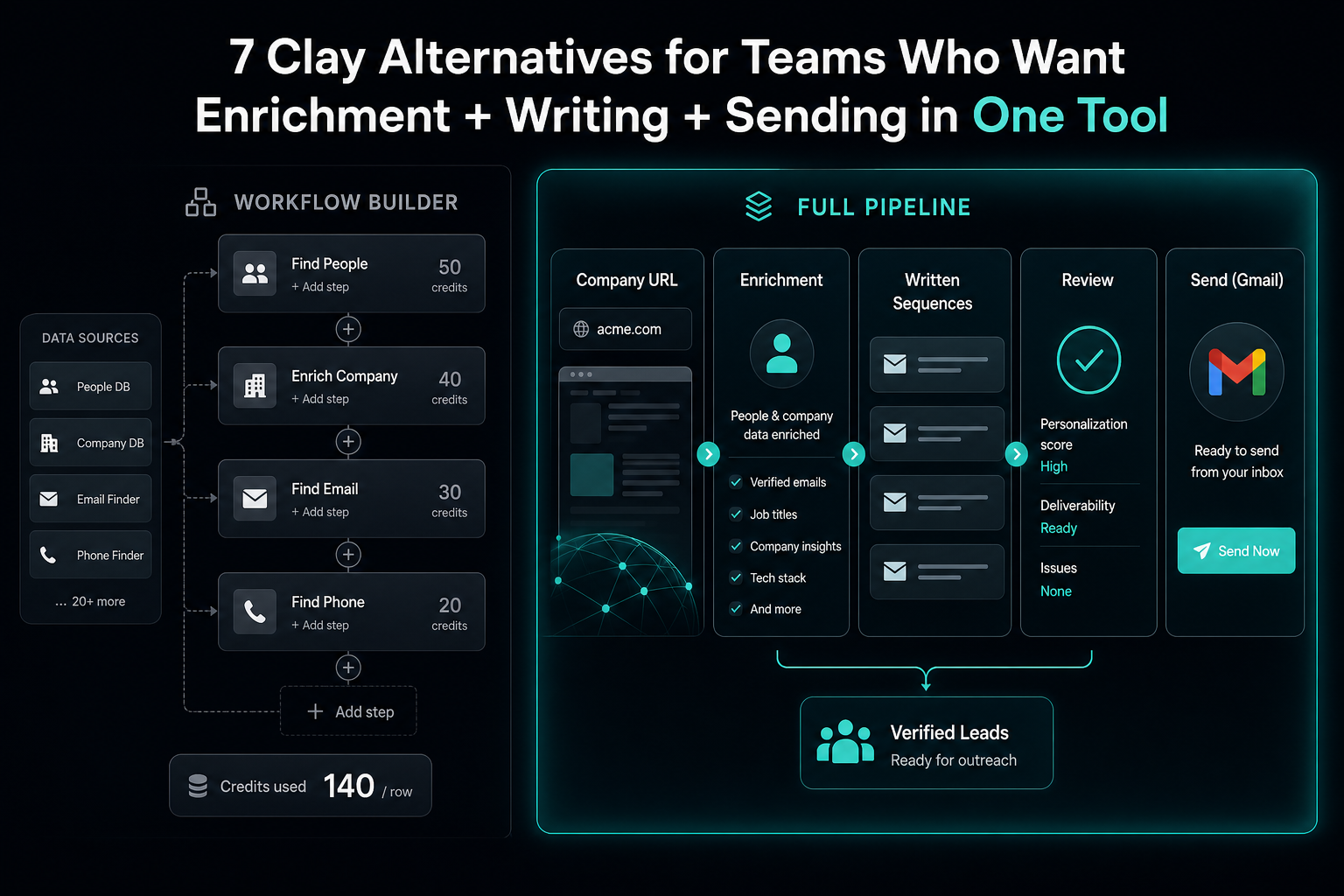
Clay is genuinely the most powerful enrichment platform in B2B — waterfall logic across 75–150+ data providers, AI agents (Claygent) that can research arbitrary fields, and flexibility no single-source database matches. The honest problem is everything that comes after enrichment. Clay doesn't offer autonomous outbound tools like LinkedIn prospecting, automated connection requests, or AI-driven messaging sequences — once your data is enriched, you still need a separate sequencing tool and a separate sender. And after Clay's March 2026 pricing overhaul split costs into Data Credits and Actions, with Actions metered on every workflow step regardless of whether enrichment returns data, the total cost of running Clay well has climbed for a lot of teams. This guide covers seven real alternatives, organized by what's actually missing for you — and where AmroGen fits for teams who want URL-based research without the setup time at all.
Table of Contents
- What Clay Does Better Than Anything Else
- [Where Clay Creates Friction](#where-it-breaks]
- Who Actually Needs a Clay Alternative
- 7 Clay Alternatives
- Comparison Table
- FAQ
What Clay Does Better Than Anything Else
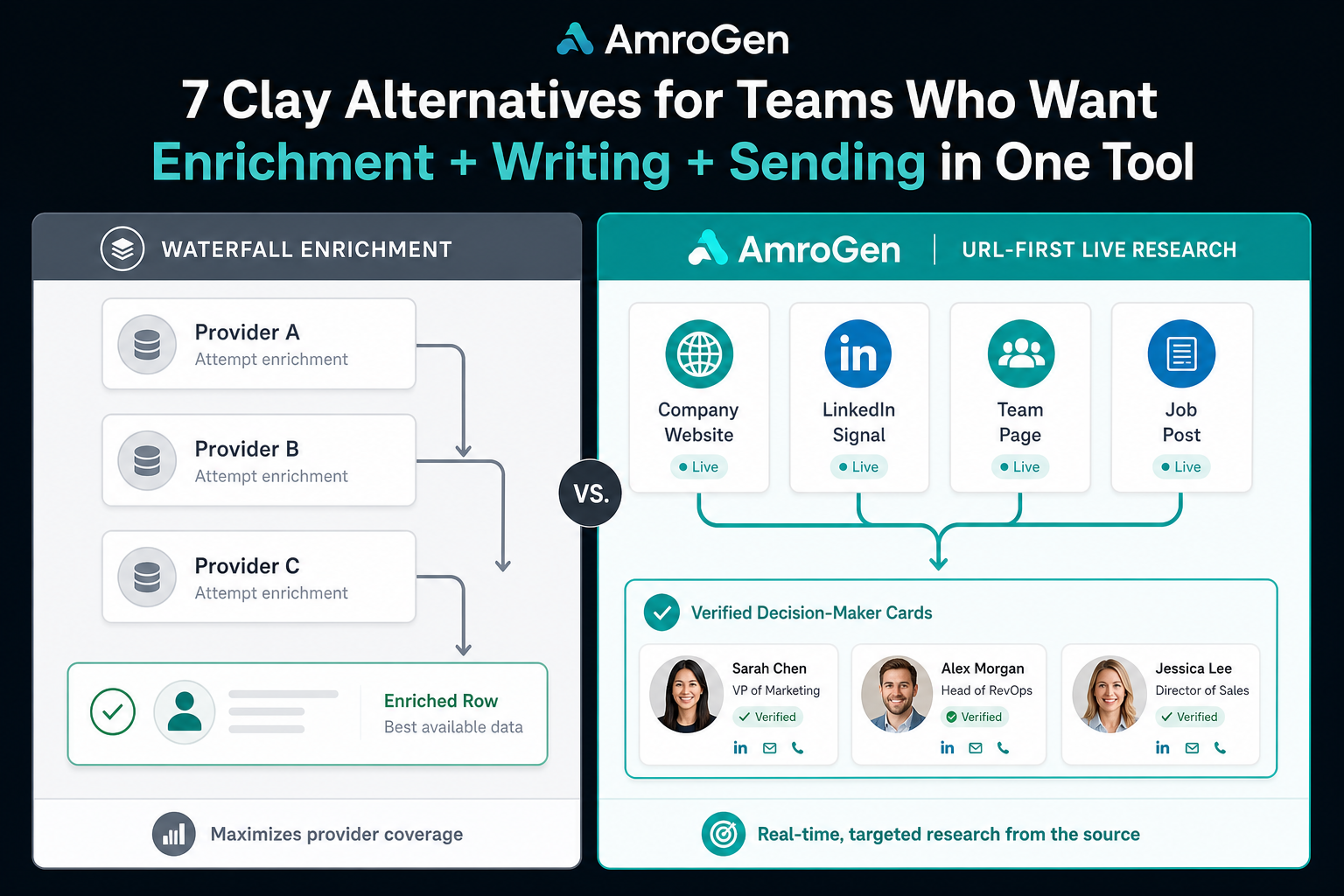
Clay's core strength is waterfall enrichment — chaining multiple data providers per prospect so that if one source fails to return an email or phone number, the next one in the chain tries. This produces hit rates that single-source databases can't match. Claygent, Clay's AI research agent, can pull custom fields from arbitrary public sources — podcast appearances, GitHub activity, specific technographic details — that no pre-built database tracks at all. For RevOps teams with the technical capacity to build and maintain these workflows, Clay is well-suited for custom prospecting workflows and waterfall enrichment in a way nothing else on this list replicates.
Where Clay Creates Friction
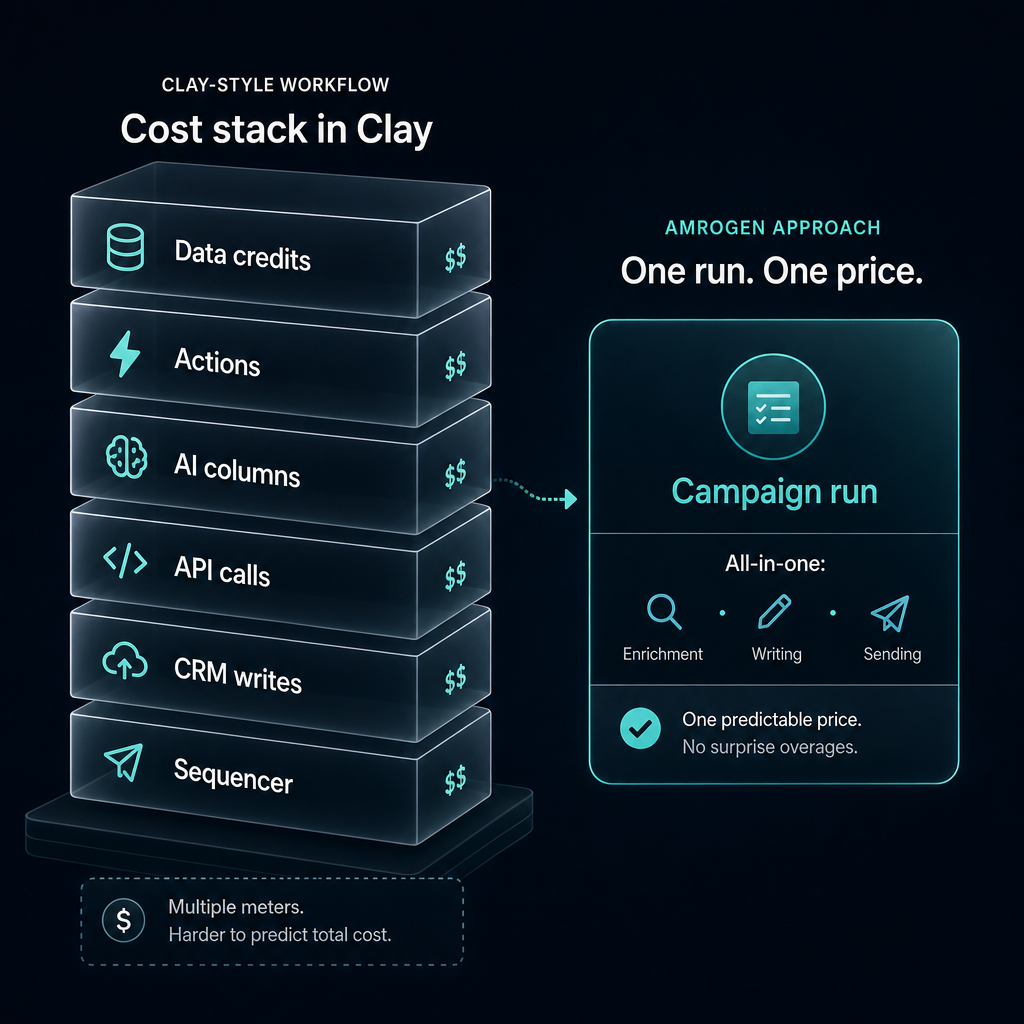
Three structural issues show up repeatedly across independent reviews.
It's built for engineers, not revenue teams. Clay was built more for RevOps engineers than revenue teams — managing API chains, juggling credits, and fixing inconsistent data quality often takes more time than it saves for teams without dedicated technical capacity. Setting up a single working enrichment table typically takes 2–4 hours of workflow building before you see a single enriched row.
Pricing has gotten more complex, not less. As of March 2026, Clay splits costs into Data Credits (enrichment lookups) and Actions (every platform step including AI columns, API calls, and CRM writes) — and Actions now charge for every workflow step regardless of whether enrichment returns data. Reddit and Trustpilot reviews consistently flag mid-cycle credit exhaustion and top-up fees. Published plans run $185/month (Launch) to $495/month (Growth), but real total spend reaches $1,000–2,500+/month for active teams once data credits are factored in.
It stops at enrichment. Clay produces a clean, enriched list. It doesn't write the outreach, doesn't send it, and its architecture isn't optimized for direct AI agent access the way newer MCP-native tools are. You still need to wire it into Instantly, Smartlead, or another sequencer — and you still need to write the copy, or prompt something else to write it.
Who Actually Needs a Clay Alternative
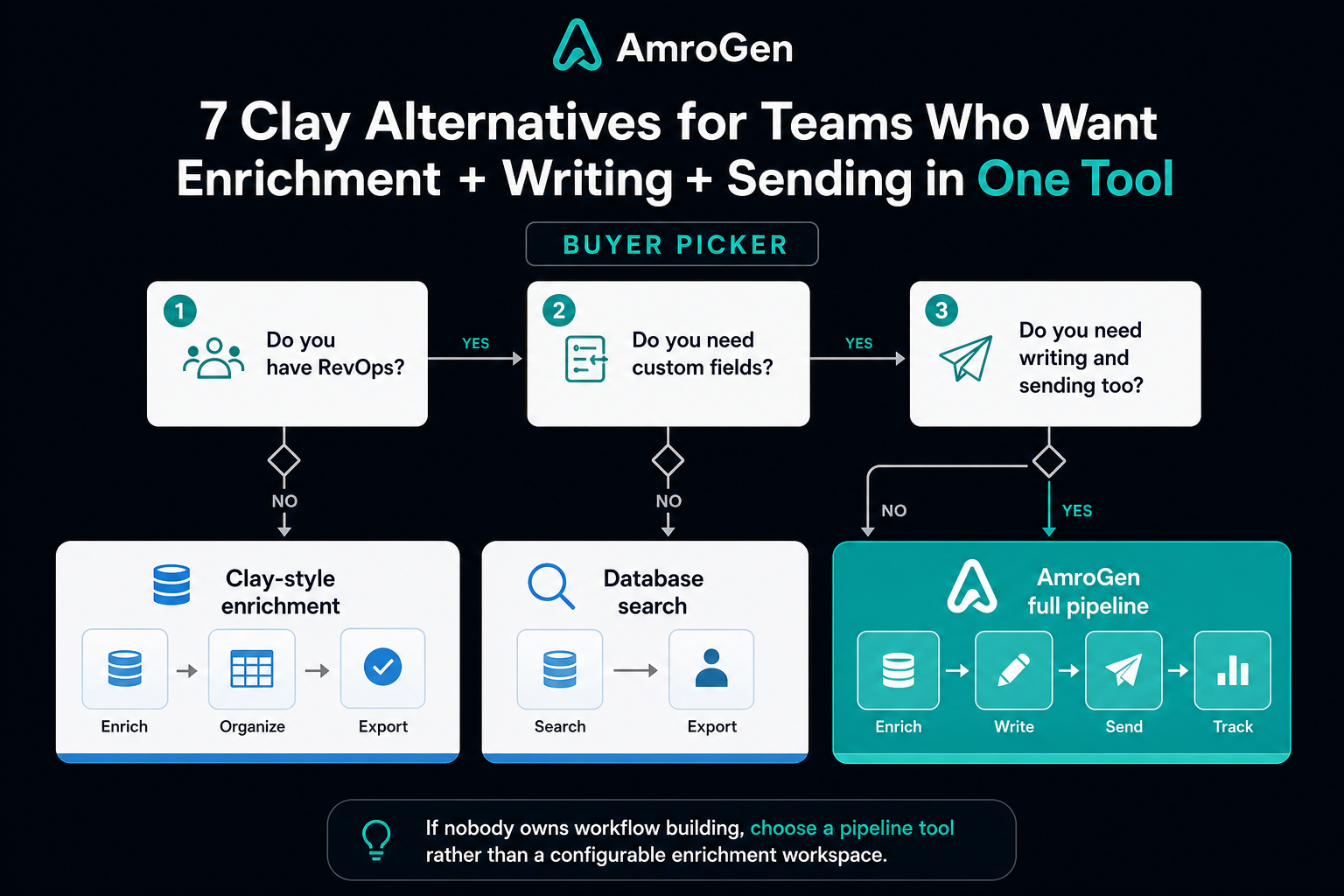
You don't have a RevOps function. If nobody on the team can build and debug a waterfall enrichment workflow, Clay's flexibility is wasted spend.
You want enrichment, writing, and sending in one workflow. Clay solves one-third of the pipeline. If you're assembling Clay + a sequencer + a sender + an AI copy tool, the setup and integration overhead is the real cost, not any single tool's price tag.
You're spending more time managing credits than prospecting. Mid-cycle credit exhaustion and unpredictable Action charges are now one of the most cited frustrations in 2026 reviews.
You want results in minutes, not after hours of table configuration.
7 Clay Alternatives
1. AmroGen — for the full pipeline without the setup
Clay enriches data. AmroGen replaces the entire upstream workflow: give it a company URL instead of a spreadsheet of providers to configure, and the Lead Generator agent browses the company's live web presence directly — no API chains, no Data Credits, no Actions metering. It returns researched, enriched leads (email, LinkedIn, phone, ICP score) in minutes, then the Orchestrator and specialist agents write personalised email, LinkedIn, and SMS sequences from that same research — reviewed for quality before you see them, and sent via Resend or Gmail when connected.
This isn't a more powerful enrichment engine than Clay — Clay wins decisively on raw enrichment flexibility and breadth of data sources. It's a different answer to a different question: not "how do I enrich data with maximum control," but "how do I go from a target company to reviewed, sendable outreach without building a workflow first."
Best for: Teams without RevOps capacity who want research, writing, and sending collapsed into one step. Pricing: From $29/month, or ~$2.80/run.
2. Apollo.io — for teams who want a search bar instead of a workflow builder
Apollo holds a 4.8/5 rating on G2 from 9,000+ reviews and is the most popular all-in-one alternative to Clay specifically because it replaces workflow-building with a search interface: find leads, enrich them, and start a sequence without leaving the platform. The trade-off is flexibility — Apollo doesn't do waterfall enrichment across multiple providers; you get Apollo's data or nothing. The free tier includes 10,000 email credits/month, among the most generous in the category. Pricing: Free tier; paid from $49/user/month.
3. Cleanlist — for multi-provider enrichment without engineering
Cleanlist automatically waterfalls through 15+ data providers and returns a triple-verified list in under 10 minutes with zero workflow configuration — directly targeting Clay's setup-time problem. Upload a CSV, get enriched results, no spreadsheet logic to debug. Pricing: From $29/month.
4. ZoomInfo — for single-source enterprise accuracy
For teams who used Clay specifically to improve data quality through waterfalling multiple sources, ZoomInfo often provides comparable accuracy from a single trusted source, particularly for North American enterprise accounts — at the cost of significantly higher price and far less flexibility for custom workflows. Pricing: Custom, typically $14,995+/year.
5. Cognism — for compliant European enrichment
The clear pick when GDPR compliance and EU coverage matter more than enrichment flexibility. Phone-verified mobile data via Diamond Data, DNC screening across 13–14 countries. Pricing: Custom, enterprise.
6. UserGems — for job-change and relationship intelligence specifically
A narrower tool than Clay by design: UserGems focuses specifically on tracking when your customers, champions, and prospects switch companies, creating warm pipeline opportunities with reportedly 3x higher conversion rates than cold outreach. Not a full Clay replacement, but a sharp fit if relationship-based pipeline is your specific use case.
7. Floqer — for continuous CRM enrichment without workflow building
Positions itself as a full GTM orchestration platform with continuously-running background CRM workflows that keep records enriched automatically and flag accounts as they become ICP-fit — closer to Clay's flexibility than most alternatives, with 80 data providers versus Clay's 150+. Pricing isn't published; requires a sales call.
Comparison Table
| Tool | Best for | Writes & sends outreach? | Setup time | Pricing |
|---|---|---|---|---|
| AmroGen | Full pipeline, no RevOps needed | Yes — researched, reviewed, Gmail-sent | Minutes | $29/mo (~$2.80/run) |
| Apollo.io | Search-bar simplicity | Sequencing only, no AI writing | Minutes | Free tier; $49+/user/mo |
| Cleanlist | Fast multi-provider enrichment | No | ~10 minutes | $29/mo |
| ZoomInfo | Single-source enterprise accuracy | No | Days (onboarding) | $14,995+/yr |
| Cognism | EU/EMEA compliance | No | Days (onboarding) | Custom |
| UserGems | Job-change signal tracking | No | Days | Custom |
| Floqer | Continuous CRM enrichment | No | Sales call required | Not published |
FAQ
What does Clay do that other tools don't? Waterfall enrichment across up to 150+ data providers in a single configurable workflow, plus Claygent — an AI research agent that can pull custom, non-standard fields (podcast appearances, GitHub activity, niche technographics) that pre-built databases don't track. No alternative matches this exact flexibility, though several replicate the core waterfall benefit with far less setup.
Is Clay worth the price? Worth it if you have RevOps capacity to build and maintain workflows and need enrichment depth no single database provides. Less worth it if your team is spending more time debugging credit consumption and table logic than actually prospecting — which is the most common complaint in 2026 reviews following the March pricing changes.
What is a cheaper alternative to Clay? Cleanlist offers comparable multi-provider waterfall enrichment from $29/month with no separate Action-style metering. AmroGen, while solving a different problem (full pipeline vs pure enrichment), runs roughly $2.80 per campaign at pay-as-you-go pricing.
Can I use AmroGen instead of Clay? If your goal is maximum enrichment flexibility across many custom data sources, Clay remains the stronger tool. If your goal is going from a target company to researched leads with written, quality-reviewed outreach without building or maintaining a workflow, AmroGen solves that without Clay's setup time, separate sequencer, or separate sender.
What tools are similar to Clay.com? Floqer and Bytemine are the closest direct competitors in enrichment-workflow flexibility. Cleanlist and UpLead solve the multi-provider enrichment problem with far less configuration. Apollo and ZoomInfo solve it with a single trusted database instead of orchestration across many.
Data reflects publicly available sources as of June 2026.
Internal links: /alternatives/clay-alternative · /ai-sdr-tools · /features/lead-generation · /pricing