Best AI SDR Tools 2026: We Tested 12 — Here's What Actually Books Meetings
TL;DR
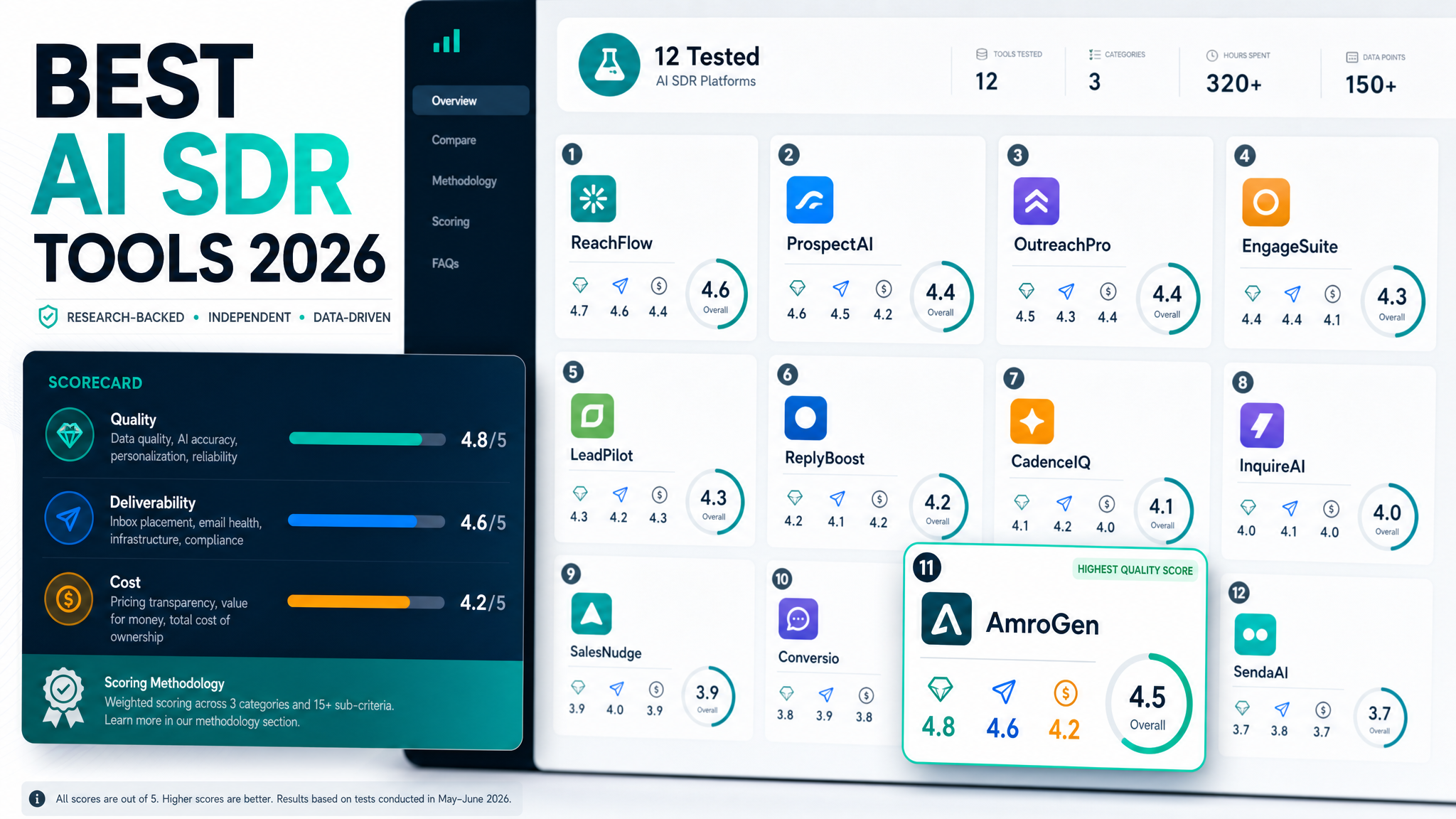
We scored 12 AI SDR platforms on the four things that actually predict whether a tool will still be running in 90 days: personalisation depth, whether anything reviews the output before it ships, deliverability infrastructure, and real cost per meeting booked and held. Reply rates swing from 3.43% for generic outreach to roughly 18% for signal-specific personalised campaigns — a five-times gap that is the entire value proposition of this category. Entry pricing ranges from $25 a month to $900+. And almost nobody in this comparison publishes what happens to an AI draft before a real person sees it, which is the gap that explains most of this category's 50–70% annual churn.
Table of Contents
- What We Scored These On
- Quick Comparison Table
- The 12 Tools
- Pricing Side by Side
- How to Pick the Right One
- Buying Mistakes Worth Avoiding
- FAQ
What We Scored These On
Feature counts don't tell you much about whether a tool will actually work for your team. We scored each platform against four things that the best independent research on this category consistently flags as the actual outcome drivers.
First, personalisation depth — does the tool pull real, current signals like job changes, funding rounds, and hiring activity, or does it drop a company name and title into a template? Second, whether there's a quality check on the draft before anything sends — this is rarer than it should be. Third, sending infrastructure and deliverability — does it protect your domain reputation or put it at risk? Fourth, real cost per meeting held, not just list price, once you factor in the 3.43% reply rates and typical show rates most teams actually see.
This framework draws on evaluation criteria from research covering the category this year, cross-referenced against hands-on testing from teams that have run actual campaigns through these platforms.
Quick Comparison Table
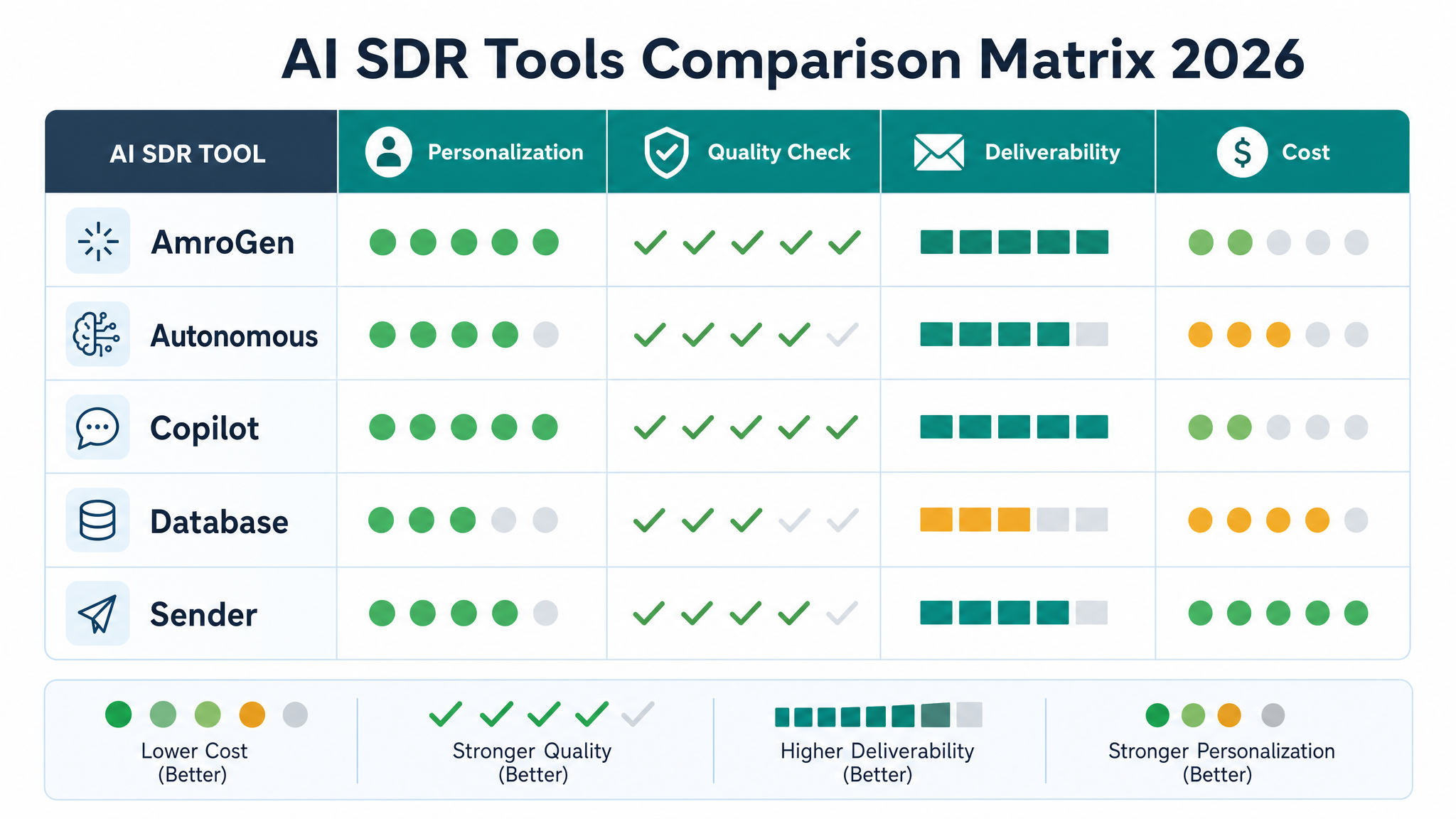
| Tool | Category | Channels | Entry Pricing | Quality Check Before Send | Best For |
|---|---|---|---|---|---|
| AmroGen | Hybrid-autonomous pipeline | Email, LinkedIn, SMS | From $29/mo (~$2.80/run) | Yes — automatic scoring + auto-retry | No lead list yet; want research, copy, and review in one place |
| Artisan (Ava) | Fully autonomous | Email, LinkedIn | $250/mo | Not published | SMB/mid-market wanting fast deployment |
| 11x.ai (Alice + Julian) | Fully autonomous | Email, voice/phone | Enterprise, unpublished | Not published | Enterprise needing email + phone agents |
| AiSDR | Fully autonomous | Email, LinkedIn, SMS, phone | $900/mo | Not published | Growth-stage teams wanting transparent, no-lock-in pricing |
| Saleshandy | Copilot | Email, calls, LinkedIn (manual) | $25/mo | Human review by default | Budget-conscious teams; AI-assisted drafting |
| Salesforge (Agent Frank) | Fully autonomous, email-only | Email only | $599/mo quarterly | Not published | Teams prioritising deliverability above channel breadth |
| Clay | Intelligence layer | None native | $185/mo | N/A — enrichment only | RevOps teams building custom enrichment workflows |
| Apollo.io | Database + copilot | Email, LinkedIn, calls | $49/user/mo | Human review | Large contact database with sequencing built in |
| Coldreach | Research-first autonomous | Email, LinkedIn | $899/mo | Signal-qualification gate | Want accounts qualified before any copy is written |
| Lyzr (Jazon) | Configurable enterprise agent | Email, custom | $0–$1,999/mo | Configurable | Regulated industries needing on-prem deployment |
| Instantly.ai | Sending infrastructure + AI agents | Email primarily | $37/mo | Not a writing tool | Already have a list; need deliverability at volume |
| ZoomInfo Copilot | Intelligence + prioritisation | None native | Enterprise | N/A | Already on ZoomInfo's data foundation |
The 12 Tools
AmroGen — best for teams starting without a lead list
The pipeline starts from a single URL. A Lead Generator agent browses the target company's website directly rather than querying a stored database, an Orchestrator maps out the outreach strategy, specialist agents write email, LinkedIn, and SMS sequences, and — the step most platforms skip — the Orchestrator scores every sequence for personalisation depth, factual accuracy, and format before it reaches you for approval. Drafts that don't clear the bar get revised automatically. Sequences send from your own Gmail account, not a new cold domain, so there's no warm-up period and your existing sender reputation carries the campaign from day one.
From $29/month, or about $2.80 per pipeline run on pay-as-you-go. → How the sequences and review step work
Artisan (Ava) — best autonomous agent for SMB/mid-market
Artisan markets Ava as a digital BDR rather than a software feature. She sources from a 300M+ contact database across 200+ countries, enriches each record with firmographic, technographic, and buying-signal data, and drafts outreach using what Artisan calls a personalisation waterfall — layering multiple data points from social media, company sites, and intent signals. Email and LinkedIn are handled in the same workflow. Hands-on testing noted personalisation quality that's noticeably better than basic AI cold email writers in the 2026 iteration.
From $250/month (Artisan Intern tier).
11x.ai (Alice + Julian) — best for enterprise with a phone requirement
11x runs a dual-agent model: Alice handles autonomous outbound prospecting and email/LinkedIn messaging, Julian manages inbound phone qualification and meeting scheduling. One named customer, Checkr, reported a 1.5x increase in qualified meetings after adoption. Enterprise pricing, not published — expect a sales cycle before you see a number.
AiSDR — best for growth-stage teams that hate lock-in
Coordinates email, LinkedIn, and SMS from one interface with a phone dialer via Aircall integration. The main differentiator isn't capability — it's pricing transparency. Quarterly billing, cancel anytime, roughly 20% discount on annual commitment. In a category where most enterprise tools bury pricing behind a demo request, the clear terms are a meaningful differentiator for teams that don't want to negotiate.
$900/month for 1,200 messages, billed quarterly.
Saleshandy — best budget option for teams writing their own copy
Built as a complete outbound workflow under one login: an 830M+ contact database with 75+ filters, an AI Sequence Copilot that generates multi-step sequences from a prompt, built-in email warm-up, and a CRM. Time from signup to a live outreach sequence in hands-on testing was around 10 minutes. The trade-off relative to autonomous tools is that a human still reviews and can edit before anything sends — which is a feature, not a bug, if you want that control.
From $25/month — the lowest entry price in this comparison.
Salesforge (Agent Frank) — best deliverability infrastructure
Built its reputation on email deliverability tooling (Mailforge, Infraforge, Warmforge) before adding Agent Frank as the AI layer on top. Best-in-class domain rotation, warmup, and multi-IP provisioning. The explicit trade-off is narrower channel coverage — email only — in exchange for sending infrastructure that most platforms in this list don't match.
Agent Frank from $599/month, billed quarterly.
Clay — best data layer for RevOps-heavy teams
Clay isn't an AI SDR in the sending sense. It aggregates 75+ data providers into a spreadsheet-style workspace, runs conditional enrichment logic, and pushes results to whichever sequencing tool you connect downstream. The honest description from independent analysis is that it has no native sending, a real learning curve, and credit-based pricing that adds up quickly. If you have a RevOps function and want the cleanest possible data feeding your outreach, it's the category leader. If you don't have someone to build and maintain the workflows, it's the wrong tool.
From $185/month (Launch), $495/month (Growth).
Apollo.io — best for database + sequencing without multiple tools
Combines a 275M+ verified contact database with built-in email sequencing, a dialer, and basic CRM functionality. Its appeal for smaller teams is consolidation — database, outreach, and AI-assisted sequencing under one roof without a separate subscription for each layer. Also has a free tier, which matters for teams testing the category before committing budget.
From $49/user/month; free tier available.
Coldreach — best for research-driven outbound
Explicitly research-first: monitors 113M+ accounts and 550M+ contacts for buying signals — job postings, funding news, tech stack changes — before generating any outreach. The qualification gate is what makes it different: the platform answers whether an account shows pain, what their current status quo looks like, and whether the timing is right before a single draft is written. That catches a different failure mode than a quality-review layer does — it stops bad targeting rather than bad copy.
From $899/month, with white-glove onboarding included.
Lyzr (Jazon) — best for regulated industries
An enterprise agent platform covering banking, insurance, HR, and procurement, with Jazon as the SDR-specific agent blueprint. The fundamental positioning here is different from everything else on this list — Lyzr sells customisable AI infrastructure rather than a plug-and-play product, which is exactly right for technical teams in regulated industries who need on-prem deployment and custom compliance controls.
$0/month open-source, $1,999/month Enterprise, with a free 3-month pilot for qualified customers.
Instantly.ai — best for high-volume email sending
Sending infrastructure first and foremost: unlimited sending accounts, a 4.2M+ account private warmup network, automated inbox placement testing, and three AI agents added on top for sourcing and reply handling. Instantly's own 2026 benchmark reports a 3.43% overall average reply rate across customer campaigns — a useful industry baseline figure regardless of which tool you use. The honest description is that this is a cold email tool, not a research or writing tool, and it works best when a list and copy arrive from somewhere else.
From $37/month.
ZoomInfo Copilot — best add-on for existing ZoomInfo customers
Layers AI-powered prioritisation on top of ZoomInfo's existing data and intelligence foundation rather than functioning as a standalone SDR. Most relevant for enterprise teams already running on ZoomInfo who want AI workflow recommendations layered on top without platform-switching. Enterprise pricing, unpublished.
Pricing Side by Side
| Tier | Tools | Monthly Cost |
|---|---|---|
| Budget | AmroGen, Saleshandy, Instantly | $25–$49 |
| Mid-market | Artisan, Apollo.io, Clay (Launch) | $185–$250 |
| Premium autonomous | Salesforge, Clay (Growth) | $495–$599 |
| High-volume autonomous | Coldreach, AiSDR | $899–$900 |
| Enterprise / unpublished | 11x.ai, ZoomInfo Copilot, Lyzr Enterprise | Custom |
For context: a fully loaded human SDR typically costs over $100,000 a year once salary, OTE, recruiting, and ramp time are counted — meaning even the most expensive platform here costs less per year than three months of one SDR's salary.
How to Pick the Right One
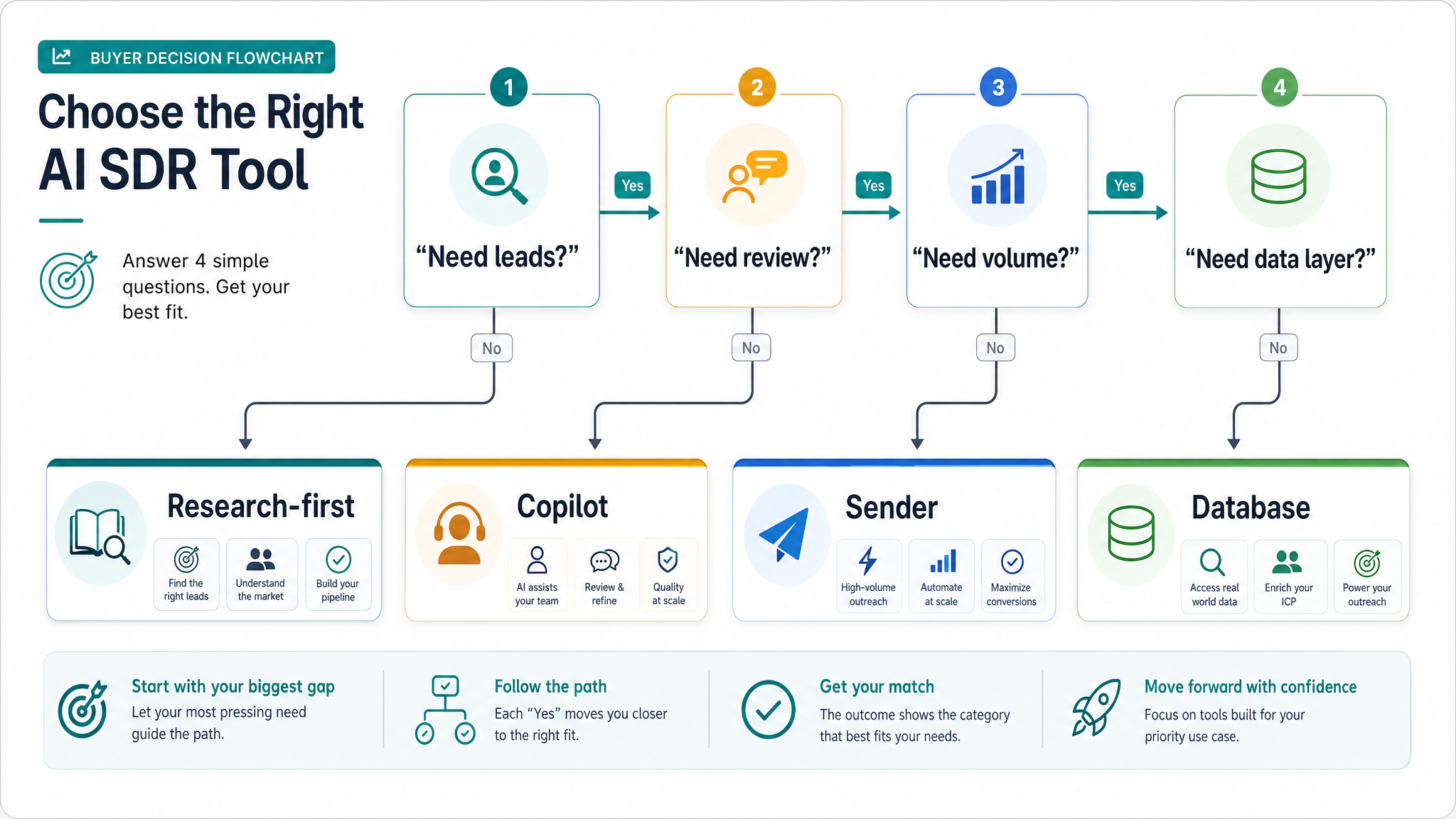
No lead list, want research + copy + quality review all in one: AmroGen.
Large database with sequencing built in, willing to write your own copy: Apollo.io.
RevOps function and want full control over enrichment logic: Clay, paired with a separate sender.
Deliverability is the top concern, email is your only channel: Salesforge or Instantly.
Want accounts qualified before anything gets drafted: Coldreach.
Enterprise, need both outbound email/social and inbound voice handling: 11x.ai.
Regulated industry, need custom on-prem deployment: Lyzr.
Buying Mistakes Worth Avoiding
These five mistakes show up in the post-mortems of failed AI SDR pilots more than any others.
Comparing across categories. A fully autonomous agent and a data enrichment layer are not the same type of product. Comparing them side by side produces a meaningless result.
Buying on the demo. Ask for three live-drafted emails for a real prospect from your own CRM before signing. Most scripted demos look better than production.
Skipping deliverability due diligence. If a vendor can't clearly explain their bounce-prevention mechanism, that's a flag.
Buying autonomy when signal quality is the real bottleneck. The agent isn't usually what's failing — the data it's working from is.
Measuring a pilot on meetings booked instead of meetings held. No-show rates can make a weak tool look strong for the first month.
FAQ
Which AI SDR tool is most affordable? Saleshandy and AmroGen sit at the lowest entry points — $25–$29/month — against $250–$900+ for established autonomous platforms like Artisan, Coldreach, and AiSDR.
Best option for a small B2B team? Tools that don't require a pre-existing lead list or heavy technical setup tend to work best for small teams, since they remove the dependency on a separate data subscription or a RevOps person to maintain workflows.
Is Artisan AI worth it? Personalisation quality has improved substantially in the 2026 iteration by most independent accounts. The main reservation reviewers flag is pricing accessibility relative to entry-level alternatives, particularly for smaller teams.
How does AI compare to hiring a human SDR? A fully loaded human SDR costs $100,000+ annually. These platforms run $300–$11,000+ per year. The trade-off is judgment — AI wins on volume and consistency, humans still outperform on complex objection handling and relationship-building.
What makes a good AI SDR tool in 2026? Signal-driven personalisation rather than merge tags, a quality check before anything sends, and sending infrastructure that protects rather than risks your domain reputation.
Which has the best email deliverability? Salesforge (built on its Mailforge/Warmforge infrastructure) and Instantly lead on dedicated deliverability tooling. AmroGen takes a different approach — sending from your existing Gmail account rather than a new cold domain, so your established sender reputation carries the campaign.
What's the average reply rate? 3.43% for generic, optimised cold email campaigns, rising to roughly 18% for signal-specific, deeply personalised outreach.
Reflects publicly available pricing and feature data as of June 2026. Confirm current pricing directly with vendors before purchasing — this market moves fast.