B2B Sales Outreach Platform Comparison 2026: What the Market Misses
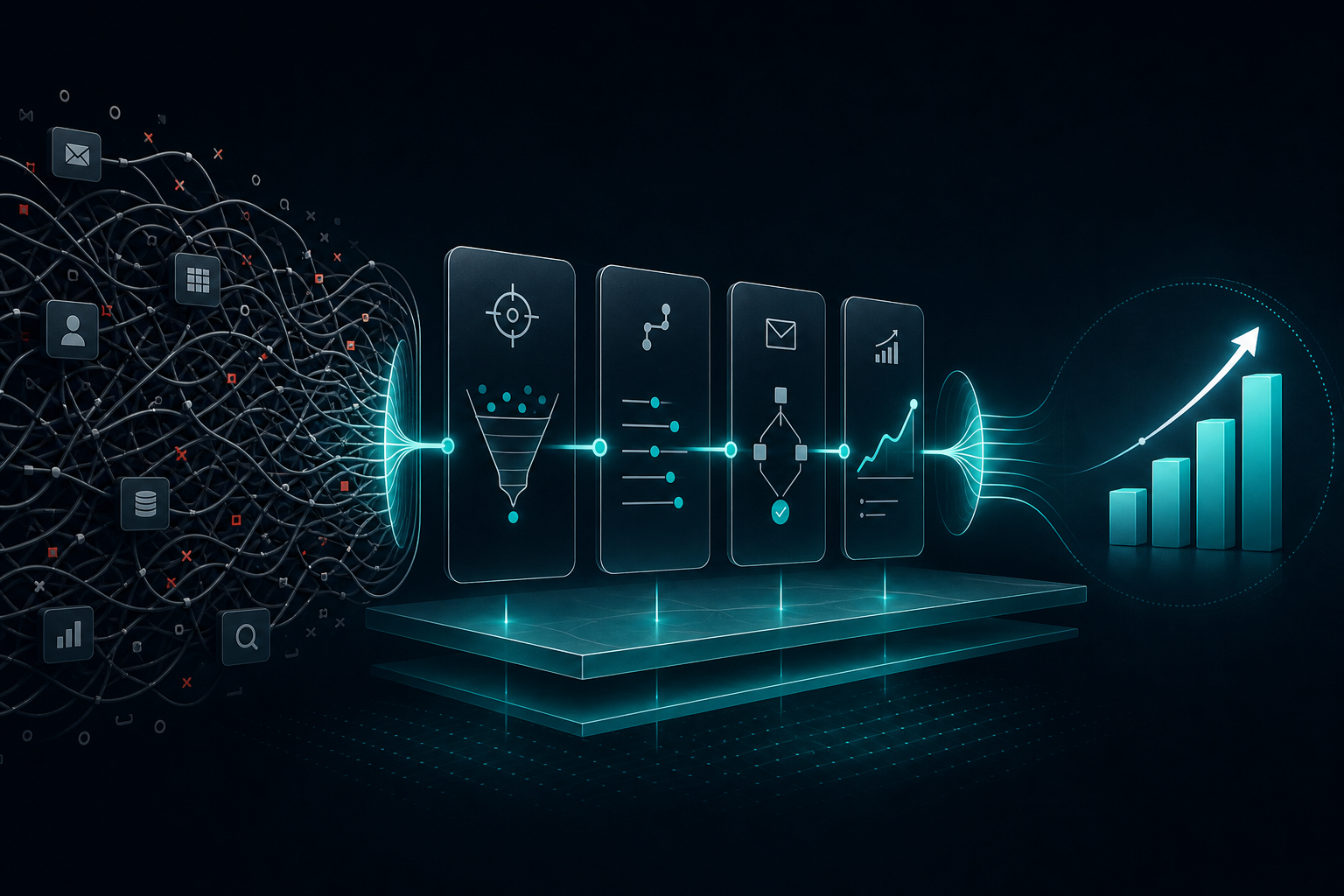
The landscape of B2B outbound sales has fractured. If you are a Head of Sales, a Revenue Operations Lead, or a founder trying to build a pipeline in 2026, you are likely staring at a martech stack that feels more like a patchwork quilt than a unified system.
You have a tool for finding data. You have a tool for verifying emails. You have a tool for sending emails. You have a tool for warming up domains. And somewhere in the middle, you are relying on generic AI wrappers or expensive human Sales Development Representatives (SDRs) to write the actual copy.
The core problem in the market today is that the definition of a "B2B sales outreach platform" has been stretched to the breaking point. Enterprise software giants claim to do it all, yet require months of implementation and dedicated administrators. Point solutions solve one fraction of the pipeline but leave you to stitch the rest together.
This comprehensive guide breaks down the 2026 B2B sales outreach platform ecosystem. We will examine the four distinct categories of tools on the market, analyze where legacy enterprise platforms fall short for small-to-medium teams, and explain why the future of outbound relies on multi-agent AI architectures rather than mail-merge templates.
SERP Analysis & Market Insight: Why the Top Search Results Are Misleading
If you search for "B2B sales outreach platform" on Google today, you will notice a distinct pattern in the Search Engine Results Pages (SERP).
Search Intent and Competitor Patterns
The top 10 results are heavily dominated by enterprise behemoths: Outreach, Salesloft, ZoomInfo, and Apollo. The SERP is populated by high domain authority (DR 85+) sites, industry analyst reports from Gartner's Sales Engagement Market Guide, and aggregator lists from G2's Grid for Sales Engagement.
The search intent is highly commercial. Buyers searching this term are looking for software to buy, but the results they are served assume they are buying for a 500-person enterprise sales floor. The content on these ranking pages focuses heavily on CRM synchronization, rep activity tracking, compliance, and enterprise-grade forecasting.
The Differentiation Opportunity
What the current SERP misses entirely is the small-to-medium business (SMB), startup, and lean sales team segment. A solo founder, a lean agency, or a 3-person sales team does not need a platform designed to monitor rep activity. They need a platform that does the activity for them.
There is a massive gap in the market positioning. Enterprise tools solve for management and visibility. Lean teams need a solution for execution and pipeline generation.
This is where AI-native tools like AmroGen differentiate themselves. Instead of offering a blank canvas that requires you to bring your own data, write your own templates, and manage your own deliverability, the new wave of full-pipeline platforms handles the entire process from URL to ready-to-send sequences. By targeting the "small B2B teams" angle explicitly, we can bypass the enterprise noise and speak directly to the buyers who are frustrated by the heavy, expensive, and manual nature of legacy platforms.
What is a B2B Sales Outreach Platform?
Snippet Target:
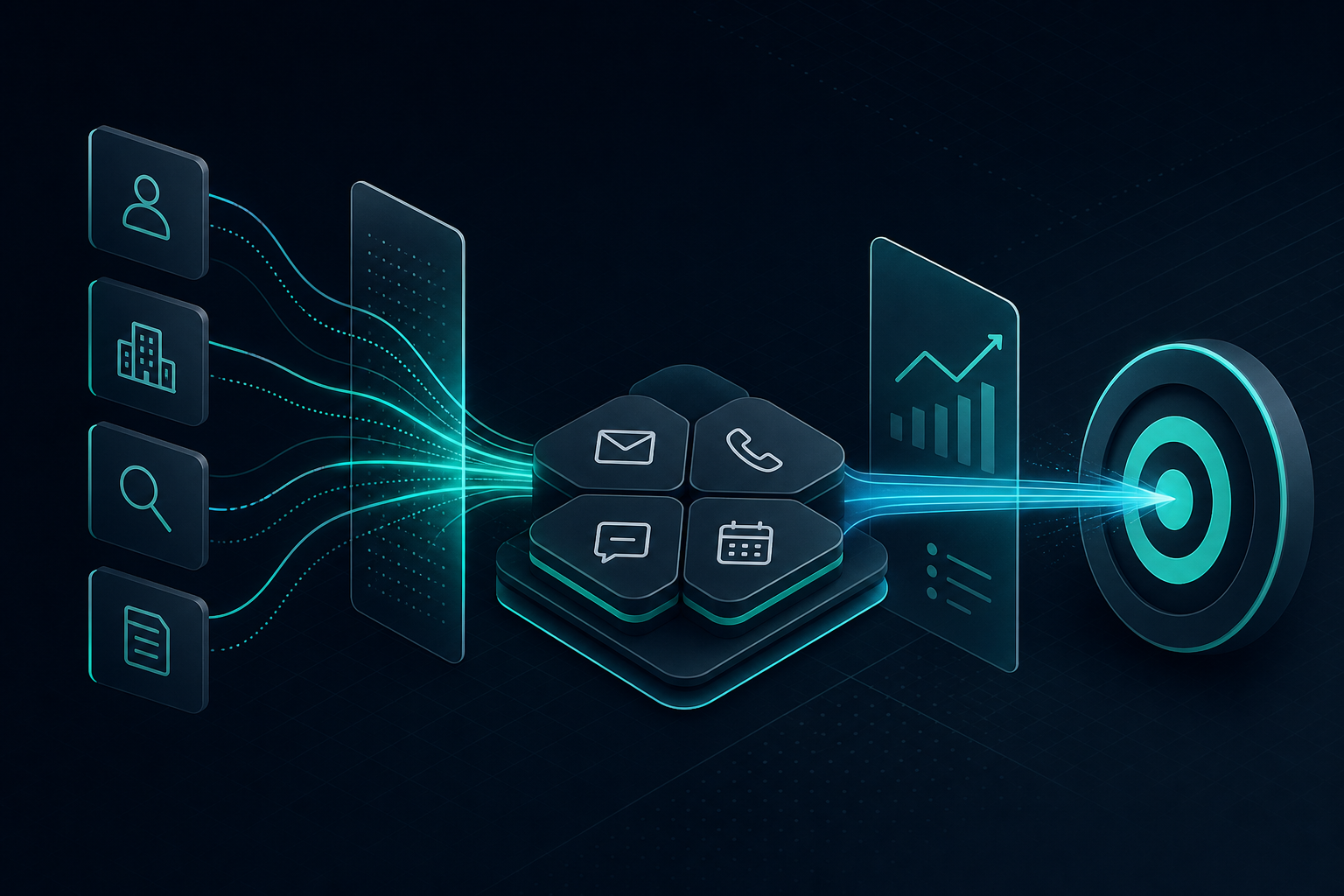
A B2B sales outreach platform is a software solution designed to help sales teams identify, contact, and follow up with potential buyers at scale. While legacy platforms focus on organizing manual tasks and sending templated emails via mail-merge, modern AI-native platforms manage the entire pipeline—discovering researched decision-maker leads, researching account context, and generating hyper-personalized, 5-step email sequences with LinkedIn and SMS copy (email sends live; LinkedIn is manual follow-up).
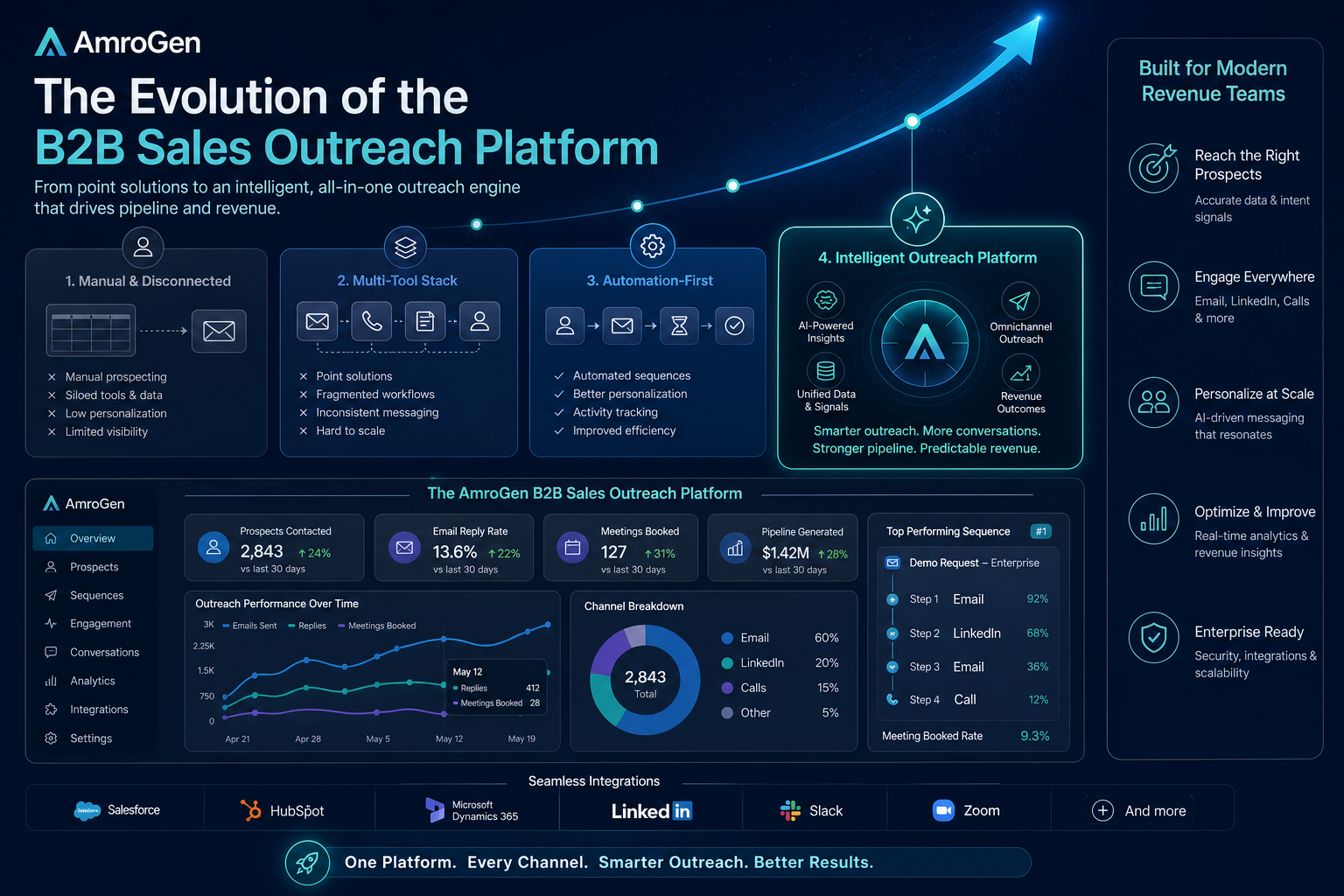
The Evolution of Outreach (2015–2026)
To understand where we are, we must understand how the technology has evolved.
Generation 1: The Mail Merge Era (2015-2018) Early platforms were simply bulk email senders attached to a CRM. You uploaded a CSV of contacts, wrote a template with {{first_name}} and {{company_name}} tags, and hit send. Deliverability was easy, and buyers were less fatigued.
Generation 2: Sales Engagement Platforms (2018-2022) As buyers started ignoring generic emails, platforms like Outreach and Salesloft introduced multi-channel sequencing. They allowed reps to combine phone calls, LinkedIn connections, and emails into a structured cadence. However, the copy was still largely templated, and reps spent 80% of their time researching accounts to manually personalize the first 20% of an email.
Generation 3: The Data & Sending Split (2022-2024) With the rise of strict spam filters and Google/Yahoo's sender requirements, the market split. Deliverability became a massive issue. Companies started using specialized data tools (like Apollo and ZoomInfo) to find leads, and specialized sending tools (like Instantly and Smartlead) to manage dozens of inbox infrastructures. Writing the copy was outsourced to offshore agencies or early, generic ChatGPT prompts.
Generation 4: Multi-Agent AI Pipelines (2025-Present) Today, the standard has shifted. Buyers demand extreme personalization, referencing their specific role, recent company news, and industry context. Because human SDRs cannot manually research and write 50 personalized emails a day cost-effectively, the market has moved toward AI multi-agent systems. Platforms like AmroGen use distinct AI agents working in a coordinated pipeline to research, write, review, and send—collapsing the multi-tool stack into a single interface.
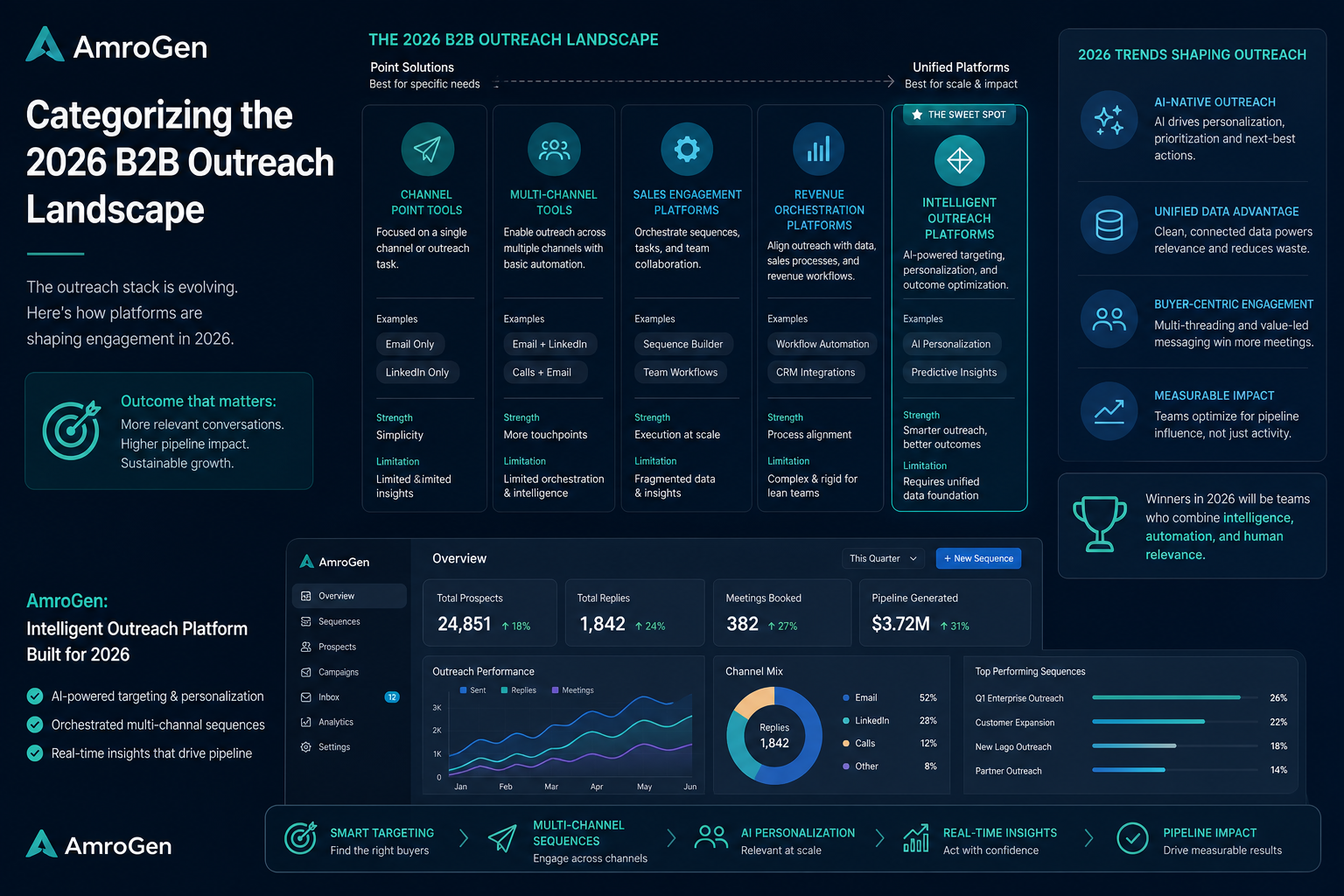
The 4 Categories of B2B Sales Outreach Platforms in 2026
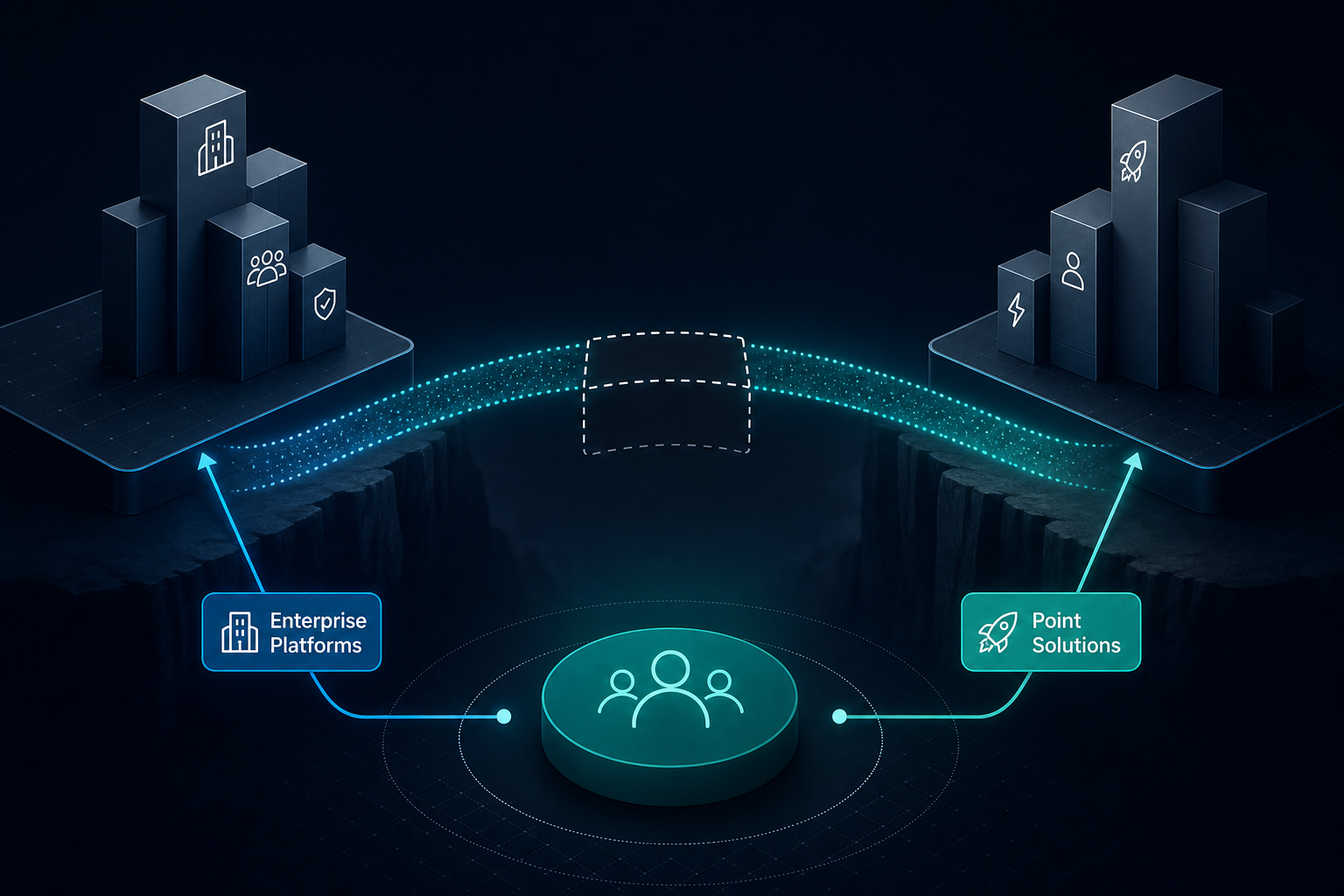
The market is no longer a monolith. If you are evaluating a B2B sales outreach platform, you must first understand which category of tool you are actually looking at. Most buyers make the mistake of buying a tool from Category 1, expecting it to do the job of Category 4.
Category 1: Data & Enrichment Platforms
These platforms focus primarily on database size, contact accuracy, and data enrichment. They are essentially massive search engines for B2B contacts.
Key Players: Apollo.io, ZoomInfo, Clay, Clearbit (now HubSpot).
How they work: You log in, use filters (industry, headcount, revenue, job title), and the platform generates a list of contacts.
- Apollo.io: Offers an incredible all-in-one database. For a low monthly fee, you get access to millions of contacts. However, while Apollo has added sequencing features, its personalization engine is fundamentally template-based. It relies on standard merge tags, resulting in generic copy that often yields reply rates hovering around 1.2%. If you are looking for an Apollo alternative that actually writes the copy for you, you need to look outside this category.
- ZoomInfo: The enterprise standard for data. Highly accurate, but comes with massive annual contracts. It is a data provider, not an outreach writer.
- Clay: The darling of Revenue Operations in recent years. Clay is incredibly powerful for "waterfall enrichment"—pinging multiple data providers to find a single email. However, Clay is exceptionally complex to set up. It requires a dedicated RevOps professional to manage the workflows, and crucially, it does not send the emails. You still have to connect it to a sending platform.
Who they are for: Teams with dedicated SDRs and RevOps managers who want to build complex, custom data workflows and are willing to write their own outreach templates.
Category 2: Sending & Deliverability Tools
These platforms were born out of necessity when Google and Microsoft cracked down on cold email deliverability. They do not provide data; they just send emails efficiently.
Key Players: Instantly, Smartlead, Lemlist.
How they work: You connect multiple secondary domains and inboxes (e.g., instead of yourcompany.com, you buy tryyourcompany.com, getyourcompany.com). The tools "warm up" these inboxes by sending fake emails back and forth to build sender reputation. You then upload a CSV of leads you got from Category 1, load up a template, and the tool distributes the sending volume across your inboxes to avoid spam filters.
The downside: They solve the infrastructure problem but do nothing for the messaging problem. Personalization in these tools is limited to whatever columns you have in your CSV. If you want hyper-personalized emails, you have to write them before uploading them. Furthermore, managing 20+ secondary domains is a technical headache that most founders and sales leaders despise.
Who they are for: High-volume, "spray and pray" cold email agencies that rely on volume rather than account-level personalization.
Category 3: Enterprise Sales Engagement Platforms (SEPs)
These are the legacy giants. They were built to manage massive sales floors and ensure reps follow a standardized process.
Key Players: Outreach.io, Salesloft.
How they work: These platforms integrate deeply with Salesforce or HubSpot. They provide a "pane of glass" for AEs and SDRs to live in all day. They track every call, email, and LinkedIn message, providing management with granular analytics on rep performance.
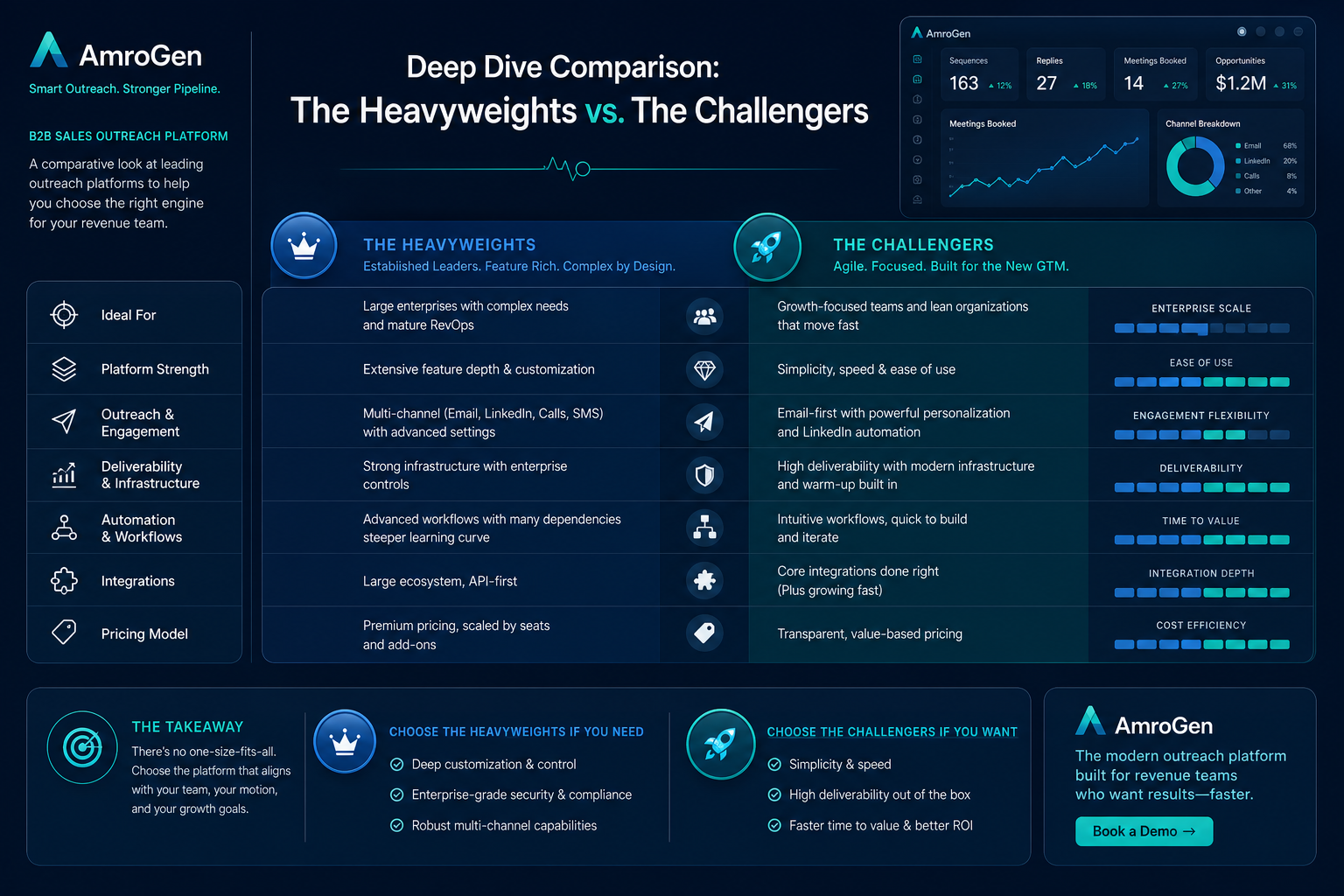
The downside: They are incredibly heavy. Implementing Outreach or Salesloft often takes months and requires a dedicated Salesforce administrator. More importantly, they are enablement tools, not execution tools. They organize the work, but the human rep still has to do the heavy lifting of researching the account and writing the email. Because they charge per seat (often $1,200+ per user per year), they are prohibitively expensive for lean teams.
Who they are for: Series C+ companies and enterprises with large, established SDR teams, long sales cycles (12+ months), and complex multi-stakeholder deals.
Category 4: Full-Pipeline AI SDR Platforms
This is the newest category, built specifically to solve the fragmentation of the previous three. Instead of requiring you to buy data from Apollo, enrich it in Clay, write it in ChatGPT, and send it via Instantly, these platforms handle the entire pipeline.
Key Players: AmroGen, Artisan.
How they work: These tools require minimal input—often just a target company's website URL. The platform's AI agents automatically scrape the target website, identify the ideal decision-makers, verify their contact details, research their specific context, and generate highly personalized outreach sequences across multiple channels.
AmroGen's Approach: AmroGen represents the cutting edge of this category through its 6-agent AI architecture. When you input a URL, it doesn't just pass a prompt to a generic LLM. The Orchestrator agent acts like a senior sales manager. It directs specialist agents to find the leads and write the copy. Crucially, AmroGen features a built-in quality review loop. The Orchestrator scores every piece of generated outreach on a scale of 1 to 10 for personalization depth. If a sequence scores below a 7, the Orchestrator automatically sends it back for revision—up to three times—before the user ever sees it.
Furthermore, AmroGen sends via Resend (preferred when connected) or Gmail OAuth. Because the volume is low and the personalization is exceptionally high, there is no need for complex domain warm-ups or secondary infrastructure.
Who they are for: B2B SaaS companies, agencies, solo founders, and lean sales teams (1-5 reps) who want to generate pipeline without hiring more SDRs or stitching together five different software tools.
Deep Dive: Outreach.io vs. Salesloft (And Why Small Teams Should Avoid Both)
One of the most common questions in the B2B sales space—and a frequent "People Also Ask" query on Google—is: What is the difference between Outreach.io and Salesloft?
If you are an enterprise buyer, the nuances matter. According to the Forrester Wave for B2B Revenue Engagement Platforms, both platforms are leaders, but they have slightly different philosophies:
- Outreach.io historically focused heavily on the SDR persona and outbound prospecting. It is known for its rigorous sequence structuring, highly customizable rulesets, and deep integration with complex Salesforce instances. It is highly analytical and built for volume.
- Salesloft historically focused slightly more on the Account Executive (AE) persona and the full revenue lifecycle. Their interface is often considered slightly more intuitive, and their Cadence features are built to balance outbound prospecting with active deal management and customer success.
The Reality for SMBs: For a startup, an agency, or a small sales team, the difference between Outreach and Salesloft is irrelevant. Both represent the wrong approach for lean teams in 2026.
Both platforms suffer from the same fundamental flaws for SMBs:
- High Total Cost of Ownership (TCO): You pay a high per-seat license fee, plus mandatory implementation fees, plus the cost of the data provider (ZoomInfo/Apollo) you must plug into them.
- The "Empty Shell" Problem: When you log into Outreach for the first time, it is empty. You have to build the sequences. You have to write the templates. You have to source the leads.
- Manual Effort: Even with recent AI features bolted on, reps still spend 3–4 hours a day researching accounts and tweaking templates to avoid sounding like a robot.
If your primary job to be done is "Help me build a pipeline of qualified leads for a new market without hiring more SDRs," neither Outreach nor Salesloft solves your problem. They just give your non-existent SDRs a place to work.
The "Franken-Stack" Problem: The Hidden Cost of Stitching Tools
Because enterprise SEPs are too expensive, many growth marketers, founders, and lean revenue operations teams attempt to build their own B2B sales outreach platform using point solutions.
This typically looks like:
- Apollo.io to export lists of leads ($99/mo).
- Clay to enrich those leads, find missing emails, and scrape company news ($149/mo).
- ChatGPT Plus or a custom Make.com workflow to write personalized first lines based on Clay's data ($20/mo + API costs).
- Instantly or Smartlead to send the emails across 10 different burner domains ($97/mo).
- Google Workspace accounts for the 10 burner domains ($60/mo).
The Financial Cost: ~$425 per month. The Time Cost: 15-20 hours of setup, plus 5-10 hours a week managing API breaks, deliverability drops, and CSV uploads between tools.
This "Franken-stack" is a massive drain on resources. It creates data silos where your sending tool doesn't know what your data tool is doing, leading to attribution nightmares. More importantly, it requires a highly technical operator to maintain. If a solo founder or an AE tries to run this stack, they end up spending 80% of their time playing IT administrator and 20% of their time actually talking to prospects.
Technical Deep Dive: How AI Multi-Agent Architectures Change Outreach
To understand why platforms like AmroGen are replacing the Franken-stack, we have to look under the hood at how AI is being utilized in 2026.
Most legacy platforms that claim to have "AI features" are simply using LLM wrappers. They take a standard template, pass a prompt to a model like GPT-4 ("Rewrite this email to sound more professional"), and output the result. This is single-turn, unverified AI generation. It results in emails that sound robotic, use generic phrases like "I hope this email finds you well," and hallucinate facts about the prospect's company.
The AmroGen Multi-Agent Approach AmroGen is built differently. It utilizes 6 purpose-built Anthropic Managed Agents running in a coordinated pipeline. This is not a single prompt; it is a simulated sales floor.
- The Research Agent: Takes the target URL, navigates the site, reads the "About Us" page, recent blog posts, and technical documentation to understand exactly what the company does.
- The Discovery Agent: Identifies the buying committee. If you sell HR software, it specifically looks for the VP of HR, Chief People Officer, or Talent Acquisition Leads.
- The Enrichment Agent: Cross-references the discovered identities with verified contact databases to secure accurate email addresses and LinkedIn profiles, assigning an ICP (Ideal Customer Profile) Fit Score (High/Medium/Low).
- The Copywriting Agent: Drafts the multi-channel sequence (Email, LinkedIn, SMS). It uses the deep context gathered by the Research Agent to craft AI sequences that genuinely reference the prospect's specific situation.
- The Orchestrator (The Manager): This is the critical differentiator. The Orchestrator reviews the Copywriting Agent's output. It scores the personalization depth on a scale of 1 to 10. Does this sound like a template? Does it reference a specific pain point? Is the tone conversational? If the score is below a 7, the Orchestrator rejects the draft and forces the Copywriting Agent to rewrite it (up to 3 retries).
- The Dispatch Agent: Prepares the approved, high-scoring sequences for user review and eventual sending via the user's connected Gmail account.
Because of this quality review loop, bad AI output never reaches the user. The copy sounds like a thoughtful human wrote it for that specific person. The pipeline runs from company URL through lead discovery, sequence generation, orchestrator quality scoring (7+ to proceed), and two human review gates before sending.
The Role of MCP (Model Context Protocol) in Sales Outbound
One of the most significant shifts in 2026 is the integration of AI tools into broader workflows. Existing sales tools have no AI-agent-friendly interface. They have standard REST APIs, which are rigid and require complex coding to utilize.
AmroGen is the only outreach platform built with a native MCP (Model Context Protocol) server. Introduced by Anthropic, MCP allows AI models to securely interact with external tools and data sources.
Because AmroGen has an MCP server built-in, AI-native builders and power users can plug AmroGen directly into their AI workflows. You can open Claude Desktop, connect the AmroGen MCP, and simply type: "Find me 10 target accounts similar to Competitor X, and run AmroGen campaigns for all of them." Claude can autonomously call the AmroGen tool, execute the pipeline, and return the results. This transforms AmroGen from a standalone web app into an embeddable AI capability for your entire go-to-market motion.
Deliverability in 2026: Why the Rules Changed
Any discussion of a B2B sales outreach platform must address deliverability.
In early 2024, Google and Yahoo implemented strict new sender requirements, enforcing SPF, DKIM, and DMARC authentication, and heavily penalizing domains with spam complaint rates over 0.3%.
This caused panic in the outbound sales world. The reaction from Category 2 (Sending Tools) was to tell users to buy 20 different domains, set up 40 different Google Workspace inboxes, and spread the volume out.
The Volume vs. Quality Paradigm Shift The "burner domain" strategy is a band-aid for bad messaging. If you have to send 5,000 emails a week to get 5 meetings, your messaging is generic, your targeting is poor, and your emails are being marked as spam.
AmroGen takes the opposite approach. By prioritizing extreme, multi-agent personalization, reply rates shift from the industry average of 1-3% up to 8-15%.
Because you are getting higher conversions on lower volume, AmroGen sends via Resend (preferred when connected) or Gmail OAuth.
- No separate cold sending domains.
- No artificial "warm-up" periods.
- No complex DNS records to manage across 20 inboxes.
You review and approve every sequence before a single email goes out. Because the emails are highly personalized, relevant, and sent in low volumes from an established, aged inbox, they land in the Primary tab, not the Spam folder.
Cost Comparison: Per-Seat vs. Per-Run Pricing
When evaluating B2B sales outreach platforms, the pricing models dictate how you scale. Let's break down the true cost of outbound pipeline generation.
Scenario A: The Human SDR + Enterprise Stack
If you hire a human SDR and equip them with legacy tools, the costs are substantial.
- SDR Fully Loaded Cost: $80,000 – $100,000 / year
- Apollo/ZoomInfo License: $1,200 – $5,000 / year
- Outreach/Salesloft License: $1,200 – $1,500 / year
- Output: An SDR can manually research and write genuinely personalized emails for roughly 40-50 leads per day.
- Total Cost: ~$85,000+ per year for ~1,000 personalized leads per month.
Scenario B: The Franken-Stack
As outlined earlier, stitching together Apollo, Clay, ChatGPT, and Instantly.
- Software Costs: ~$5,000 / year
- Management Time: 20 hours/month of a founder's or RevOps leader's time (valued at $100/hr = $24,000/year).
- Output: Highly variable. Often breaks.
- Total Cost: ~$29,000 / year.
Scenario C: AmroGen (Credits-Based Pipeline)
AmroGen shifts the business model from paying for seats to paying for pipeline. Credits are consumed per pipeline run (a campaign run from URL input to ready-to-send sequences). 1 pipeline run of ~10 leads costs 8 credits.
- Starter Plan: $29/month — 100 credits (~12 pipeline runs / 120 leads). Perfect for testing outbound.
- Growth Plan: $99/month — 500 credits (~62 pipeline runs / 620 leads).
- Scale Plan: $299/month — 2,000 credits (~250 pipeline runs / 2,500 leads).
- Pay-as-you-go: $0.35/credit.
At the Pay-as-you-go rate, generating a fully researched, hyper-personalized multi-channel sequence for a target account (10 decision-makers) costs approximately $2.80.
You are paying $2.80 for the exact same output that would take a human SDR two hours to research and write. You get the quality of a human SDR without the $85,000 headcount, and you get the software without the heavy annual contracts. Check out our full pricing details to see how it scales.
Decision Framework for 2026: How to Choose Your Platform
With so many options, how do you choose the right B2B sales outreach platform? Use this framework based on your company's profile.
1. The Enterprise GTM Team
- Profile: Series D or Public, 50+ SDRs, 100+ AEs, complex Salesforce architecture, 12-18 month sales cycles selling to Fortune 500 CIOs.
- Your Need: Governance, compliance, activity tracking, deep CRM sync.
- The Recommendation: Outreach or Salesloft, paired with ZoomInfo. You have the budget for the software and the headcount to do the manual research required for 7-figure deals.
2. The High-Volume Lead Gen Agency
- Profile: Selling meeting-booking services to local businesses or low-ACV SaaS. Relying on massive volume (10,000+ emails a week).
- Your Need: Inbox rotation, spintax, cheap data scraping, secondary domain management.
- The Recommendation: Apollo for data + Instantly or Smartlead for sending. You are playing a numbers game and personalization depth is less critical than deliverability infrastructure.
3. The RevOps "Mad Scientist"
- Profile: A highly technical growth marketer who loves building complex API workflows and Webhooks.
- Your Need: Ultimate flexibility to route data from 15 different sources before sending an email.
- The Recommendation: Clay + Make.com + Smartlead. It will take weeks to build, but it will do exactly what you want (until an API changes).
4. The Lean Team / Startup / Founder-Led Sales
- Profile: Series A-C SaaS, agencies, consultancies, or solo founders. 1-5 sales reps. No dedicated RevOps team.
- Your Need: Pipeline generation without hiring more SDRs. You need to target specific accounts, get researched contacts, and send highly personalized multi-channel sequences without spending 4 hours a day writing copy.
- The Recommendation: AmroGen.
- You don't need a lead list; just input the target company URL.
- You don't need a copywriter; the 6-agent AI writes and reviews the copy.
- You don't need complex domain setups; it sends from your Gmail.
- It acts as a complete AI SDR tool that lives entirely in one platform.
AmroGen's Internal Linking & Content Strategy Hub
Note on Content Strategy: This article serves as a comprehensive pillar page within the AmroGen content ecosystem, designed to capture high-intent, top-of-funnel search traffic for "B2B sales outreach platform."
By categorizing the market objectively, we establish trust with the reader. From this central hub, we strategically route users to our specialized product and comparison pages based on their specific pain points:
- Readers frustrated with manual template writing are directed to our deep dive on AI sequences.
- Readers looking to replace their expensive, low-reply-rate database tools are routed to our Apollo alternative comparison page.
- Readers looking for a broader understanding of the AI sales landscape are guided to our guide on AI SDR tools.
- High-intent buyers ready to evaluate costs are linked directly to our pricing page.
This hub-and-spoke model ensures that search engines recognize AmroGen as a topical authority in the B2B outbound space, while providing users with a logical journey from market education to product activation.
Overcoming Common Objections to AI Outreach
If you are a sales leader used to the old way of doing things, the idea of a platform completely automating your pipeline might trigger some anxiety. Here are the most common objections lean teams have when moving to a full-pipeline AI platform like AmroGen, and the reality of how the technology addresses them.
"The AI copy will sound robotic, generic, or off-brand." This is true for Generation 3 tools that just use basic ChatGPT wrappers. It is not true for AmroGen. Because of the built-in quality review loop, the Orchestrator agent acts as a gatekeeper. It scores every single sequence on personalization depth (1-10). If the copy uses generic phrases, fails to reference the lead's specific role, or sounds like a template, the Orchestrator forces a rewrite. You get the quality of a top-tier human copywriter, automatically.
"I'm worried about hitting spam filters and hurting my main domain reputation." This is a valid fear if you are "blasting" thousands of generic emails. AmroGen is built for targeted, account-based outreach. Emails send directly from your own Gmail account—the same one you use every day. Because the volume is managed and the personalization is incredibly high, engagement rates stay healthy. Furthermore, you review and approve every single sequence before a single email is dispatched. You are always in control.
"What if the leads aren't verified or accurate?" Data decay is a massive problem in legacy databases like ZoomInfo and Apollo, where contacts can be months out of date. AmroGen's Discovery and Enrichment agents verify contact details in real-time during the pipeline run. The system assigns an ICP Fit Score so you only spend time on leads that actually match your ideal customer profile.
"We need full CRM sync with Salesforce before we can do anything." If you have a massive, complex enterprise Salesforce instance that requires every single activity to be logged for compliance, AmroGen might not be the right fit (you are the Anti-Persona). However, if you are a lean team where the primary goal is booking the meeting, AmroGen focuses purely on top-of-funnel pipeline generation. Once the prospect replies, you manage the deal in your CRM of choice.
People Also Ask (FAQ)
To further clarify the market, here are answers to the most common questions buyers have when evaluating B2B sales outreach platforms.
What is a B2B sales outreach platform? A B2B sales outreach platform is a software tool used by sales and marketing teams to automate and manage communications with potential buyers. Traditionally, this meant organizing lead lists and sending templated emails. In 2026, modern platforms like AmroGen handle the entire process end-to-end: finding the leads, researching the company, writing highly personalized multi-channel messages, and sending them.
What is the difference between Outreach.io and Salesloft? Both are enterprise-grade Sales Engagement Platforms (SEPs). Outreach historically focused heavily on outbound SDR workflows and rigorous sequencing rules, while Salesloft leaned slightly more toward full-lifecycle revenue engagement and Account Executive workflows. Both are expensive, require heavy CRM integration, and charge per seat. Neither platform actually writes personalized copy from scratch without human intervention.
Which outreach platform is best for small B2B teams? For lean teams (1-5 reps), startups, and solo founders, AI-native full-pipeline platforms like AmroGen are the best choice. Small teams cannot afford the $80k+ cost of a human SDR or the time required to manage a "Franken-stack" of four different tools (Apollo + Clay + ChatGPT + Instantly). AmroGen allows a small team to input a target URL and get ready-to-send, reviewed outreach through the agent pipeline, effectively acting as an automated SDR.
How much does a B2B outreach platform cost? Costs vary wildly by category. Enterprise tools (Outreach/Salesloft) cost $1,200 to $1,500+ per user annually, plus the cost of a required data provider ($1k-$5k). Sending tools (Instantly) cost ~$100/month but require you to bring your own leads. Modern AI platforms like AmroGen use a consumption-based model. AmroGen subscriptions start at $29/month, or you can pay-as-you-go at $0.35 per credit, which equates to about $2.80 to generate a fully researched, personalized campaign for a target account of 10 leads.
Conclusion: The End of the Manual Pipeline
The era of the "Franken-stack" is coming to a close. The market has realized that buying a database from one vendor, an enrichment tool from another, an AI writer from a third, and a sending infrastructure from a fourth is an unsustainable way to build a business.
Enterprise platforms will continue to serve massive sales floors that prioritize management visibility over execution speed. But for the growth-stage SaaS company, the lean agency, or the founder doing founder-led sales, the definition of a B2B sales outreach platform has fundamentally changed.
You no longer need to spend three hours a day researching accounts and tweaking templates just to get a 1.2% reply rate. You no longer need to hire an SDR just to do manual data entry.
With platforms like AmroGen, you point the AI at a company URL. The agents find the decision-makers, verify the data, research the context, and write genuinely personalized sequences across email, LinkedIn, and SMS. The Orchestrator reviews the work, ensuring it meets a high standard of quality. You click approve, and the emails send from your own Gmail.
URL to reviewed pipeline. That is what the market has been missing, and that is exactly what AmroGen delivers.
Ready to stop writing templates and start booking meetings? Create your first campaign with AmroGen today and see what a 6-agent AI pipeline can do for your outbound motion.