The B2B Prospecting Tool That Doesn't Need a Lead List
TL;DR
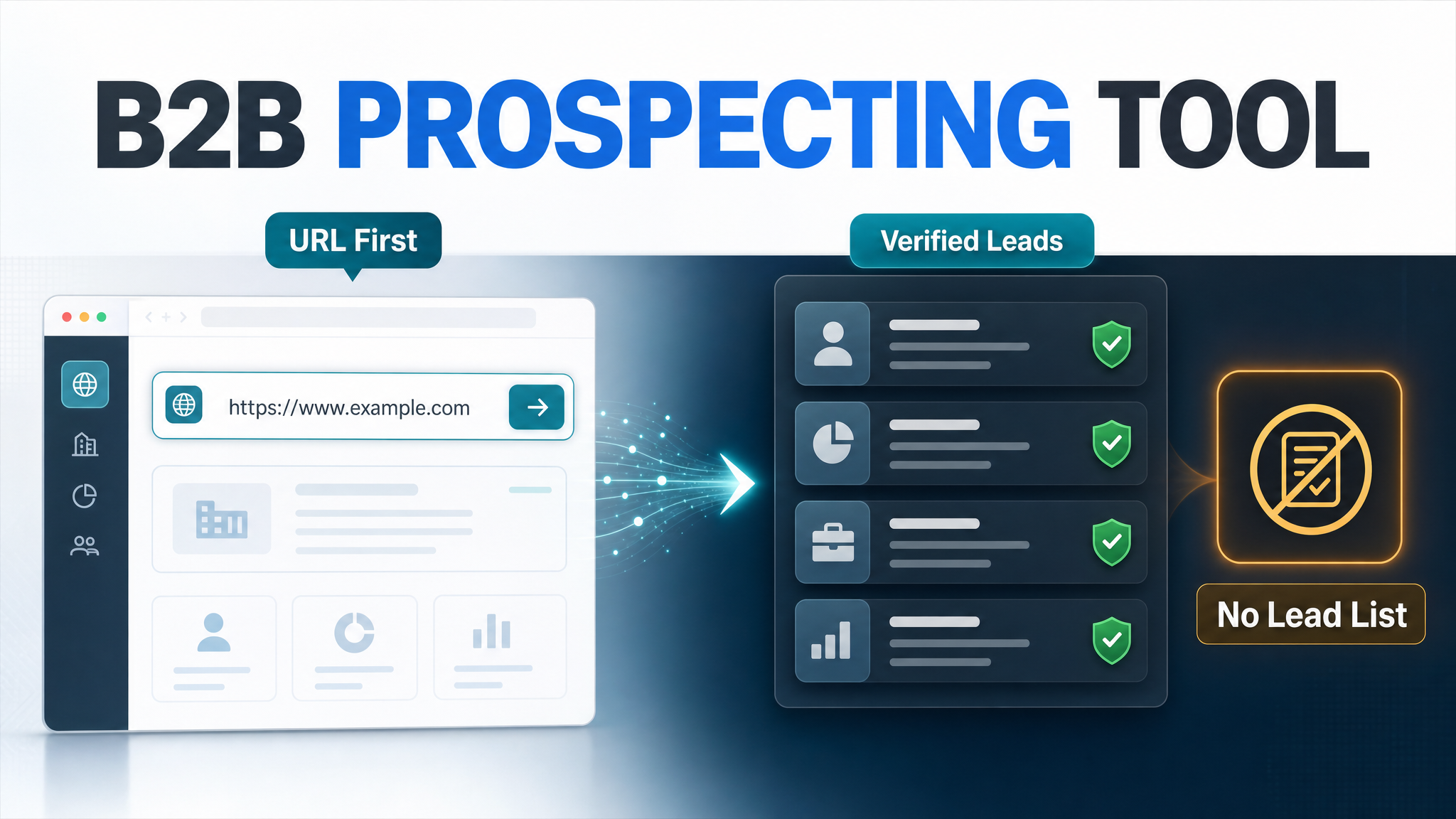
The B2B prospecting tool market hit $4.49 billion in 2026, growing at over 16% annually. There are now more tools in this category than any single team could evaluate — and nearly all of them share one requirement: you have to bring a lead list. Database tools give you one to query. Sequencing tools help you send to one. Intelligence layers help you score one. AmroGen is different — you give it a company URL and it builds the list for you. This guide breaks down the five categories of prospecting tools in 2026, where the standard approach works well, and where starting from a URL is a better path.
Table of Contents
- What B2B Prospecting Tools Actually Do
- The Five Categories (and Why They're Not Interchangeable)
- The Lead-List Problem Most Tools Don't Solve
- How URL-First Prospecting Works
- When the Database Approach Wins
- When URL-First Wins
- Comparison by Use Case
- FAQ
What B2B Prospecting Tools Actually Do
A B2B prospecting tool is any software that helps a sales team find, verify, and prioritise contacts to reach out to. Beyond that definition, the category fragments into tools that do wildly different things, and the mistake most teams make is comparing tools across categories rather than within them — asking which is "better" when they're not solving the same problem at all.
The result is predictable: a company buys a database tool, connects it to a sequencing tool, and still has someone manually exporting CSVs between them every morning. According to the Salesforce 2026 State of Sales report, 87% of sales organisations now use some form of AI for prospecting or outreach — yet the majority still operate with disconnected tools that require manual effort to bridge every hand-off. The tools are good. The stack architecture is where pipeline quietly disappears.
The only way to pick the right prospecting tool is to first get clear on which of the five categories you actually need.
The Five Categories (and Why They're Not Interchangeable)
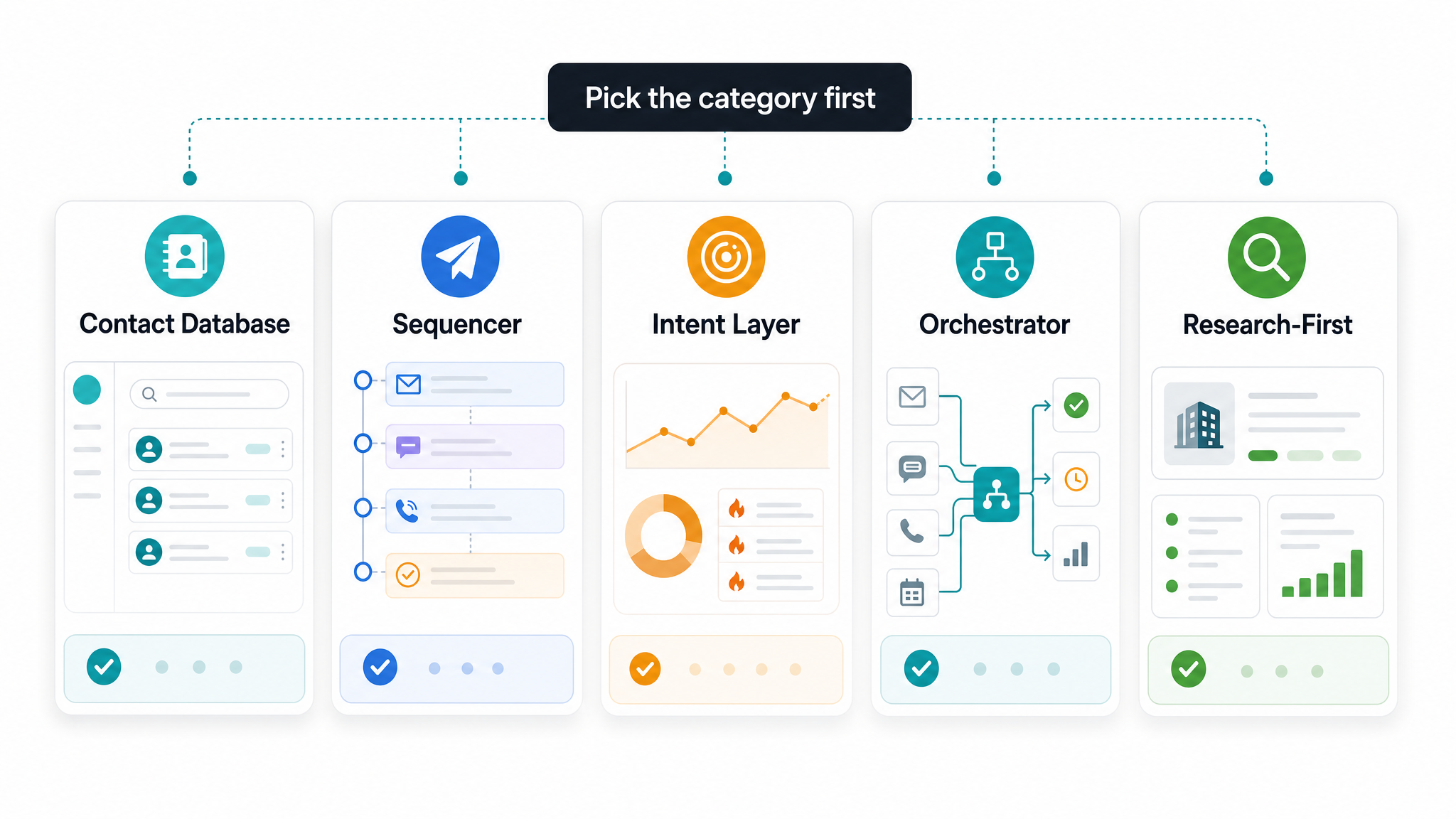
The B2B prospecting tool landscape organises into five distinct categories, each solving a different problem.
1. Contact databases hold large inventories of pre-verified B2B contacts. Apollo (275M+), ZoomInfo (600M+), Cognism, Lusha. You search and filter within the database and export a list of people who match your ICP criteria. Fast. High volume. Accuracy varies by database and segment — most single-source databases deliver 70–85% accuracy, meaning 15–30% of outreach is built on wrong or stale data before a single email is sent.
2. Sequencing and engagement platforms automate the outreach once you have the list. Instantly, Smartlead, Lemlist, Saleshandy, Outreach, Salesloft. They don't find leads — they contact the ones you bring them.
3. Intelligence layers surface which accounts are actively researching relevant topics so you know who to prioritise. ZoomInfo Copilot, 6sense, Bombora. They tell you when to reach out, not who to reach.
4. Orchestrators connect signal capture, enrichment, and outreach into a single automated workflow so leads flow from research to sequence without manual CSV exports. Unify is the clearest example. The orchestration gap is where most pipeline leaks happen — not inside the individual tools, but in the space between them.
5. Research-first pipeline tools start from a URL or account name, browse live sources to identify contacts, enrich in real time, and feed directly into outreach — no separate list-building step. AmroGen sits here.
Understanding which category you need eliminates most of the market before a single demo.
The Lead-List Problem Most Tools Don't Solve
Every category above — database tools, sequencers, intelligence layers, orchestrators — assumes you know which companies to target and have or can build a contact list for them. The workflow is implicit: identify target accounts, find contacts, verify data, load into sequencer, send.
That workflow has a gap nobody advertises. Building the list takes time. Lots of it.
Sales reps waste hours each week manually researching prospects and hunting for contact details — toggling between LinkedIn, a CRM, an enrichment platform, and an email finder just to build context for a single outreach email. By the time the list is clean and loaded, the timing signal that made the account attractive has sometimes passed. Outreach sent within 10 minutes of a buying signal dramatically outperforms outreach sent 24 hours later.
And for companies that aren't well-represented in major databases — smaller businesses, international markets, niche industries — the list-building problem is worse. Apollo's coverage thins outside US mid-market and enterprise. ZoomInfo is expensive and built for large organisations. LinkedIn Sales Navigator provides relationship intelligence but not email addresses where available or direct-dial phones — so you still need another tool for the actual contact data.
The standard answer to all of this is "add another tool to the stack." Most outbound teams now run five or more prospecting tools simultaneously. The data from Unify is stark: pipeline leaks happen at the hand-offs between tools, not inside them.
How URL-First Prospecting Works
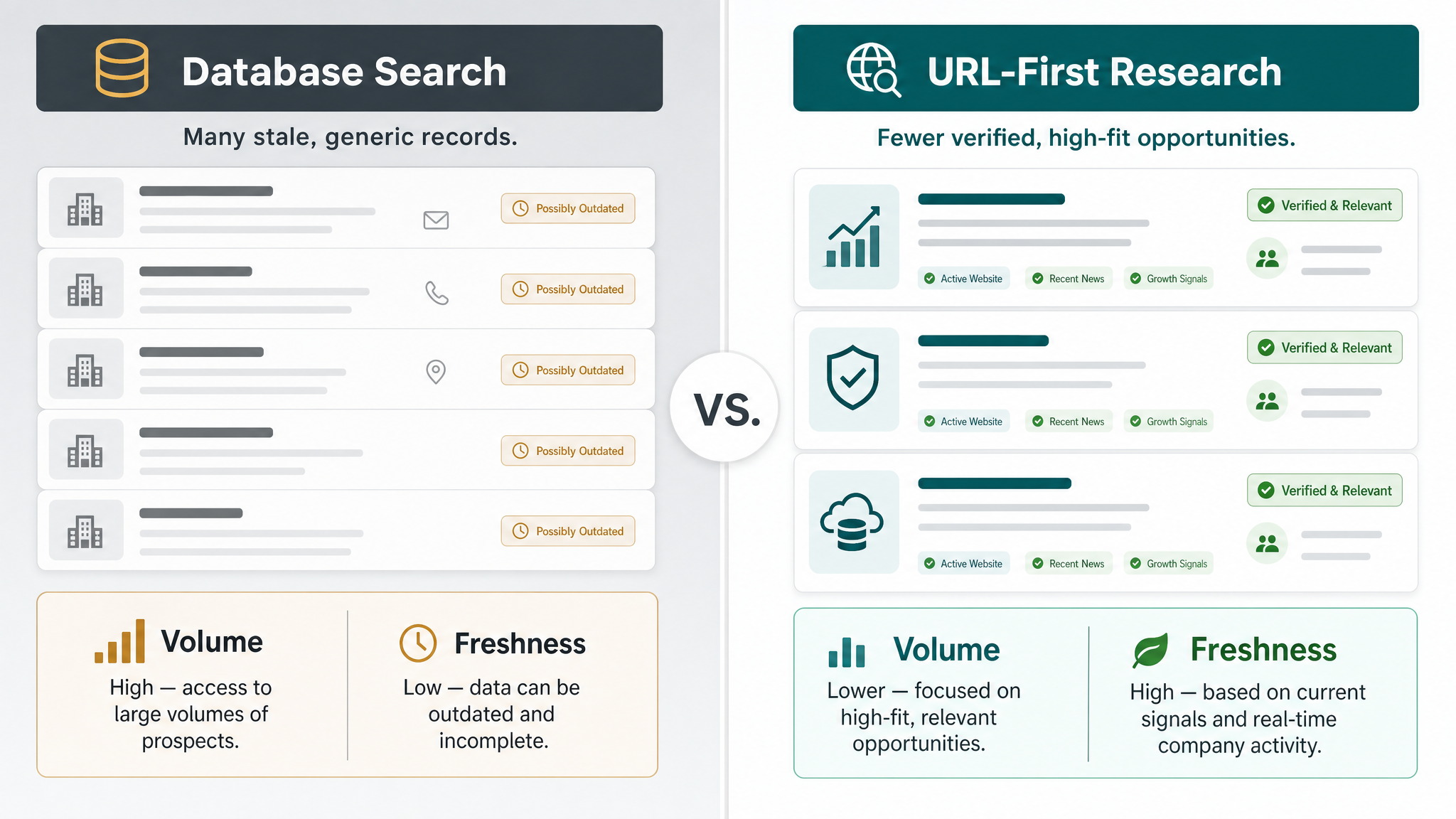
AmroGen takes a different path: give it a company URL and it builds the list itself.
The Lead Generator agent browses the target company's live website, their LinkedIn company page, and publicly available individual profiles. It identifies which roles are relevant for your ICP — founders, C-suite, VPs, department heads — and surfaces people currently employed in those roles, not whoever happened to be there when a database was last refreshed.
For each contact, it enriches in real time: business email verified via SMTP check, LinkedIn profile URL, direct phone where available, current title and company, location, and an ICP fit score based on how closely the lead's role and company match your target criteria. All of this happens at campaign creation time, not months earlier.
The output isn't a 10,000-contact database export. It's a 10–100 contact list of the right people at the specific company you care about, built from current data, ready to move directly into outreach sequencing — without a CSV export, a manual enrichment run, or a separate verification step.
When the Database Approach Wins
The URL-first approach isn't the right tool for every situation. Being clear about where the database approach is stronger is more useful than pretending otherwise.
High-volume outbound across many companies at once. If you're prospecting 500 companies this month, URL-based research one at a time doesn't scale the way a database search does. Apollo lets you build a 5,000-contact list in minutes. AmroGen is better suited to focused, targeted campaigns where the quality of each contact matters more than the raw count.
US mid-market and enterprise with well-documented contacts. For this segment, Apollo and ZoomInfo have strong coverage and waterfall enrichment through multiple providers can push email accuracy into the high nineties. The database approach works well here.
Existing stack integration. If your team is already running on Apollo or ZoomInfo and Salesforce, a URL-based tool is an addition to the stack rather than a replacement. It fills specific gaps — accounts not in the database, international markets, very recent hires — rather than replacing the whole workflow.
Intent signal routing. When a company has visited your pricing page and you want to reach the right person within 10 minutes, a live browsing agent isn't the fastest path. A database with intent signal integration routes the signal to an existing contact record immediately.
When URL-First Wins
You don't have a lead list and don't want to build one. This is the most common situation for founder-led sales and small teams doing targeted outbound. A URL is enough to start. AmroGen handles everything from the URL to the researched lead list to the personalised outreach sequences to the Gmail send.
Your targets are outside major database coverage. International companies, businesses with under 50 employees, niche industries, and companies in markets where the big databases have thin coverage are all situations where URL-based live research outperforms a database query.
Data freshness matters more than volume. Contacts verified today have higher deliverability than contacts verified six months ago. For teams where domain reputation is a concern — teams that have had deliverability issues, or teams sending from a primary inbox rather than a cold domain — fresher contact data is worth the lower per-run volume.
You want research, outreach writing, quality review, and sending in one place. AmroGen doesn't just produce a lead list. It runs the full pipeline: leads → Orchestrator strategy → specialist agent sequences → quality review loop → Gmail send. The prospecting step is the first of five, not the only thing the tool does.
Comparison by Use Case
| Use case | Best approach | Tool examples |
|---|---|---|
| High-volume outbound, 500+ companies/month | Database-first | Apollo, ZoomInfo, Cognism |
| Targeted ABM, 5–20 specific accounts | URL-first | AmroGen |
| US mid-market contacts with strong coverage | Database-first | Apollo, Saleshandy Lead Finder |
| International or niche markets, thin database coverage | URL-first | AmroGen |
| No lead list, want everything in one tool | URL-first | AmroGen |
| Intent signal routing at scale | Database + orchestrator | ZoomInfo Copilot, Unify |
| Connecting existing tools and eliminating manual hand-offs | Orchestrator | Unify |
| Data accuracy concerns, high bounce risk | URL-first (SMTP-verified at run time) | AmroGen |
FAQ
What is a B2B prospecting tool? Software that helps sales teams find, verify, and prioritise contacts to reach out to. The category spans contact databases, engagement platforms, intelligence layers, orchestration tools, and research-first pipeline tools — each solving a different part of the prospecting problem.
How does B2B prospecting work? Traditional prospecting starts with a database query filtered by ICP criteria (industry, company size, job title) and exports a contact list for outreach. Research-first prospecting starts with a company URL, browses live sources to identify currently employed decision-makers, enriches their contact information in real time, and passes researched leads directly to outreach.
What is the best B2B prospecting tool in 2026? Depends on your use case. For high-volume outbound from a large database: Apollo and ZoomInfo. For targeted, account-specific outbound where freshness and coverage matter: AmroGen. For connecting an existing prospecting stack and eliminating manual hand-offs: Unify. Only 28% of sales reps hit quota last year — the tools themselves aren't the problem for most teams, the architecture connecting them is.
How do I find B2B prospects automatically? Database tools automate list-building from stored contact records. URL-based tools like AmroGen automate the research, enrichment, and ICP scoring from a company's live web presence. Both remove manual lookup and CSV-building — the difference is whether the data is pulled from storage or sourced live.
What's better than Apollo for prospecting? For specific situations, several tools outperform Apollo: Cleanlist for waterfall enrichment accuracy (98% vs Apollo's 70–80%), AmroGen for URL-based live research when database coverage is thin, ZoomInfo for enterprise data depth, Cognism for European compliance and data. No single tool is universally better — it depends on your segment, volume, and what's currently breaking.
Data reflects publicly available sources as of June 2026.
Internal links: /features/lead-generation · /ai-sdr-tools · /alternatives/apollo-alternative