Automated B2B Prospecting That Does the Research, Not Just the Outreach
TL;DR
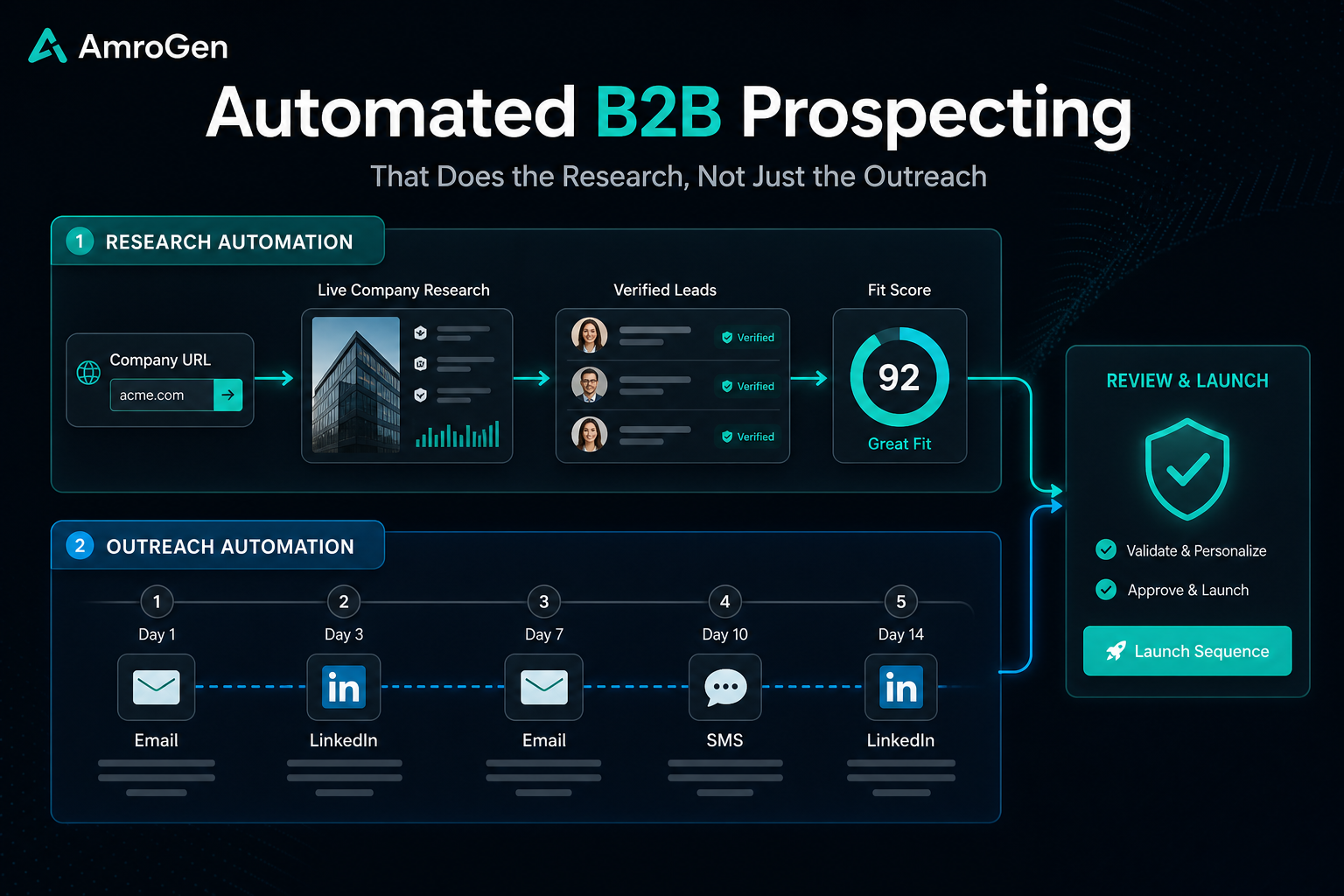
"Automated B2B prospecting" usually means automating the send — you bring a list, the tool handles sequencing and follow-up timing. The research that goes into building the list and writing what gets sent is still manual. AmroGen automates a step earlier: the list itself gets built automatically from a single company URL, and the outreach gets written automatically from that same research, before any sending automation kicks in. This guide covers what's typically automated versus manual in B2B prospecting today, walks through what a fully automated run actually produces, and explains where prospecting ends and outreach begins.
Table of Contents
- What "Automated Prospecting" Usually Means
- The Gap: Research vs Sending Automation
- Two Approaches to Automating the Research Step
- What a Fully Automated 25-Lead Run Produces
- Prospecting vs Outreach: Where One Ends and the Other Begins
- Can AI Actually Do B2B Prospecting?
- FAQ
What "Automated Prospecting" Usually Means
Search for "automated B2B prospecting" and most results describe the same workflow: connect a contact database, set filters, automatically push matching contacts into a sequencing tool, and let the sequencer handle timing and follow-ups without manual intervention. This is real automation — nobody's manually exporting CSVs or tracking follow-up dates in a spreadsheet — but it automates the distribution of outreach, not the construction of who to target or what to say.
The research that determines whether a contact is actually a good fit, and the writing that determines whether the outreach gets a reply, both typically remain manual steps sitting just outside the "automated" part of the workflow most tools describe.
The Gap: Research vs Sending Automation
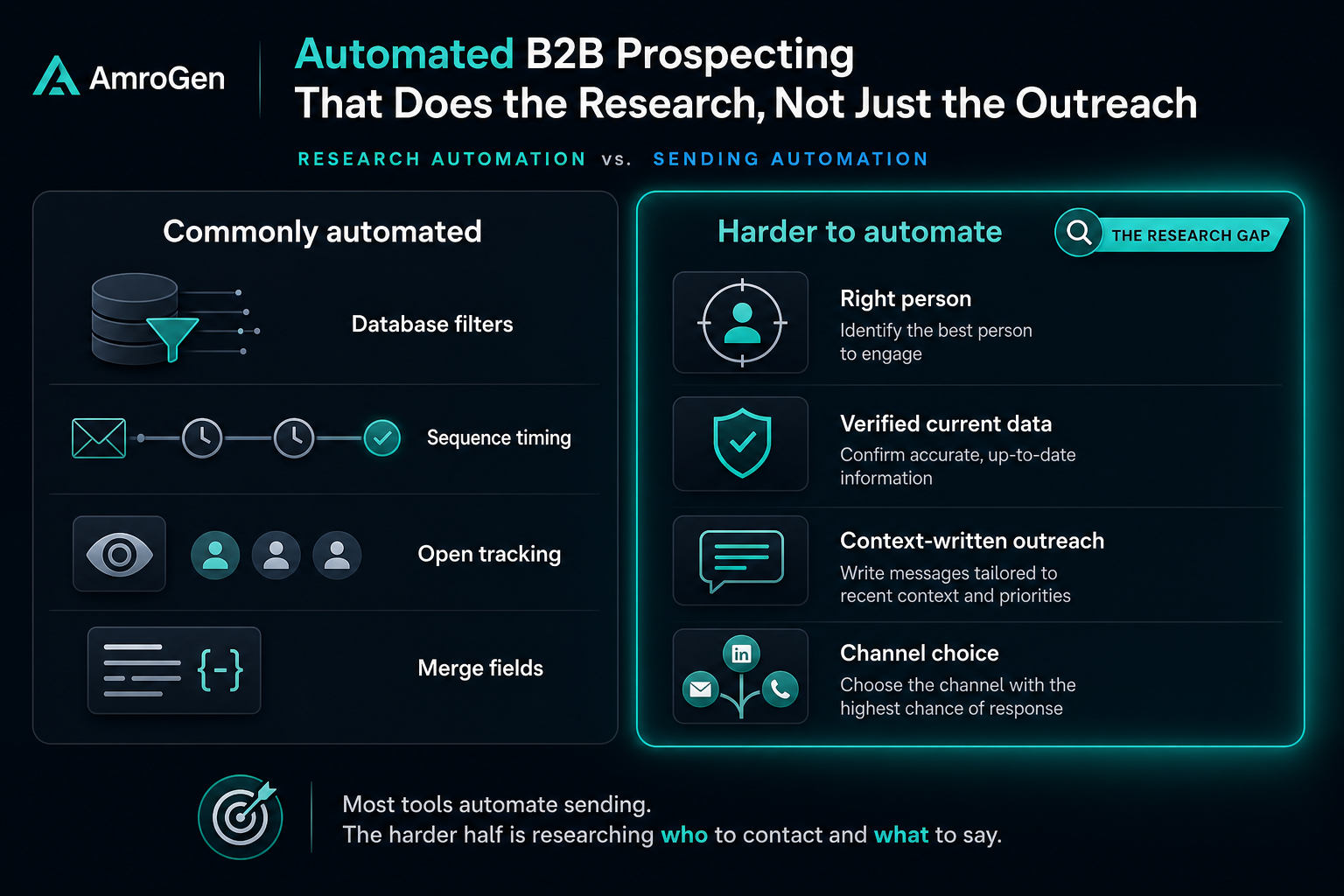
It's worth being precise about which parts of B2B prospecting are commonly automated today and which aren't, because "automated" gets applied loosely to cover a fraction of the actual workflow.
Commonly automated: Database search and filtering. Sequence timing and follow-up scheduling. Engagement tracking (opens, clicks, replies). Basic personalisation via merge fields.
Less commonly automated, but where the real research lives: Determining which specific person at a target company is actually the right contact, given that company's specific structure (not just a generic title match). Verifying that contact data is current, not a stale database record. Writing outreach that reflects something specific and current about the prospect, rather than inserting their name into a template. Deciding which channels make sense for a specific lead based on what contact data actually exists for them.
A tool that automates the first list but leaves the second list manual has automated the easier half of the problem.
Two Approaches to Automating the Research Step
Database pull, automated. Some platforms automate the research step by continuously syncing and filtering a stored database — new contacts matching your criteria flow into your pipeline automatically as the database updates. This is genuinely useful, but it's still bounded by the database's coverage and refresh cycle, and B2B contact data decays at roughly 2.1% per month regardless of how automated the sync is — it automates querying a static source, not researching a target company from scratch.
Live research, automated. A different approach: instead of querying a stored database, an agent is given a target — typically a company URL — and automatically researches that company's current web presence to determine who's relevant and what their current contact details are, generating the list from scratch rather than filtering an existing one. AmroGen's Lead Generator agent works this way, browsing a company's live website and LinkedIn presence to surface decision-makers and verify their contact information in real time, with no database query involved at all.
The distinction matters because the live-research approach finds contacts that simply don't exist in any database — recent hires, smaller companies, international markets — while the database-pull approach, however automated the syncing is, can only ever surface what's already been indexed somewhere.
What a Fully Automated 25-Lead Run Produces
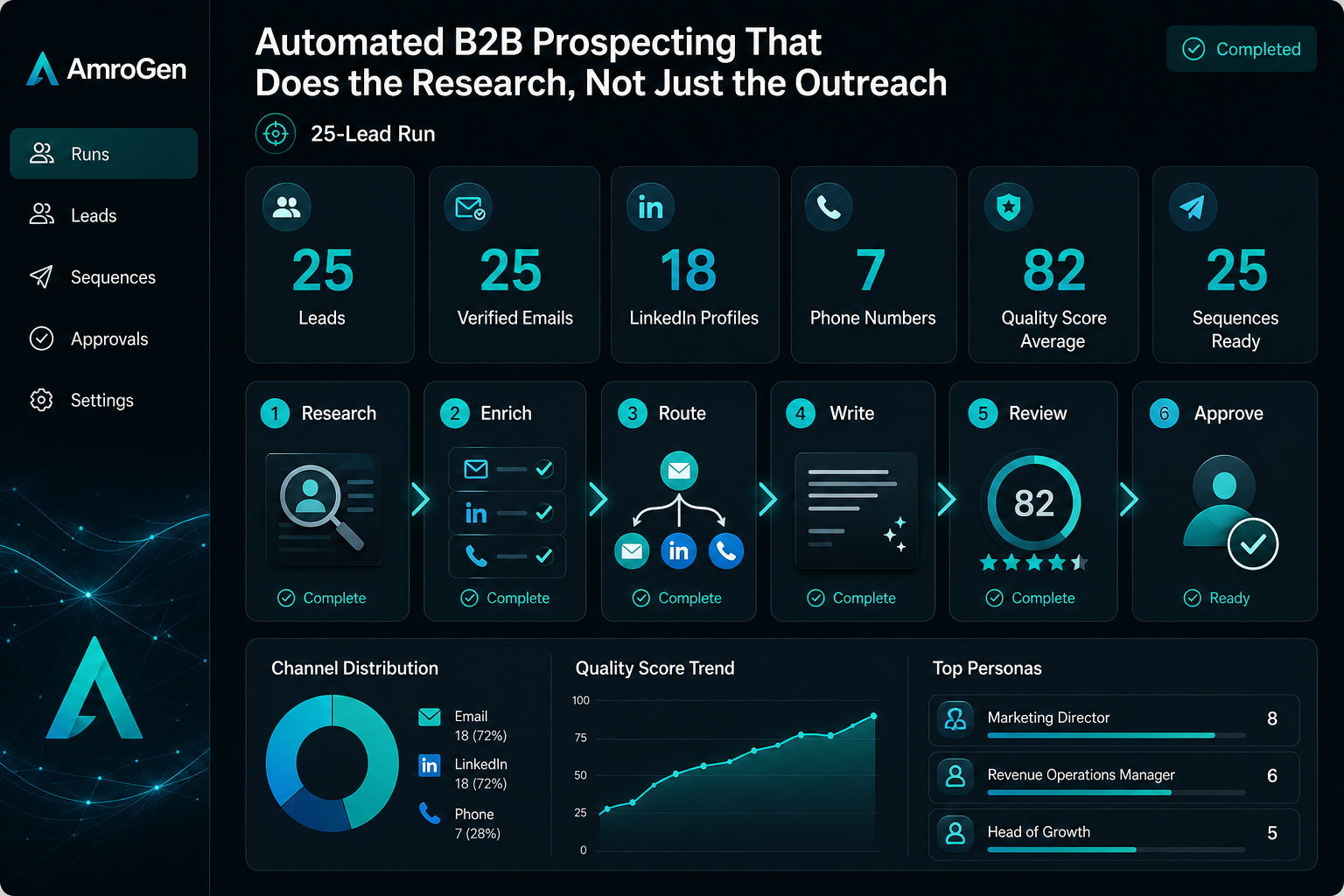
To make this concrete: here's what happens, automatically, when AmroGen runs a 25-lead campaign from a single company URL, with no manual steps in between phases.
Phase 1 — Research and enrichment (automatic). The Lead Generator agent reads the target company's website and public presence, identifies relevant decision-maker roles for the campaign's ICP, and researches 10–100 leads (you choose the count per run) in those roles. Each comes back with name, title, company, email where available, LinkedIn URL, phone where available, and an ICP fit score. No manual list-building, no database query.
Phase 2 — Strategy and routing (automatic). An Orchestrator agent reads each lead's profile and decides which channels are appropriate — a lead with email and LinkedIn gets a multichannel sequence; a lead with only email gets an email-only nurture; leads with phone numbers get an SMS step added.
Phase 3 — Sequence generation (automatic). Specialist agents write the actual outreach for each lead — typically a five-step email sequence, LinkedIn touchpoints where relevant, SMS where applicable — drawing on the research context the Lead Generator surfaced, not a fixed template.
Phase 4 — Quality review (automatic). Before any of this reaches a human, an Orchestrator agent scores every sequence on personalisation depth, factual accuracy, and format compliance, sending weak output back for revision automatically.
The one manual step: reviewing discovered leads (10–100 per run) and their sequences, and approving them to send. Everything before that point — research, enrichment, routing, writing, and quality review — runs without manual intervention, typically completing through the reviewed agent pipeline.
Prospecting vs Outreach: Where One Ends and the Other Begins
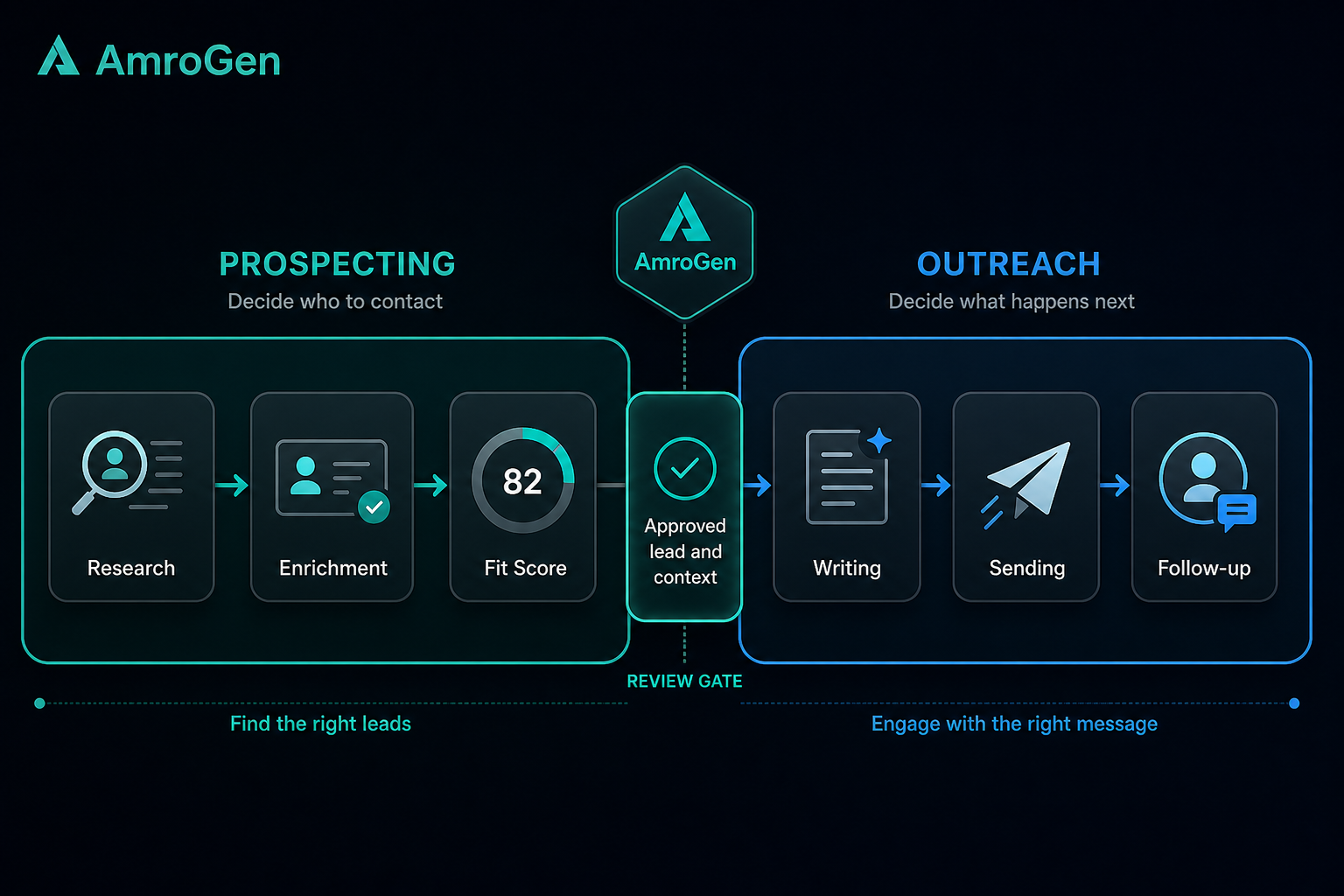
These terms get used almost interchangeably, but they describe genuinely different stages. Prospecting is identifying and qualifying who to contact — research, enrichment, fit scoring. Outreach is what happens once you've decided who to contact — writing and sending the actual messages.
Most "automated prospecting" tools, despite the name, automate more of the outreach stage (sequencing, follow-up timing) than the prospecting stage itself (research, qualification, contact verification) — which is part of why the category label can be misleading. A tool that genuinely automates prospecting should be doing the research and qualification work, not just scheduling messages to a list someone else built.
Can AI Actually Do B2B Prospecting?
Yes, with a meaningful caveat about what "doing" prospecting actually requires. AI can browse a company's public web presence, identify likely decision-maker roles based on company structure, and verify contact information — all of which were previously manual research tasks. What AI handles less reliably without good underlying data is judgment calls that depend on context a human would intuit (whether a title that doesn't match standard patterns is actually relevant, for instance) — which is why the quality of an AI prospecting tool depends heavily on how much genuine research it does versus how much it's pattern-matching against limited signals.
The honest summary: AI-driven prospecting in 2026 handles the mechanical research and verification work well — finding people, confirming current roles, verifying contact details — and is increasingly capable at qualification scoring when given good signal data. 45% of high-performing sales teams have already adopted hybrid human-AI models, where AI handles research and first-touch personalisation while humans focus on relationship development — which reflects the reality that AI prospecting remains most effective when paired with a human review step before outreach goes out, precisely the gap a built-in quality review process is designed to close.
FAQ
How do I automate B2B prospecting? Two layers to automate: the research (finding and verifying who to contact) and the outreach (writing and sending). Most tools automate the second layer well — sequencing and follow-up timing — but leave the first layer (research and contact verification) manual or dependent on a static database. Tools that research live company data from a URL input, rather than querying a stored database, automate the research layer as well.
What is the best automated prospecting tool? Depends on whether your bottleneck is volume or research depth. For high-volume, broad-segment prospecting with continuous database syncing: Apollo or ZoomInfo with intent-signal layering. For targeted, account-specific prospecting where you want the research itself automated from a company URL rather than a database query: AmroGen.
Can AI do B2B prospecting? Yes, for the mechanical components — identifying relevant roles, finding currently employed people in those roles, and verifying contact information from live sources. AI-driven prospecting performs best when the research feeding it is genuinely current rather than pattern-matched against limited or stale data, which is why live-research approaches tend to outperform AI layered purely on top of a static database.
What is the difference between prospecting and outreach? Prospecting is the research and qualification stage — determining who to contact and confirming their details are current and accurate. Outreach is what happens after that decision is made — writing and sending the actual messages. The two are often bundled under "automated prospecting" in tool marketing, but they're functionally distinct stages, and a tool can automate one without meaningfully automating the other.
Reflects publicly available information as of June 2026.
Internal links: /features/lead-generation · /features/ai-sequences · /campaigns/new