12 Apollo.io Alternatives That Actually Fix What's Broken (Tested in 2026)
TL;DR
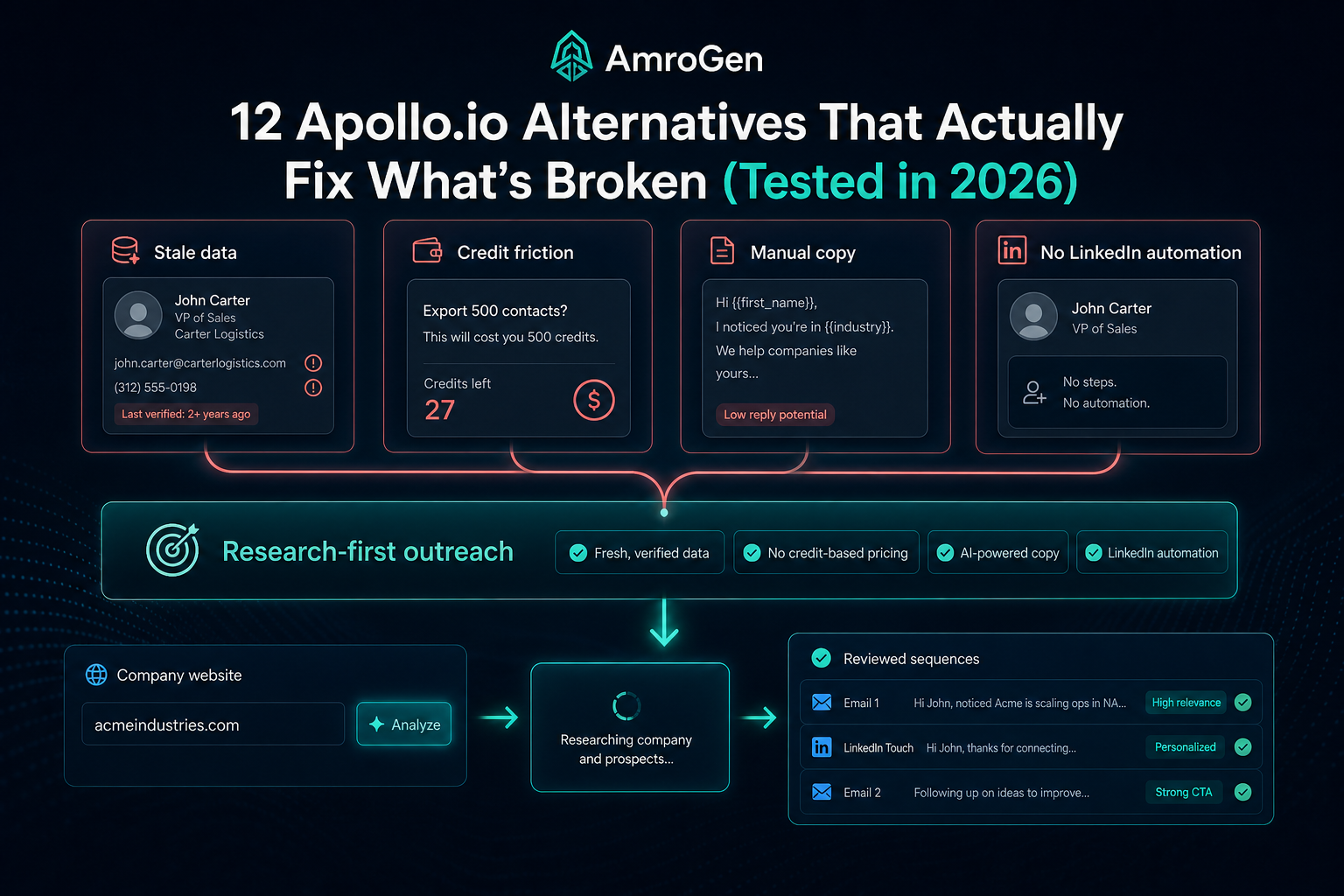
Apollo.io claims 91% email accuracy, but real-world bounce rates on exported contacts regularly run 15–30%, sometimes higher — because the database isn't re-verified in real time. A contact valid three months ago might not be valid today. That's the structural reason so many teams start evaluating alternatives, but "Apollo alternative" means different things depending on what's actually broken for you: stale data, a confusing credit system, no AI-generated copy, or the fact that you still have to write every email yourself after the database does its job. This guide starts with that question — what are you actually trying to fix — and works through 12 real alternatives organized by the problem each one solves, including AmroGen for teams whose real issue is that Apollo finds leads but doesn't write or review the outreach.
Table of Contents
- What Apollo Actually Does Well
- Why Teams Look for Alternatives
- Start Here: What Are You Actually Replacing?
- 12 Apollo.io Alternatives by Problem
- Comparison Table
- FAQ
What Apollo Actually Does Well
Before listing alternatives, it's worth being honest about why Apollo became the default. It combines a 275M+ contact database with built-in email sequencing, a power dialer, and basic CRM functionality, all under one login at a price point ($49–119/user/month) that's accessible to small teams. Apollo holds a 4.7 out of 5 rating on G2 across 9,645+ reviews — the product itself works for a lot of people. If you're a two-person team that needs to find contacts and start a basic sequence without managing three separate subscriptions, Apollo remains a reasonable starting point.
Why Teams Look for Alternatives
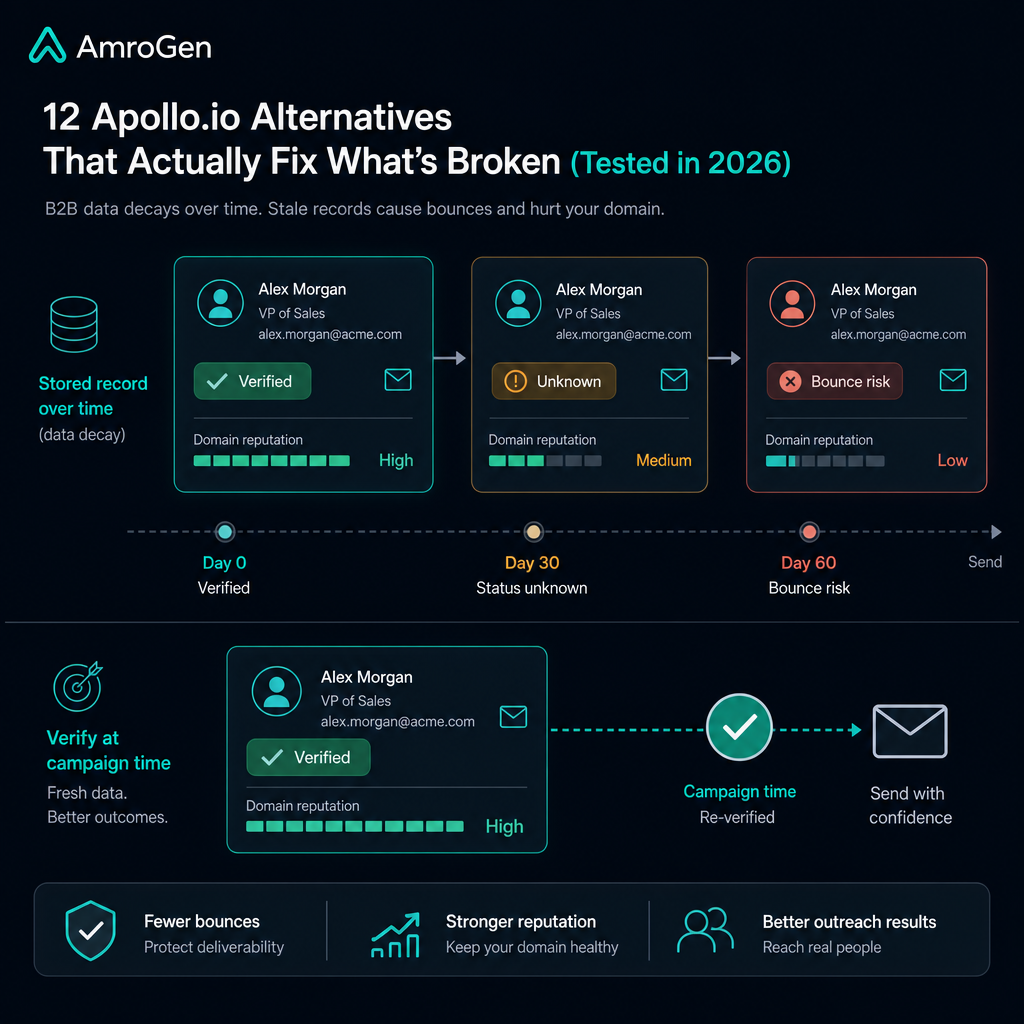
The pattern that shows up across nearly every independent review is consistent. Data accuracy degrades faster than the database refreshes. Apollo's database isn't re-verified in real time, so a contact valid three months ago might not be today — by the time you send, the damage to your domain reputation is already done. Pricing has friction at scale. Credits expire every billing cycle, advanced filters like intent signals and website visitor tracking are locked behind the $119/user Organization tier, and Apollo's Trustpilot rating sits at 2.9 out of 5 across 1,122+ reviews — driven by billing disputes and credit-system surprises rather than core product complaints. LinkedIn automation was removed. As of January 30, 2026, Apollo removed automated LinkedIn actions entirely — connection requests, messages, and profile views are now manual tasks marked complete inside the platform, not automated steps. And underlying all of it: Apollo finds and verifies leads, but the outreach itself still has to be written. The sequencing tool gives you a structure; you or a copilot prompt fill in the words.
Start Here: What Are You Actually Replacing?
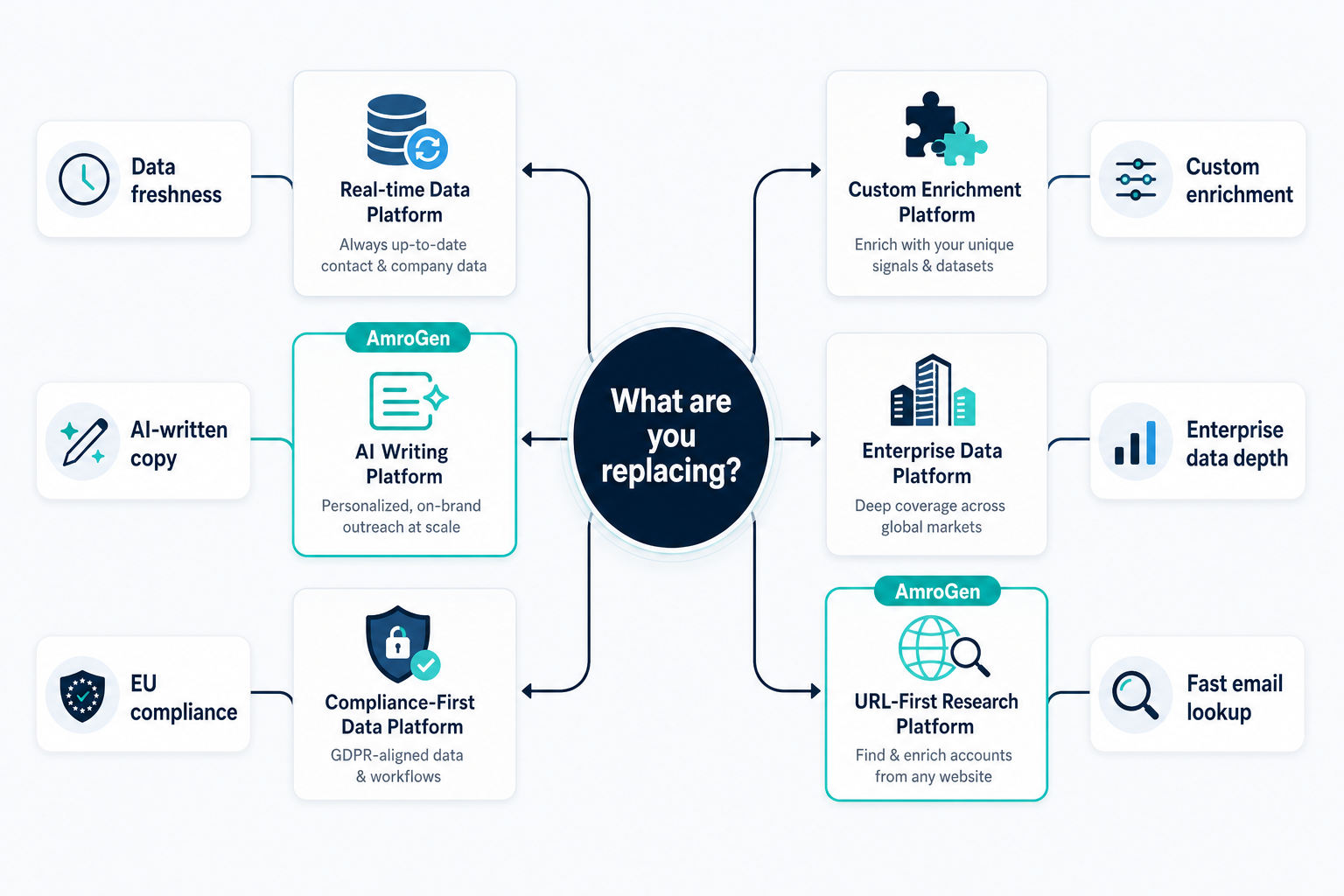
The single biggest mistake in this category is treating "Apollo alternative" as one search with one right answer. Apollo bundles three things — a contact database, a sequencing tool, and basic engagement tracking — and most alternatives are strong at one or two of those, not all three. Before reading further, decide which of these is your actual bottleneck:
"My data is stale and bounces too much." You need better verification — look at Cognism, Seamless.ai, or Saleshandy.
"I have leads but still have to write every email myself." You need AI that writes from research, not a database with a copy assistant — look at AmroGen or Artisan.
"I need enterprise data depth and don't mind the price." Look at ZoomInfo.
"I'm selling into Europe and need compliance." Look at Cognism.
"I need flexible, custom enrichment workflows." Look at Clay.
"I just need contacts I don't already have, fast." Look at Hunter.io, UpLead, or Lusha.
12 Apollo.io Alternatives by Problem
1. AmroGen — for teams tired of writing the copy themselves
Apollo finds you a contact. It doesn't research that contact's current company situation or write a sequence that reflects it — you write the email, or you prompt a copilot to draft one. AmroGen works from the opposite direction: give it a company URL instead of querying a database, and the Lead Generator agent browses the company's live web presence to surface decision-makers, verifies their contact details via SMTP check at campaign time, and then specialist agents write personalised email, LinkedIn, and SMS sequences from that research — reviewed by an Orchestrator agent that scores every sequence before you see it.
This solves a different problem than most tools on this list. It's not a bigger or cheaper database — it's the writing and quality-review layer that sits on top of lead discovery, built into the same pipeline as the research itself.
Best for: Teams without a lead list who want research, AI-written sequences, and a quality check in one workflow — particularly when targeting companies too small or international for strong Apollo coverage. Pricing: From $29/month, or ~$2.80 per pipeline run.
2. Saleshandy — the closest like-for-like swap
Saleshandy combines an 800M+ verified contact database with real-time data verification at the moment of reveal — and automatically refunds credits for invalid emails, something Apollo doesn't do. It includes an AI Sequence Copilot, unlimited email accounts on paid plans, a built-in CRM, and an agency portal with white-labelling. If your main complaint about Apollo is data accuracy and credit handling rather than the fundamental workflow, Saleshandy is the most direct swap. Pricing: From $25/month.
3. Cognism — for compliance-first European selling
Cognism's database is DNC-screened across 14–15 countries, with GDPR-notified data meaning contacts have been informed their data is in the system — and zero data breaches, compared to Apollo's two (2018 and 2021). Its Diamond Data product delivers phone-verified mobile numbers with an 87%+ connect rate claim. For regulated industries or European markets, this compliance infrastructure isn't a nice-to-have. Pricing: Custom, typically $15,000+/year.
4. ZoomInfo — for enterprise data depth
ZoomInfo is the largest B2B database on the market, with native Bombora intent data built in, and is best suited for enterprise sales teams prospecting into large North American accounts. The trade-off is cost — typically starting around $15K/year — and the data is still a stored database with the same fundamental decay problem Apollo has, just refreshed more aggressively. Pricing: Custom, enterprise.
5. Clay — for custom enrichment workflows
Clay doesn't compete with Apollo directly — it's an orchestration layer that chains 75–150+ data providers into waterfall enrichment sequences. Where Apollo has waterfall enrichment, it's not as flexible as Clay's data orchestration. If your team has RevOps capacity to build and maintain custom workflows, Clay produces better hit rates than any single-source database, Apollo included. Pricing: From $185/month, often $1,000–2,500+/month with data credits at scale.
6. Coldreach — for signal-driven, intent-based outbound
Coldreach monitors 113M+ accounts and 550M+ contacts for buying signals — job posts, funding news, tech stack changes — rather than relying on static filters. It's positioned as an AI SDR rather than a database, with weekly refreshed lead lists and always-on monitoring. Best for: Teams whose real complaint about Apollo is timing — reaching accounts before a competitor does. Pricing: Not publicly listed; typically $749–899/month based on comparable platforms.
7. Seamless.ai — for real-time validated contacts
Positioned specifically against Apollo's staleness problem: real-time validated contacts that build lists faster than Apollo's static database allows. A direct fit if data freshness is your primary frustration and you don't need the writing or review layer.
8. Lusha — for affordable, GDPR-compliant simplicity
A smaller, unquantified database than Apollo, but Lusha pairs with full workflow orchestration in GTM Workspace — intent-triggered sequences, AI-drafted outreach, and buying-group mapping that Lusha alone doesn't offer but its broader ecosystem covers. Affordable, self-service setup, mixed reviews on data depth outside core markets.
9. LeadIQ — for Salesforce/HubSpot-native teams
LeadIQ sources from public and private channels including social media and job boards, verifies emails in real time, and includes sales trigger tracking and an AI writer tool, with strong outreach sequence sync into Salesforce and HubSpot. The mobile number coverage is limited (max 120 on the enterprise plan).
10. Hunter.io — for fast, focused email discovery
Hunter is not a full prospecting platform — it's an email finder. Enter a domain, get every discoverable email address connected to it with confidence scores and sources. If your actual workflow is "I know exactly which company I want to reach, I just need the right email," Hunter does that one thing faster and more transparently than Apollo's broader platform. Built-in bulk verification too.
11. UpLead — for simpler verified contact sourcing
A leaner database tool than Apollo with a stated focus on real-time email verification before credits are charged. A reasonable fit for teams that find Apollo's interface and filter complexity more than they need.
12. Amplemarket — for AI-assisted multichannel without the setup
Amplemarket positions itself as an AI-powered sales assistant handling prospecting, outreach, follow-ups, and meeting scheduling in one workflow. Strong fit for mid-market teams that want data, outreach, and CRM sync under one roof without Clay-level configuration overhead.
Comparison Table
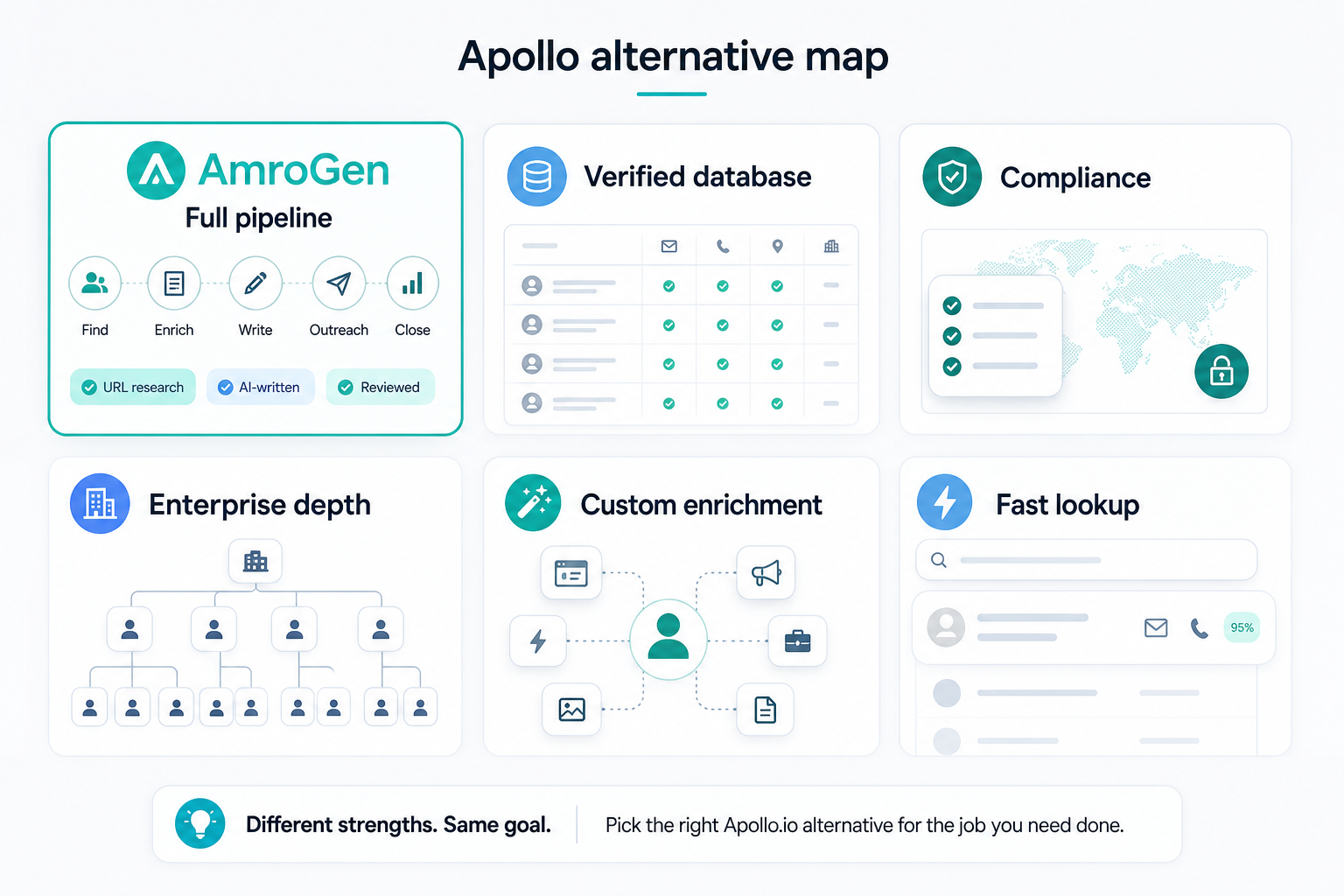
| Tool | Primary fix | Writes outreach from research? | Pricing |
|---|---|---|---|
| AmroGen | No lead list + no AI writing layer | Yes — per-lead, reviewed before send | $29/mo (~$2.80/run) |
| Saleshandy | Data accuracy + credit handling | Copilot drafts; human reviews | $25/mo |
| Cognism | EU/EMEA compliance | No | Custom, $15K+/yr |
| ZoomInfo | Enterprise data depth | No | Custom, enterprise |
| Clay | Custom enrichment flexibility | No (enrichment only) | $185+/mo |
| Coldreach | Signal-driven timing | Yes — signal-qualified | ~$749–899/mo |
| Seamless.ai | Real-time data freshness | No | Varies |
| Lusha | Affordability + GDPR | Via GTM Workspace add-on | Free tier; paid varies |
| LeadIQ | CRM-native workflow | AI writer tool included | Credit-based |
| Hunter.io | Fast targeted email lookup | No | From free tier |
| UpLead | Simpler interface | No | Varies |
| Amplemarket | AI-assisted, low setup | Yes, assistant-driven | Custom |
FAQ
What is the best Apollo.io alternative? Depends entirely on what's broken for you. For data accuracy and credit handling: Saleshandy. For European compliance: Cognism. For enterprise depth: ZoomInfo. For teams whose real problem is that Apollo finds leads but doesn't write the outreach: AmroGen.
Is there a free Apollo alternative? Several tools offer free tiers: Hunter.io (25 searches/month), Lusha (5 free credits/month), Snov.io (50 free credits), and Apollo itself has a free tier with 230M+ contacts and 65+ filters. For a full pipeline including AI-written outreach, AmroGen's pay-as-you-go model runs roughly $2.80 per campaign with no subscription required.
Which is better, Apollo or ZoomInfo? ZoomInfo has deeper US enterprise data and native intent signals at a significantly higher price point — typically $15K+/year versus Apollo's $49–119/user/month. Apollo is the better fit for smaller teams and broader use cases; ZoomInfo for enterprise teams that need data depth above all else.
What is the best B2B database alternative to Apollo? For raw database size and accuracy: Cognism (EMEA), ZoomInfo (US enterprise), or Saleshandy (verified at reveal time). For teams that don't need a stored database at all and would rather have live research per target company: AmroGen takes a fundamentally different approach.
Why do people switch from Apollo? The most cited reasons across independent reviews: bounce rates of 15–30% on exported contacts due to stale verification, credit-system billing friction, the January 2026 removal of automated LinkedIn actions, and the fact that Apollo's sequencing tool still requires you to write the copy yourself.
What can I use instead of Apollo for prospecting? If the goal is replacing the database specifically: Cognism, ZoomInfo, or Seamless.ai. If the goal is replacing the entire workflow — research, writing, quality review, and sending — without needing a separate database subscription at all: AmroGen.
Data reflects publicly available sources as of June 2026.
Internal links: /alternatives/apollo-alternative · /ai-sdr-tools · /features/lead-generation · /pricing