I Replaced My SDR Team With AI — Here's What Actually Works (2026)
TL;DR
An AI SDR tool automates the three parts of outbound that eat the most time: finding the right people, writing outreach they'll actually read, and keeping follow-up moving without someone manually tracking it in a spreadsheet. The market is now valued at over $4 billion and growing fast — but the 50–70% annual churn rate in this category tells you most teams aren't getting what they paid for. The single most consistent reason? Nothing checks the AI's output before it reaches a real person. This guide explains why that gap exists, how to spot it before you buy, and what a defensible pipeline actually looks like.
Table of Contents
- What an AI SDR Tool Actually Is
- Three Categories Disguised as One Market
- Why So Many Teams Abandon These Tools Within a Year
- What the Tools That Actually Work Have in Common
- The Quality Review Gap Nobody Talks About
- How to Evaluate One Without Being Fooled by a Demo
- The Real Cost Comparison
- Where AmroGen Fits in This Picture
- FAQ
What an AI SDR Tool Actually Is
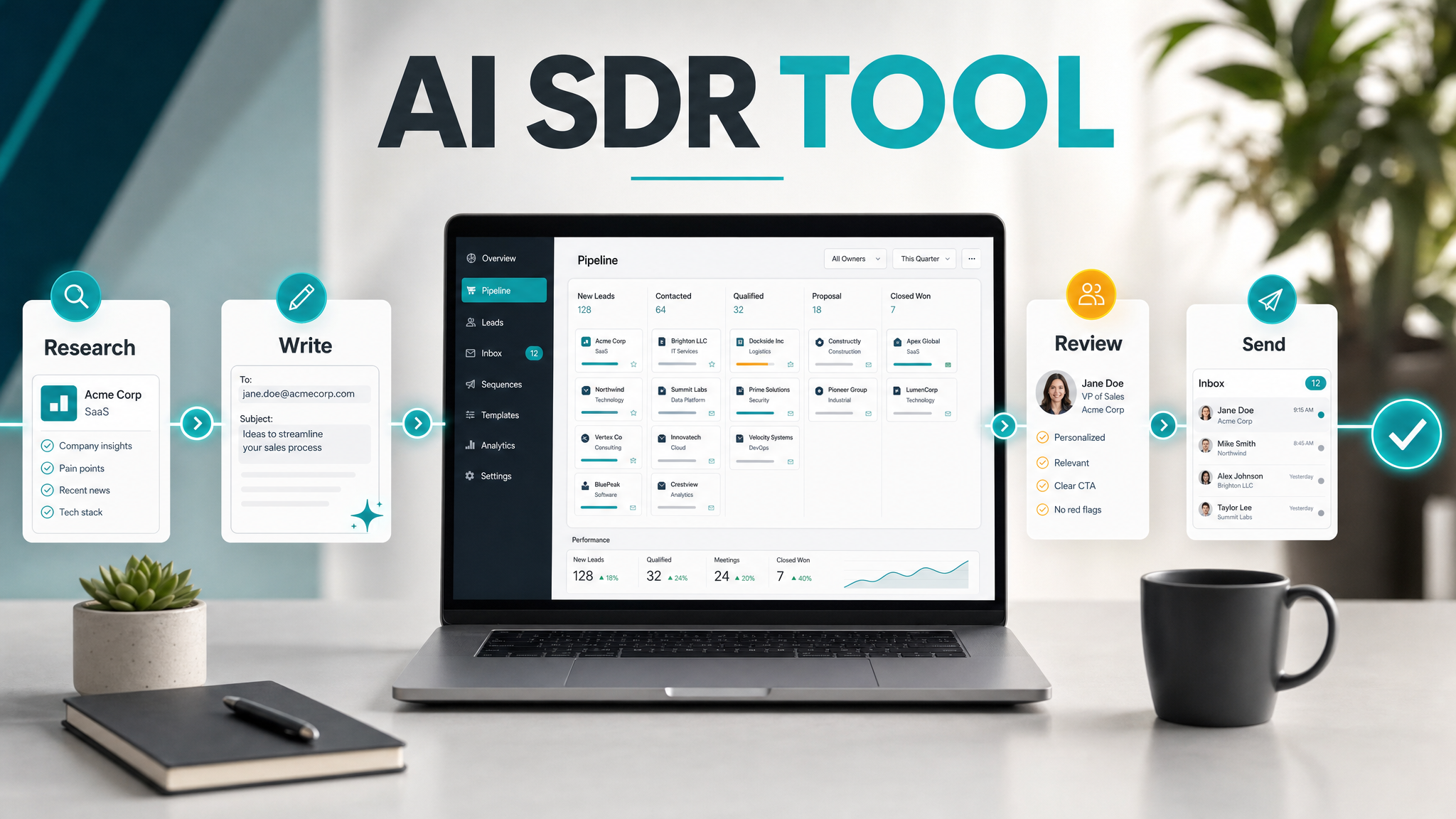
Strip the marketing away and an AI SDR tool does the work a human SDR does before a deal ever reaches an Account Executive — researching a target company, finding the right person, writing something worth reading, and keeping the follow-up sequence moving without anyone manually tracking it.
The label gets used loosely, which is where most buyers get burned. A tool that pulls a name and company from a static database and drops them into a template is doing mail merge with a new coat of paint. A tool that notices a company just raised a Series B, hired a new VP of Sales, and is actively expanding into a new market — then writes from that specific context — is doing what a sharp human SDR would do on their best day, except at a volume no human can sustain. That distinction is the whole ballgame. It's the difference between a message that gets a reply and one that gets reported as spam.
The category is not fringe anymore. Industry sizing puts it at $4.12 billion in 2025, projected to reach $15.01 billion by 2030. Gartner has gone further, forecasting that AI agents will outnumber human sellers tenfold by 2028. The growth makes sense when you look at how SDRs actually spend their days — one widely cited figure puts time spent actually selling at just 28% of working hours, with the rest going to research, data entry, and writing first drafts. AI SDR tools exist to claw that 72% back.
Three Categories Disguised as One Market
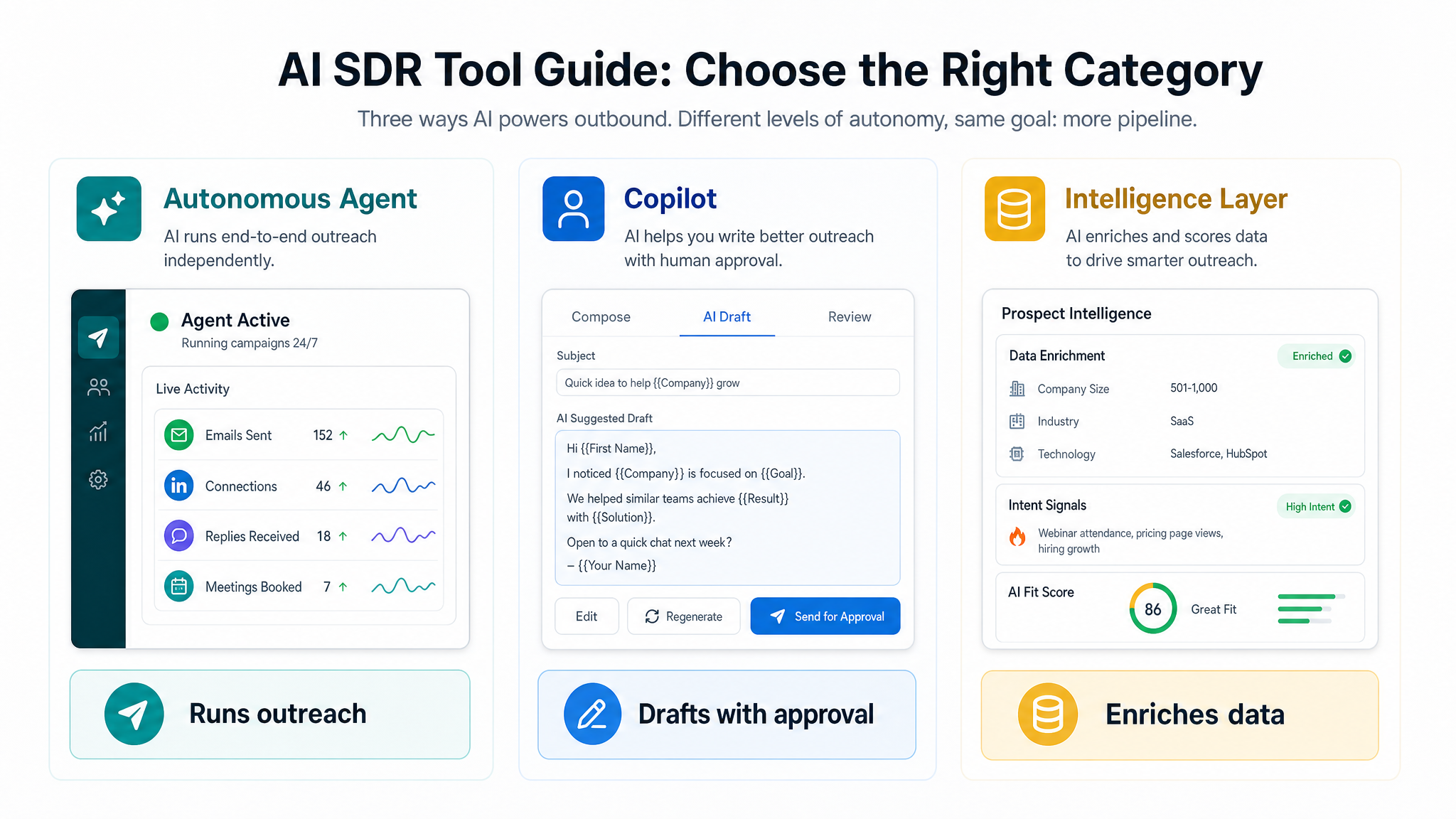
Most roundups list a dozen tools side by side as if they're interchangeable. They aren't, and confusing them is the single most common reason a pilot fails before it gets a fair test. The category splits into three shapes.
Fully autonomous agents run independently once configured — sourcing, writing, and sending without much human involvement per message. Artisan's Ava and 11x.ai's Alice are the clearest examples. This works well for high-volume outbound where deal sizes are lower and one imperfect message doesn't sink the campaign. It works badly for complex, multi-stakeholder enterprise sales, where a senior buyer can spot a hollow AI-generated opener in the first sentence. Sales trainer John Barrows put it bluntly in a line that's been widely circulated: we turned SDRs into robots, and now they're being replaced by robots — and it's not the robots' fault.
Copilots assist a human SDR rather than replacing the role. They draft the first version, suggest a next step, surface a relevant signal — and a person reviews before anything goes out. Saleshandy's AI Sequence Copilot operates this way by default, even though it's marketed under the broader AI SDR umbrella.
Intelligence layers don't send anything at all. Clay and ZoomInfo Copilot live here, feeding enriched, signal-rich contact data into whatever sequencing tool you connect downstream.
The buying mistake that wrecks most pilots, according to evaluation research published this year, is comparing tools across these three categories instead of within them. Pick the category first. Compare vendors second.
Why So Many Teams Abandon These Tools Within a Year
Here's a number that should slow anyone down before signing a contract: annual churn in this category runs 50–70%. More than half the buyers in this space are not getting what they paid for.
The pattern repeats across every independent teardown I've read on this topic:
| What goes wrong | What it actually looks like |
|---|---|
| Personalisation that isn't | The message references a funding round or a job title, but reads inserted rather than researched |
| No data foundation | Teams buy the tool before defining the ICP or cleaning up CRM hygiene |
| Wrong category for the job | A fully autonomous agent gets deployed on a complex enterprise motion it wasn't built for |
| No quality gate between AI draft and sent email | Nobody — human or machine — checks the output before it ships |
| Volume as the fix | More generic emails instead of fewer, sharper ones |
One reviewer described the failure mode simply: an AI that sends 70,000 generic emails is just a spam machine at scale. The fix the more durable platforms have converged on in 2026 is what's being called human-first AI — the model drafts, but a human or a second structured layer approves before anything reaches a real prospect.
What the Tools That Actually Work Have in Common
Three things, consistently, across the credible research I read while building this piece.
They research before they write. A tool should be able to say whether a lead is even a fit, what their specific situation is right now, and which channel makes the most sense — before generating a single sentence. If the honest answer is "I just pulled the contact record," the output reads exactly that way.
The personalisation survives a skim-read. Research published this year found that job changes and new hires are the highest-frequency, most actionable outbound signal — and stacking multiple signals together (a funding event, a new exec hire, active category research) reaches accounts in genuine buying mode rather than passive awareness. A tool relying on firmographic filler won't close that gap regardless of how fluent its writing sounds.
They don't burn your sending reputation to get there. One 2026 benchmark put overall average cold email reply rates at 3.43% for optimised campaigns — but campaigns using signal-specific, deeply personalised messaging hit roughly 18%, more than five times the average. That gap is the entire value proposition of the category. If a tool can't consistently close it, it isn't doing much a decent template couldn't.
| Approach | Typical reply rate |
|---|---|
| Generic cold email (optimised campaigns) | 3–5% |
| Generic cold email (industry average) | 3.43% |
| Signal-specific, personalised email | ~18% |
| LinkedIn outreach | 8–15% |
| Combined email + LinkedIn sequence | Up to ~22% |
If a vendor demo cites a reply rate above 20% with no caveat about personalisation depth or targeting specificity, treat it as a marketing number, not a data point.
The Quality Review Gap Nobody Talks About
Here's what's missing from nearly every comparison article on AI SDR tools, including most of the better-researched ones: none of them ask whether the AI actually checks its own output before a human sees it.
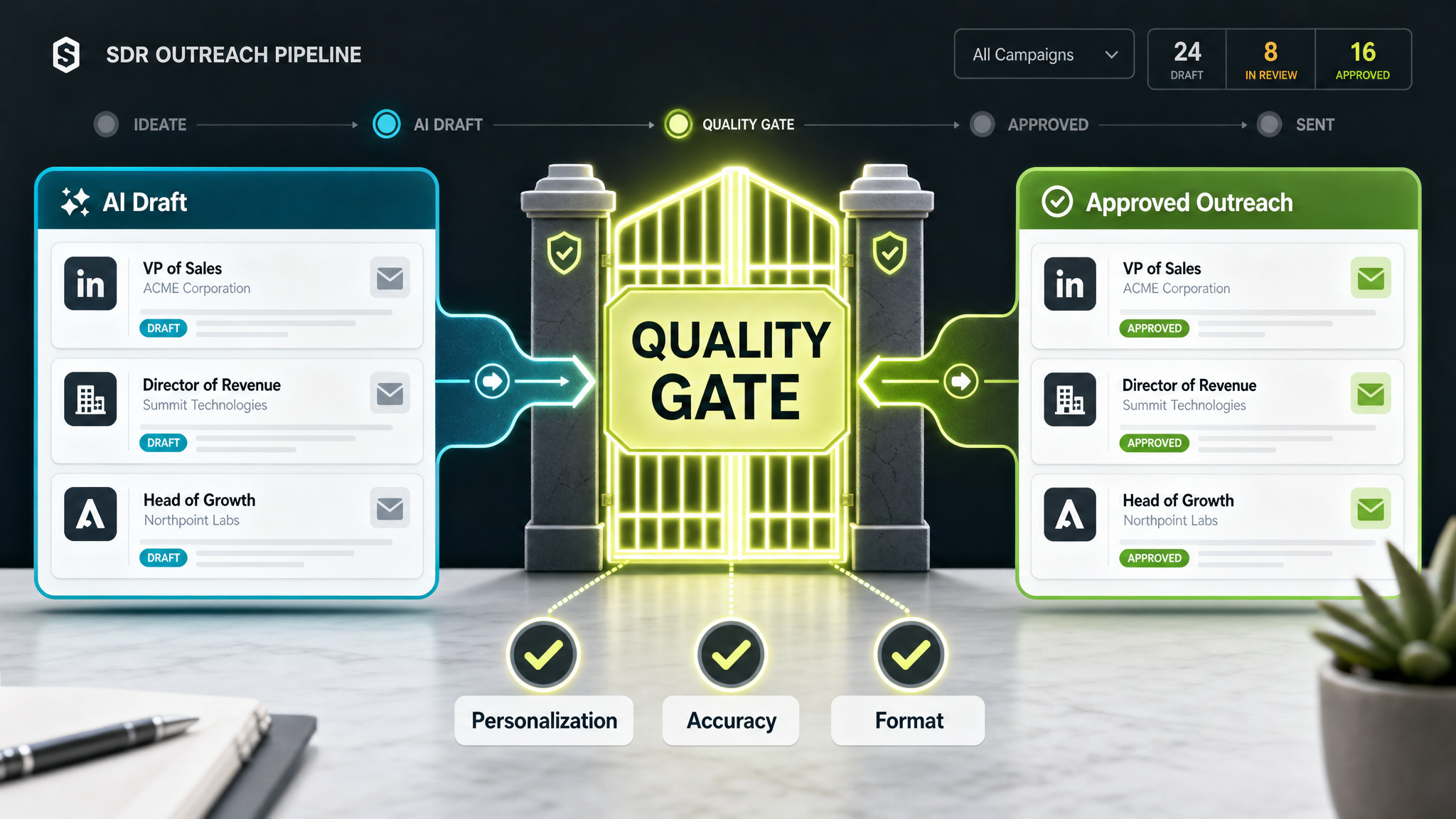
Every platform talks about personalisation. Almost none talk about verifying it. The typical workflow is draft, then either send immediately (fully autonomous) or have a person glance at it once (copilot). There's rarely a repeatable, structured gate in between — something that scores a draft for a generic opener, a factual error, or format issues, and kicks it back before it reaches anyone.
This matters because the loudest complaint across every independent review — "spam machine at scale," "turned SDRs into robots" — is the same complaint worded differently. The output wasn't good enough, and nothing caught it before it went out. A defensible architecture closes that gap with an explicit review pass: a second layer that scores each draft on personalisation depth, accuracy, and format, sending anything below the bar back for revision automatically rather than trusting a human to catch every miss across hundreds of sends a week.
How to Evaluate One Without Being Fooled by a Demo
A few rules drawn from documented buying mistakes in this category:
1. Don't buy on the demo. Most fully autonomous demos are scripted. Ask for three drafts written live, on the call, for a real prospect pulled from your actual CRM.
2. Fix the data foundation first. If your ICP isn't defined and your CRM is messy, no AI tool repairs that — it just personalises the mess faster.
3. Get the autonomy definition in writing. Which specific steps require human approval? A sales deck slide isn't a binding definition.
4. Ask directly: does anything score or check the draft before it ships? If the answer is "you do that," budget real time in your week for it — that review work doesn't disappear, it just moves to your calendar.
5. Measure a pilot on meetings held, not booked. No-show rates on AI-sourced meetings can make a weak tool look strong for the first 30 days.
6. Match autonomy level to deal complexity. Full autonomy suits high-volume, lower-stakes outbound. Complex, multi-stakeholder sales still benefit from a human somewhere in the loop.
The Real Cost Comparison
| Metric | Human SDR | AI SDR tool |
|---|---|---|
| Fully loaded annual cost | $100,000+ | $300–$11,000+/year depending on platform |
| Cost per lead | ~$262 | ~$39 — an 85% reduction |
| Time to productivity | ~3 months ramp | Days to weeks of configuration |
| Time actually spent selling | ~28% of working hours | Automates the other 72% |
The honest caveat: teams that use AI to augment human reps report 2.8x more pipeline than teams trying to fully replace the SDR function. Cost savings are real, but the strongest model in 2026 is still hybrid — AI handling volume and first drafts, humans handling judgment and the conversations that actually close.
Where AmroGen Fits in This Picture
AmroGen is built specifically around the review gap described above. The pipeline runs in four phases: a Lead Generator agent researches a target company directly from its website — no static lead list required — an Orchestrator plans the outreach strategy, specialist agents write channel-specific sequences for email, LinkedIn, and SMS, and then the Orchestrator scores every sequence on personalisation depth, accuracy, and format compliance before it ever reaches you. Anything below the threshold goes back automatically for revision.
That puts AmroGen in a hybrid-autonomous position: autonomous enough to remove the manual research and drafting burden entirely, with a structured review gate that most fully autonomous platforms in this market don't publish. Sequences send from your connected Gmail account rather than a fresh cold domain, handling deliverability risk without requiring domain purchases or warm-up periods.
See how the lead generation works and what the review step actually checks, or jump to the full platform comparison if you want every major tool side by side. If you're currently on a database-first tool like Apollo, the Apollo vs AmroGen breakdown covers what changes when you go from a static list to URL-based research.
FAQ
What is an AI SDR tool? Software that automates the prospecting, research, and outreach-writing work a human SDR would otherwise do — finding the right contacts, drafting personalised messages, and keeping multi-step sequences running across channels like email and LinkedIn.
Can AI fully replace SDRs in 2026? Sometimes. Roughly 22% of sales teams have fully replaced their SDR function with AI, while 45% run a hybrid model. Complex, high-value, multi-stakeholder deals still tend to need a human somewhere in the approval loop.
What's the best AI SDR tool for a small team? Depends on whether you already have a lead list. Teams without one benefit from tools that research and enrich from a domain or URL directly, rather than assuming a pre-built database.
How much does an AI SDR tool cost? Published pricing ranges from about $250 to $900+ a month for established autonomous platforms, against a fully loaded human SDR that typically runs past $100,000 a year.
What's the difference between an AI SDR and a BDR? Functionally very little at most companies — both describe early-funnel prospecting and qualification roles. Tools marketed under either label generally automate the same core tasks.
Do AI SDR tools actually work? Execution quality varies enormously. Signal-specific campaigns can hit roughly 18% reply rates versus the 3.43% generic average. The 50–70% annual churn in this category is the clearest evidence that quality — not the AI itself — is what separates the tools that work from the ones that don't.
What channels do they typically cover? Email is the default for nearly all of them, LinkedIn is the most common second channel, and far fewer coordinate email, LinkedIn, and SMS for the same lead inside one workflow.
Data reflects publicly available sources as of June 2026. Pricing and capabilities change — confirm current details directly with vendors before buying.