The AI SDR Software Nobody's Talking About (But Should Be) — 2026 Roundup
TL;DR
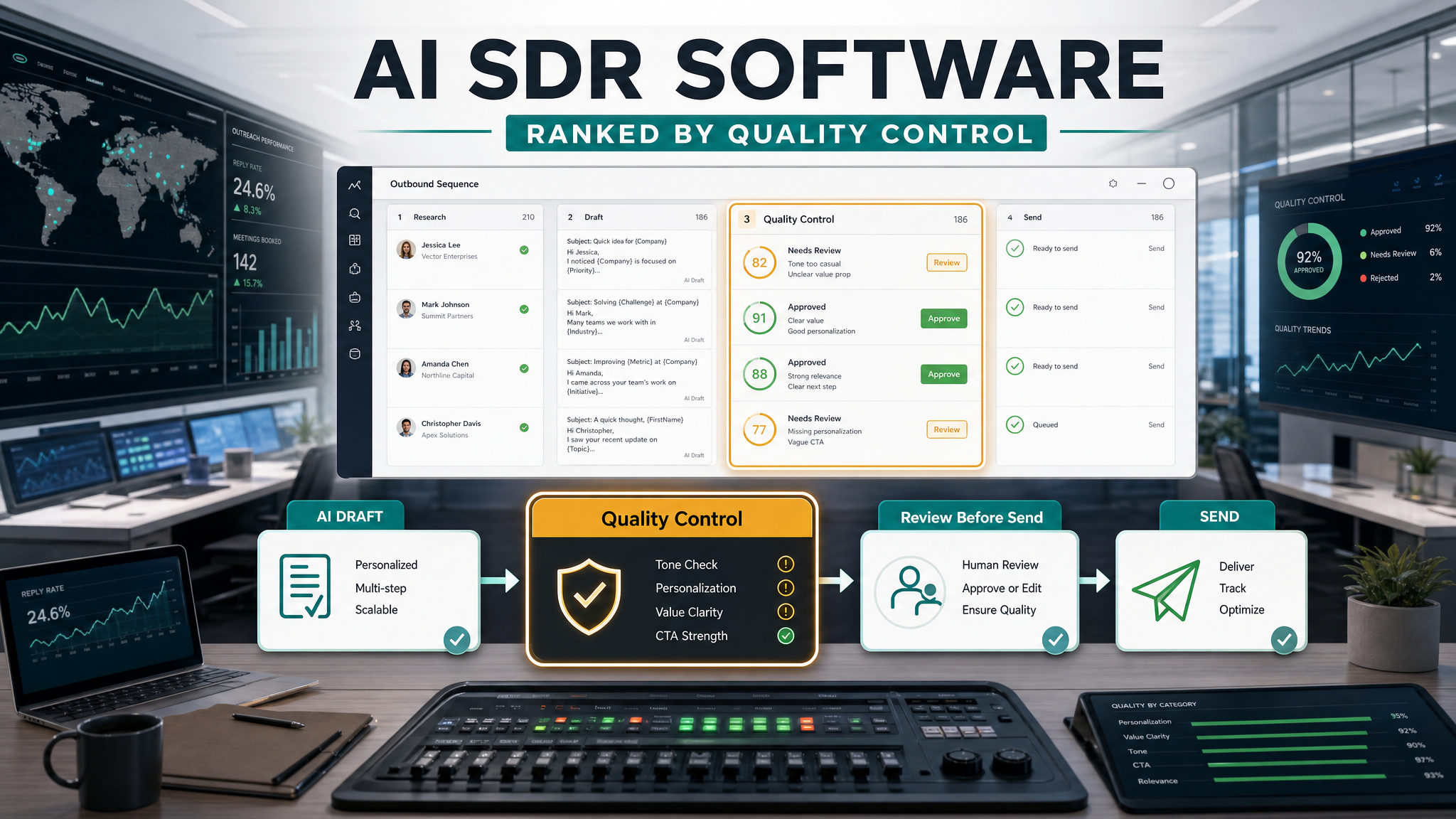
Open any "best AI SDR software" list and you'll find the same eight or nine tools ranked by feature count. Almost none of them answer the one question that actually predicts outcomes: does anything check the AI's output before it reaches a real prospect? Churn in this category runs 50–70% annually. The reason isn't a lack of AI capability — it's the absence of a quality gate between "the model generated this" and "this went out to someone's inbox." This piece ranks AI SDR software by whether it solves that problem, not by how many integrations it supports.
Table of Contents
- Why This Ranking Looks Different
- The Category Has a Real Quality Problem
- Four Questions Before You Look at Any Vendor
- Ranked by Quality Control
- What No Review Layer Actually Costs You
- Time to a Working Campaign
- FAQ
Why This Ranking Looks Different
Most AI SDR software comparisons are useful. A few of them, like the hands-on testing done by Saleshandy's team across nine platforms, are genuinely thorough. They tell you which database is bigger, how many channels each tool covers, and what the pricing tiers look like.
What almost none of them cover is what happens between "the AI drafted this" and "this is in a prospect's inbox." That step is where most campaigns succeed or fail, and it's the step most AI SDR software simply doesn't have. This ranking treats that gap as the primary evaluation criterion instead of an afterthought.
The Category Has a Real Quality Problem
The number that most vendor-adjacent content skips: annual churn for AI SDR software runs 50–70%. More buyers leave within a year than stay. That's not a sign of a young, rough category finding its feet — it's consistent evidence that something structural is broken in how most of these tools operate.
The research that actually digs into why people leave points at the same thing every time. It isn't that the AI isn't sophisticated enough. It's that an AI generating 70,000 generic emails is just a spam machine running at scale. The platforms that retain customers past year one are almost always the ones with some mechanism — a human review requirement, a signal-qualification gate, or an automated scoring loop — for catching bad output before it ships.
Every platform in this market promises "personalised outreach at scale" and "24/7 follow-up." The differentiator isn't the claim — it's whether the tool can demonstrate it live, on a real prospect from your CRM, without three weeks of configuration. That's the test that separates the tools that work from the ones that generate churn statistics.
Four Questions Before You Look at Any Vendor
These four questions eliminate most of the market before you've taken a single demo.
Do you already have a lead list?
If yes and it's solid, you need a tool that writes and sequences — Saleshandy, Instantly — not one that also does lead research. If no, or if your list is stale, you need something that sources and enriches by itself, like a URL-based lead generator or a database-first platform like Apollo.
How complex is your sales motion?
High-volume, lower deal size, broad TAM — fully autonomous tools suit this well. Complex, multi-stakeholder, high-value deals — a hybrid model with human checkpoints performs better. Full autonomy on those deals risks sending hollow, contextually thin outreach to senior buyers who'll spot it in the first sentence.
Do you have a RevOps or growth engineering function?
If yes, Clay's enrichment depth becomes genuinely valuable because someone exists to build and maintain the workflows. If no, an all-in-one platform that doesn't require Zapier chains and enrichment-source configuration will get you to a working campaign days faster.
Does the platform check its own work?
This is rare enough to be a real differentiator. If the answer is yes, find out exactly what gets scored — personalisation depth, factual accuracy, format compliance — and whether a failed draft gets revised automatically or just flagged for a human. If the answer is no, budget real time in your own week for reviewing drafts. That work doesn't vanish because the AI wrote the first version.
Ranked by Quality Control
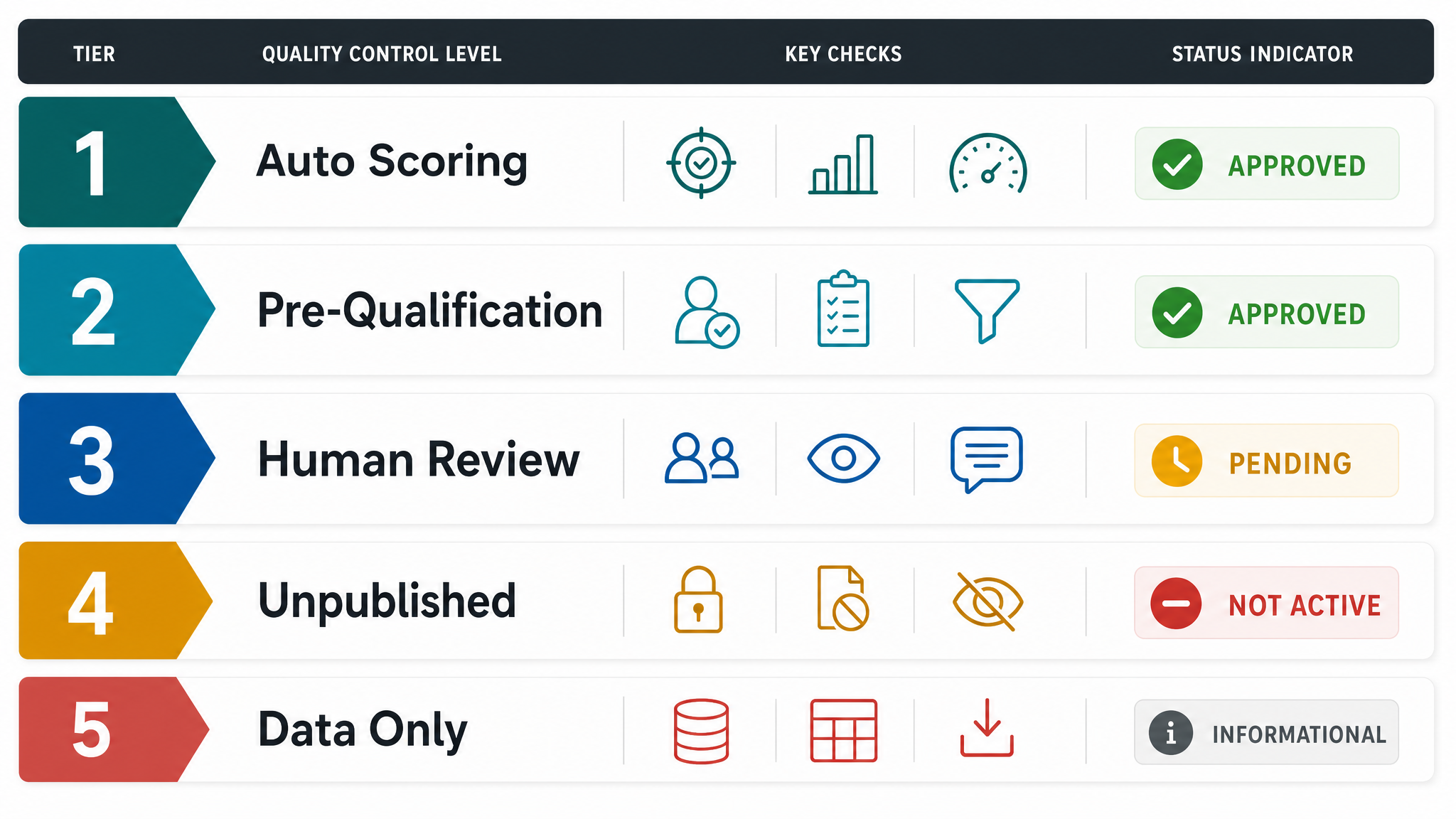
Instead of ranking by features, here's the market sorted by what stands between an AI-generated draft and a real prospect's inbox.
Tier 1 — Built-in automated scoring and retry
AmroGen. The Orchestrator agent scores every specialist agent's output for personalisation depth, factual accuracy, and format compliance, and sends weak drafts back for revision before they ever reach you for approval. It's the most explicitly documented quality gate in the category right now. Sequences also send from your own Gmail rather than a cold domain, which handles deliverability risk without requiring domain purchases or warm-up periods. → See how the review loop works
Tier 2 — Qualification before drafting
Coldreach. Doesn't review copy after it's written — instead, it qualifies the account before any copy gets drafted, screening for pain, status quo, and timing. This catches a different failure mode (wasted outreach to the wrong account) rather than bad copy aimed at the right one. Both are real problems; this is the tool that solves the targeting one.
Tier 3 — Human review by design
Saleshandy, Apollo.io, and similar copilots. These are explicit that a person reviews before anything sends. That's not a weakness — it's a different model that puts quality control in human hands rather than software. If you have the reviewer capacity and want that control, it works. Saleshandy's own description of the intended workflow is candid: the AI handles prospecting, sequencing, and deliverability; you stay in control of every conversation.
Tier 4 — No published review mechanism
Artisan, 11x.ai, AiSDR, Salesforge. All marketed as fully autonomous. None of the independent research covering them — including Topo.io's pricing comparison and Unify GTM's evaluation framework — describes an explicit quality-scoring step between draft and send. That doesn't mean output quality is poor — Artisan's personalisation has improved substantially in 2026 — it means if a bad draft happens, the mechanism for catching it isn't documented the way it is in Tier 1 or Tier 2.
Tier 5 — Not a writing tool
Clay, ZoomInfo Copilot. They don't write or send outreach, so the quality-control question doesn't apply to them directly. They improve the inputs to whatever tool does the writing downstream, which indirectly helps.
What No Review Layer Actually Costs You
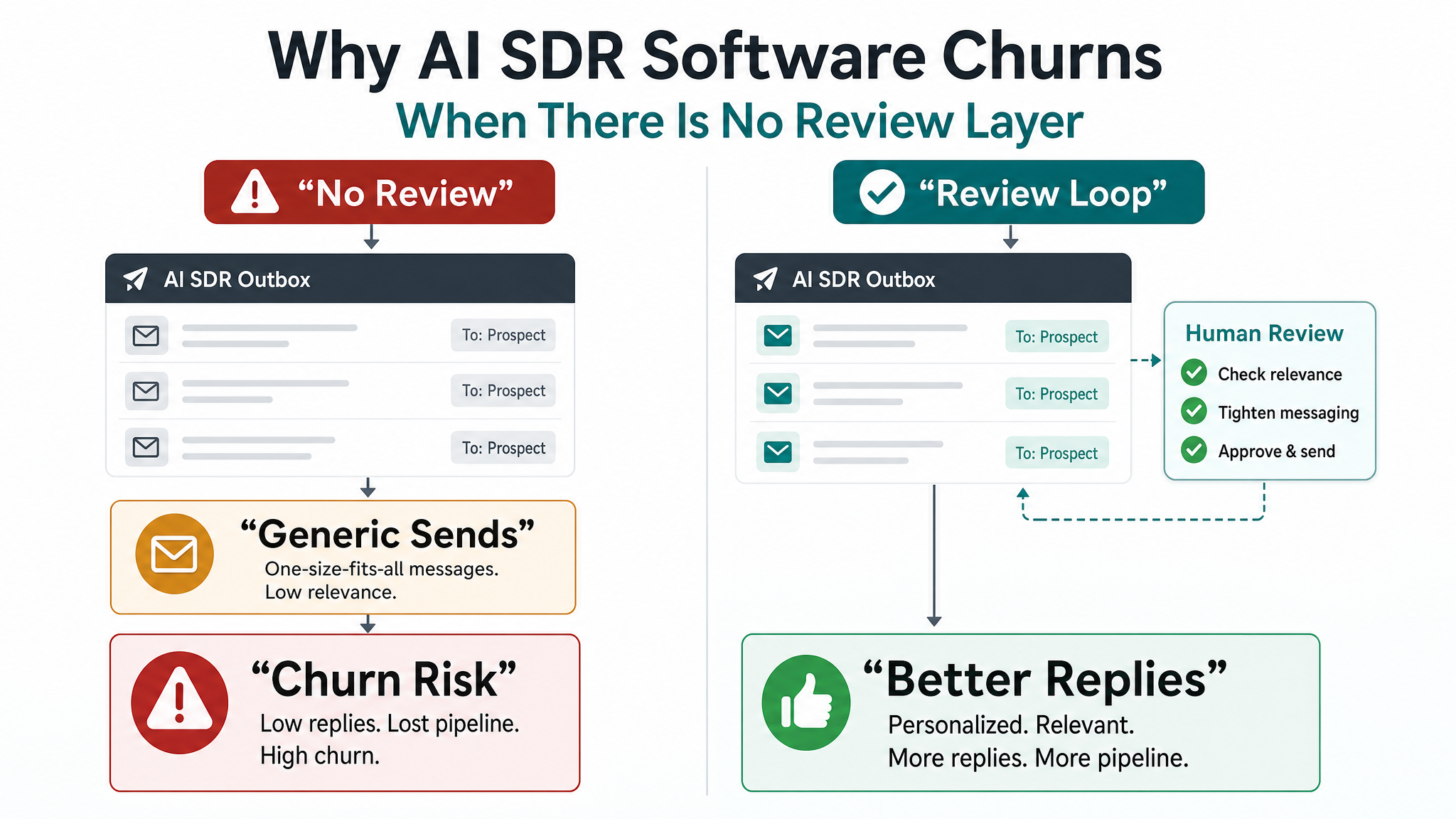
This isn't a hypothetical risk. The pattern shows up consistently across the independent research and community commentary on this category. Three quotes, three different sources, the same underlying point:
"An AI that sends 70,000 generic emails is just a spam machine at scale." — Salesmotion
"We turned SDRs into robots. And now they're being replaced by robots." — John Barrows, quoted in Salesmotion's analysis
"Most AI SDR software is overhyped garbage that floods inboxes with spammy outreach and tanks your domain reputation." — Chrysales, in their tested roundup
The common thread is the absence of a checkpoint. When a fully autonomous tool drafts and sends in the same motion, the only quality control is whatever the model produces first-pass across every lead simultaneously. One bad prompt, one missing data point, one misread signal — and it compounds across hundreds of sends before anyone notices. That's the failure mode a review layer is there to catch before it gets expensive.
Time to a Working Campaign
One factor almost every comparison ignores: how long between signing up and having a live, actual campaign running?
| Tool | Realistic setup time |
|---|---|
| Saleshandy | ~10 minutes to first active sequence |
| AmroGen | Minutes — paste a URL, review leads, approve sequences, send |
| Clay | Hours to days — table setup, enrichment-source configuration, downstream tool connections |
| Lyzr (Jazon) | Days to weeks for custom agent blueprint configuration |
| Enterprise platforms (11x.ai, ZoomInfo Copilot) | Typically requires a full sales cycle before deployment begins |
Setup time matters more than most buyers weigh it upfront. A tool that takes two weeks to configure delays the first real signal on whether personalisation quality is actually good — by which point budget and internal credibility have already been committed to the decision.
FAQ
What does AI SDR software actually do? Automates the research, personalisation, and initial outreach work a human SDR would otherwise handle — finding contacts, writing tailored messages, and managing multi-step sequences across channels like email and LinkedIn.
Is it legal? Yes, with specific practices governed by law. Cold email is regulated by CAN-SPAM in the US, GDPR in the EU, and CASL in Canada — governing consent, opt-out, and data use. LinkedIn automation is separately constrained by LinkedIn's own User Agreement, which is why most platforms throttle connection request volume to stay within the limits.
How does AI SDR software handle LinkedIn? Most generate LinkedIn-ready copy, but sending mechanics vary. Some automate sending within LinkedIn's daily limits; others produce the copy for manual sending to avoid account restriction risk entirely.
What's the ROI? Teams augmenting human reps with AI rather than replacing them outright report 2.8x more pipeline generated. Cost per lead has been measured at $39 with AI versus $262 for a fully loaded human SDR — an 85% reduction.
Which is easiest to set up? Tools without a separate lead-list import step or enrichment-source configuration tend to get you to a first working campaign in minutes rather than days.
Does AI SDR software generate spam? It can — if there's no quality or targeting check in the pipeline. The line between AI SDR software that drives replies and software that damages domain reputation is whether messages are genuinely personalised and targeted, versus generic content blasted at volume.
What happens when it gets a reply? Varies by platform. Some include automated reply classification and objection handling. Others route every reply to a human immediately. Confirm this explicitly before signing — it's one of the most commonly misunderstood capabilities in demos.
Internal links: /ai-sdr-tools · /features/ai-sequences · /about
Data reflects publicly available sources as of June 2026. Pricing and capabilities change — confirm current details directly with vendors.