AI Sales Outreach Platform: What "AI-Powered" Should Actually Mean (And Usually Doesn't)
TL;DR
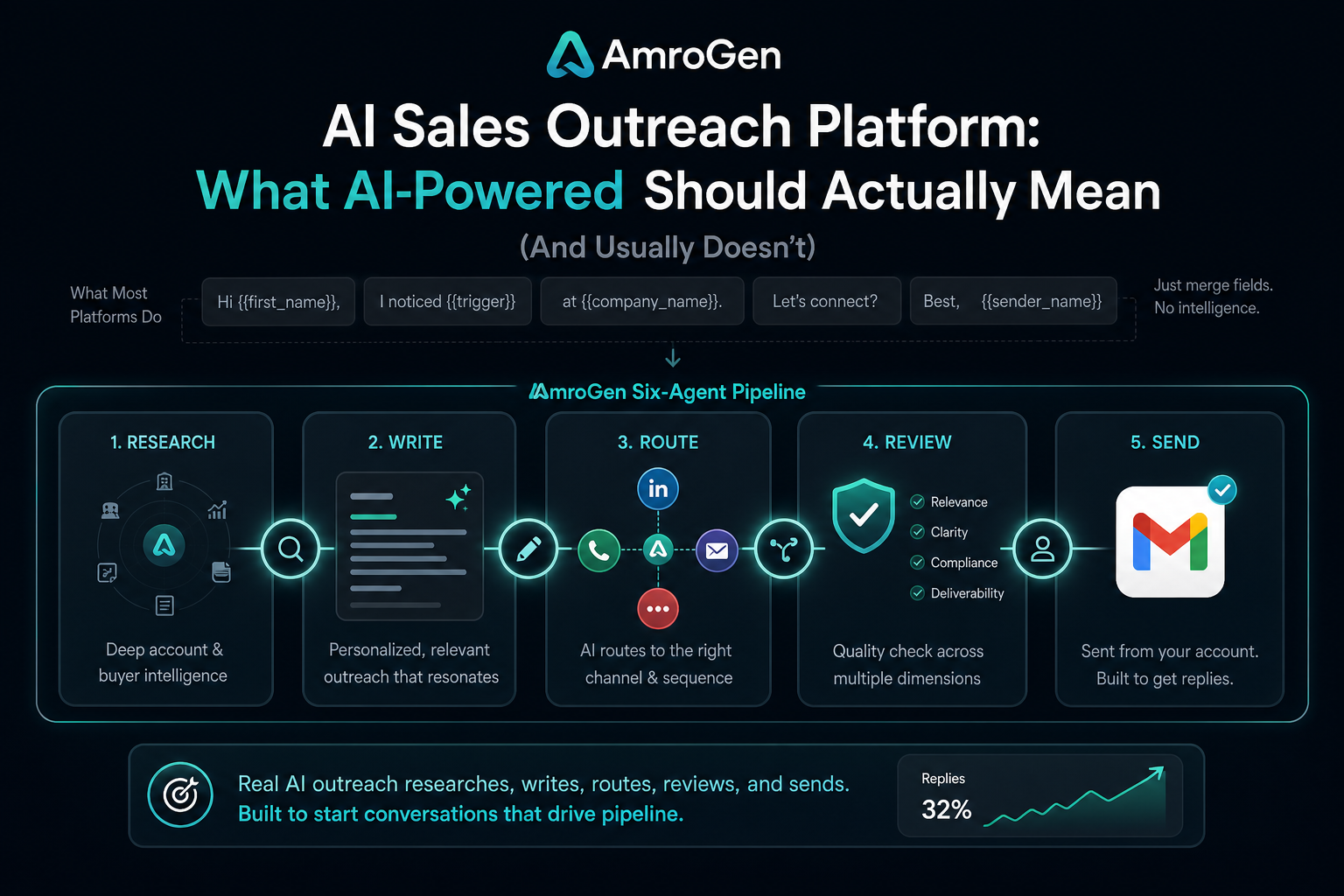
Over 70% of B2B sales teams now use some form of AI-powered outreach. Most are using it, as one industry analysis put it bluntly, "to do the same dumb thing faster" — more messages, more "I noticed you work at {company}" templates that fool nobody. The label "AI sales outreach platform" has become nearly meaningless because it gets applied to anything from a tool that drops a name into a merge field to a genuinely autonomous research-and-write pipeline. This piece defines what the label should mean, what separates real AI outreach from a relabelled mail merge, and uses AmroGen's six-agent pipeline as a concrete example of what the upper end of the category actually does.
Table of Contents
- The Problem With "AI-Powered" as a Label
- Three Levels of AI Outreach
- What a Genuine AI Sales Outreach Platform Should Do
- AI Sales Outreach vs Sales Engagement: The Difference
- The Six-Agent Pipeline as a Working Example
- How to Tell the Difference in a Demo
- FAQ
The Problem With "AI-Powered" as a Label
The phrase "AI sales outreach platform" describes everything from a tool that runs a single GPT call to insert a name and company into a fixed template, to a multi-agent system that researches a company, writes from that research, and checks its own output before anything ships. Both call themselves AI-powered. Both show up in the same comparison articles. The buyer has no easy way to tell them apart from the marketing copy alone.
The consequence is documented clearly across recent industry analysis: the best AI-powered outreach tools now pull from 75+ variables to tailor every message — job changes, content engagement, mutual connections, recent posts, company news, funding rounds, tech stack changes. The weaker end of the category still produces messages like "I noticed you're the VP of Sales at Acme Corp" — technically AI-generated, technically personalised, and instantly recognisable as neither.
Three Levels of AI Outreach
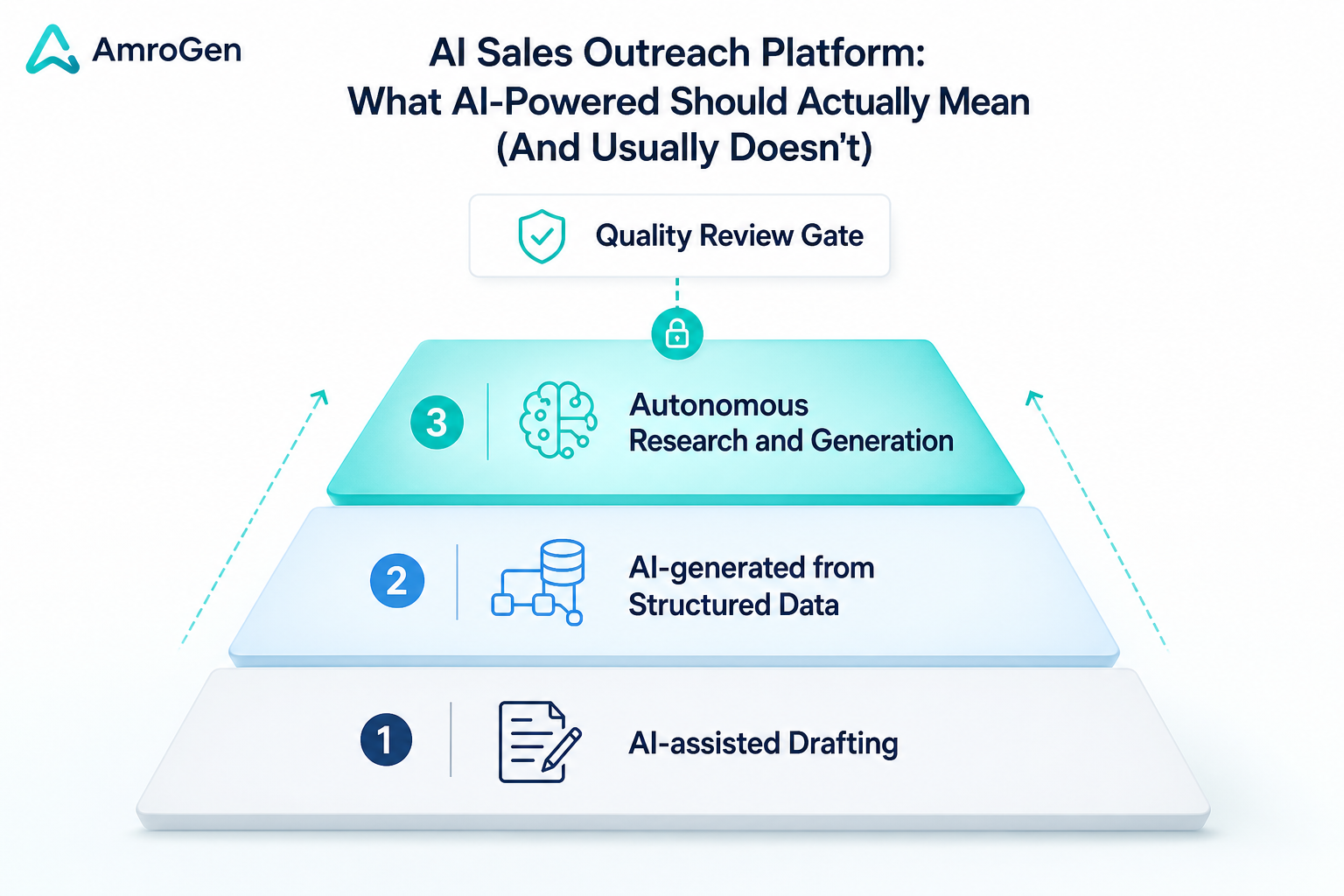
A useful way to sort what "AI-powered" actually means in practice, based on how deeply the AI is involved versus how much is still manual or templated.
Level 1 — AI-assisted drafting. A human writes a base template; AI fills in variable fields (name, company, title) or suggests minor phrasing tweaks. This is the most common implementation and the one doing the most damage to the category's credibility, because it's the version producing the "I noticed you work at {company}" messages that read as automated because they substantially are.
Level 2 — AI-generated from structured data. The AI writes the full message, not just variable fields, pulling from structured prospect data (title, company, industry, recent signals) to generate genuinely new copy per recipient rather than filling slots in a fixed structure. This is meaningfully better than Level 1, but the personalisation depth is capped by how much structured data is actually available and fed into the model.
Level 3 — Autonomous research and generation. The AI researches the prospect and company from scratch — browsing live sources, not just querying pre-loaded fields — and writes from that research. Most sales teams are currently stuck at Level 1 or 2; the competitive edge in 2026 is in making the jump to Level 3, not in adopting AI at all, since nearly every team already has.
A platform at Level 3 should also include a step that Level 1 and 2 tools almost universally skip: verification that what got generated is actually good, before a human or a prospect sees it.
What a Genuine AI Sales Outreach Platform Should Do
Four things, in combination, distinguish a real AI sales outreach platform from a relabelled sequencing tool with a GPT API call bolted on.
It researches before it writes. Not "pulls the title field from a CRM record" — actually gathers current, specific information about the lead and their company that a human researcher would have found by spending fifteen minutes on the prospect's LinkedIn and website.
The personalisation is structural, not cosmetic. The difference between "Hi {first_name}, I noticed you work at {company}" and a message that demonstrates the sender actually understood something about the prospect's current situation. The first message tells the prospect you have a database; the second tells them you're paying attention — and only one of those gets a reply.
It coordinates across channels intelligently, not mechanically. A genuine multi-channel AI platform adjusts which channel it prioritises based on what's actually working for that prospect — shifting toward email if someone consistently engages there and ignores LinkedIn, rather than blasting every channel simultaneously regardless of signal.
It checks its own output before a human or a prospect sees it. This is the step almost no platform in this category implements, and it's the single clearest differentiator between "AI wrote this" and "AI wrote this and verified it met a quality bar."
AI Sales Outreach vs Sales Engagement: The Difference
These terms get used almost interchangeably in vendor marketing, but they describe different things. A sales engagement platform — Outreach, Salesloft — automates the execution layer: sequencing, tracking, and follow-up logic across channels, typically assuming a human or another tool has already written the copy and built the list. An AI sales outreach platform, properly defined, automates further upstream: the research and writing itself, not just the delivery and tracking of messages someone else created.
In practice, most platforms blend both to some degree — Outreach has added AI agents for prospect research and prioritisation on top of its core engagement infrastructure, and several engagement platforms now include an AI copy assistant. The distinction that actually matters for evaluating a platform isn't which label it uses, but how much of the actual thinking — research, targeting, writing, and quality control — happens inside the AI versus how much is still manual work the platform is simply scheduling and tracking.
The Six-Agent Pipeline as a Working Example
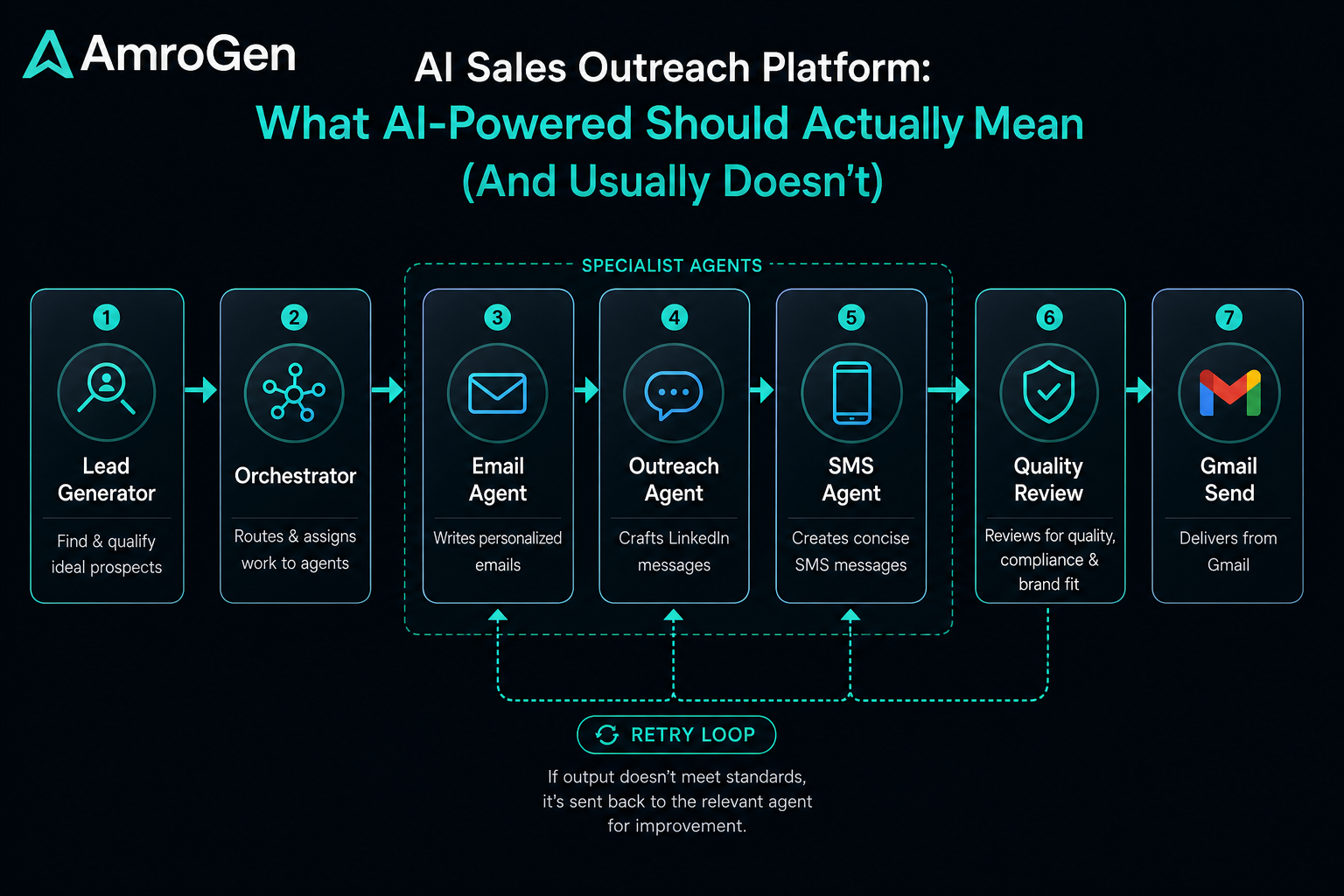
AmroGen is structured specifically to sit at Level 3 of the framework above, with the quality-check step most platforms skip built in as a core part of the architecture, not an add-on.
The pipeline runs in sequence: a Lead Generator agent researches a target company directly from its URL — reading the live website, LinkedIn presence, and public job listings — to find and verify decision-makers, rather than querying a stored database. An Orchestrator agent then plans the outreach strategy per lead, deciding which channels make sense based on what contact data was actually found (email-only leads get email sequences; leads with LinkedIn and phone get the full multichannel treatment). Specialist agents — Email, Outreach, and SMS — generate channel-specific sequences from the research the Lead Generator surfaced, writing genuinely new copy per lead rather than filling template slots. Finally, the Orchestrator reviews every sequence those specialist agents produced, scoring it on personalisation depth, factual accuracy, and format compliance, sending anything below a quality threshold back for automatic revision before a human ever sees it.
Sequences then send from the user's own connected Gmail account, which sidesteps a separate but related "AI-powered" problem — platforms that generate excellent copy but send it from a cold domain with no sender history, undermining the personalisation with poor deliverability.
How to Tell the Difference in a Demo
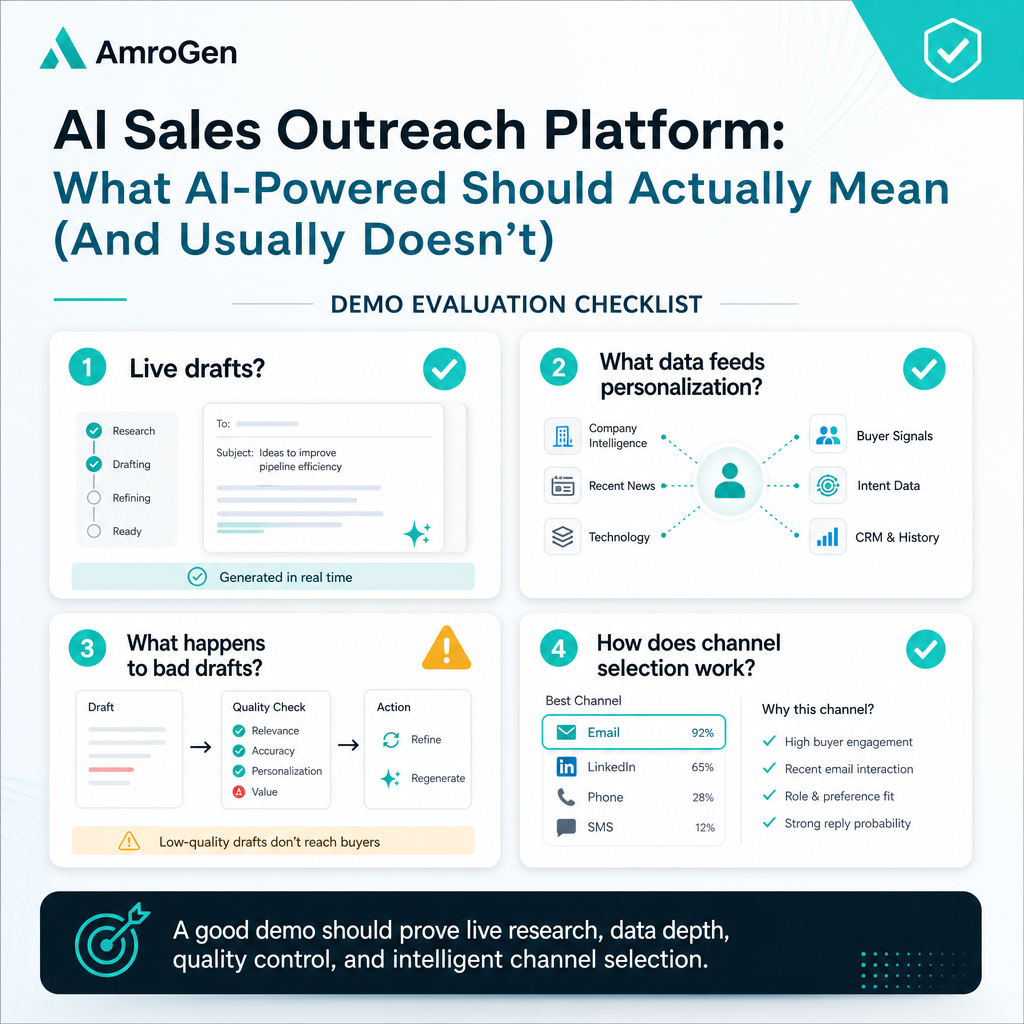
A few direct questions separate Level 3 platforms from relabelled Level 1 tools, regardless of what the marketing site claims.
Ask for three live-generated drafts for a real prospect, not a pre-built demo example. Scripted demos hide the gap between what the platform can do and what it does by default.
Ask exactly what data feeds the personalisation. "Title and company" is Level 1 or 2. "Current job listings, recent public statements, company news from the last 30 days" is Level 3.
Ask what happens to a bad draft. If the answer is "you review and fix it yourself," that's the platform shifting the quality-control burden onto you rather than solving it. If there's a structured review step that catches and revises weak output automatically, that's the differentiator that actually matters.
Ask how channel selection works. If every lead gets the exact same channel mix regardless of what contact data exists, that's mechanical automation, not intelligent routing.
FAQ
What is an AI sales outreach platform? Software that uses AI to automate the research, writing, and (in the more advanced tier) quality review of sales outreach — as distinct from a sales engagement platform, which automates the scheduling and tracking of outreach that's already been written. The label is applied loosely across the category, so the actual depth of AI involvement varies enormously between platforms claiming it.
What is the difference between sales engagement and AI outreach? Sales engagement platforms (Outreach, Salesloft) automate sequencing, tracking, and follow-up logic for outreach that's typically already been written by a human or another tool. AI outreach platforms automate further upstream — the research and copy generation itself. Many platforms now blend both, which is part of why the terms get used interchangeably in marketing despite describing different layers of the workflow.
Which AI outreach platform has the best personalisation? The strongest signal isn't a specific tool name — it's what data feeds the personalisation (current, live-researched signals versus static CRM fields) and whether there's a quality check before output reaches a prospect. Platforms that research from live sources and verify their own output before sending tend to outperform ones generating from static fields alone.
How does AI handle sales outreach? At its most basic, AI inserts variable fields into a fixed template. At a more advanced level, AI generates full message content from structured prospect data. At the most advanced level — where genuine differentiation lives in 2026 — AI researches the prospect and company from live sources, writes from that research, and checks its own output for quality before a human or prospect ever sees it.
Reflects publicly available information and industry analysis as of June 2026.
Internal links: /ai-sdr-tools · /features/ai-sequences · /about · /pricing