What AI Outreach Sequences Actually Look Like — And How to Review One Before Approving
TL;DR
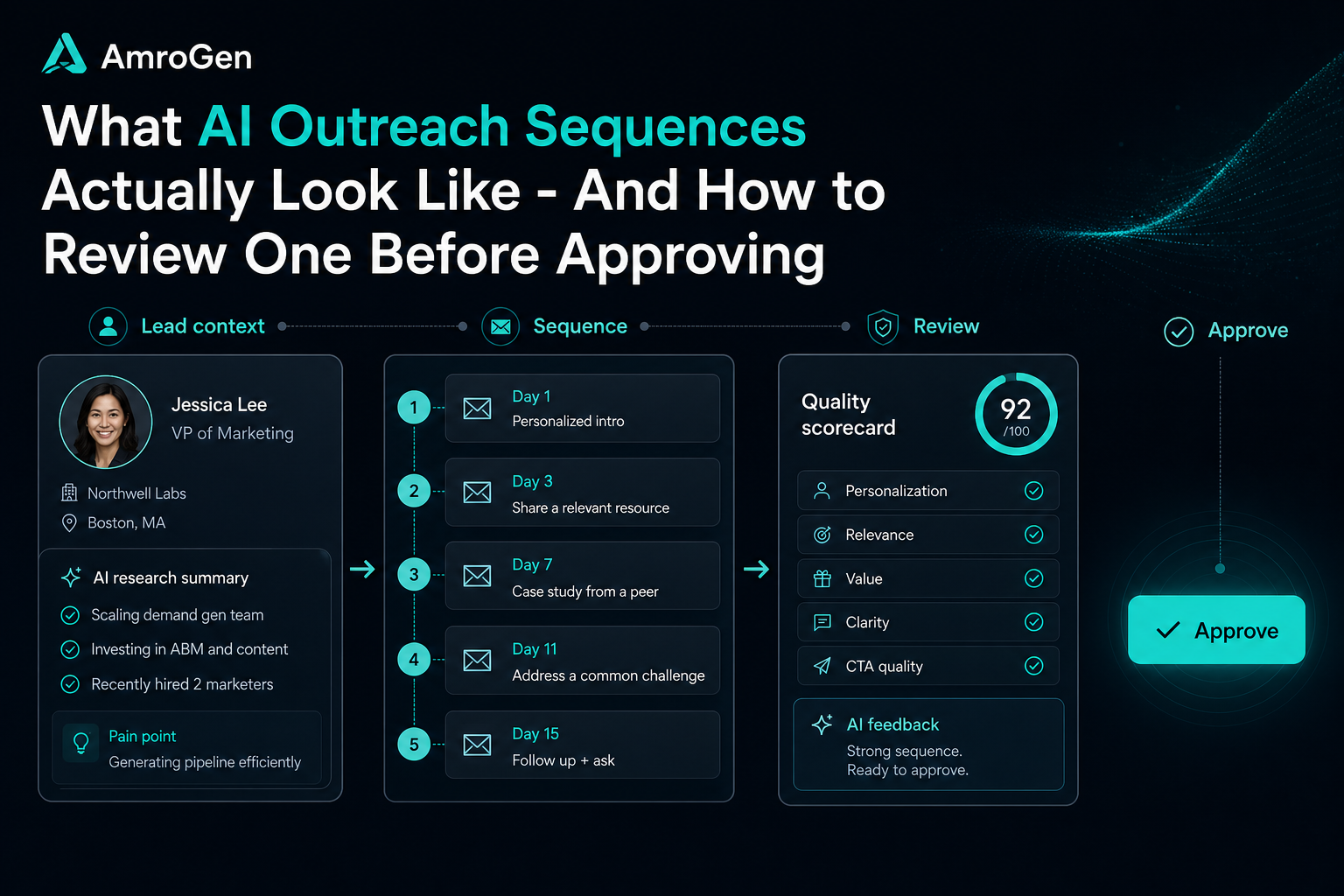
Most content about AI outreach sequences talks about the concept in the abstract — "personalised at scale," "multi-channel cadences." Almost none of it shows the actual output. This piece does: a full example sequence (email, LinkedIn, SMS) generated by AmroGen for a fictional lead, annotated to show exactly what makes each message specific to that person rather than swappable with any other recipient — plus the criteria the Orchestrator's quality review checks before any of it reaches a human for approval.
Table of Contents
- What an AI Outreach Sequence Actually Is
- The Lead and the Context
- Full Sequence: Annotated
- What the Quality Review Checks Before You See This
- How Many Steps a Sequence Should Have
- Which Channels to Use and When
- What to Look For When Reviewing a Sequence Yourself
- FAQ
What an AI Outreach Sequence Actually Is
An AI outreach sequence is a structured set of touchpoints — emails, LinkedIn messages, SMS, or a mix — generated for a specific lead, spaced across days, with each step building on the last rather than repeating the same pitch. The "AI" part covers two different things depending on the tool: some platforms use AI to personalise a template you've already written (inserting a name, company, or a researched detail into fixed slots); others, including AmroGen, generate the sequence's actual content from scratch, based on research about that specific lead, with no underlying template at all.
The distinction matters for what you should expect to see. A templated sequence reads structurally identical across recipients with different details swapped in. A sequence generated from research reads like it was written for one person, because functionally, it was.
The Lead and the Context
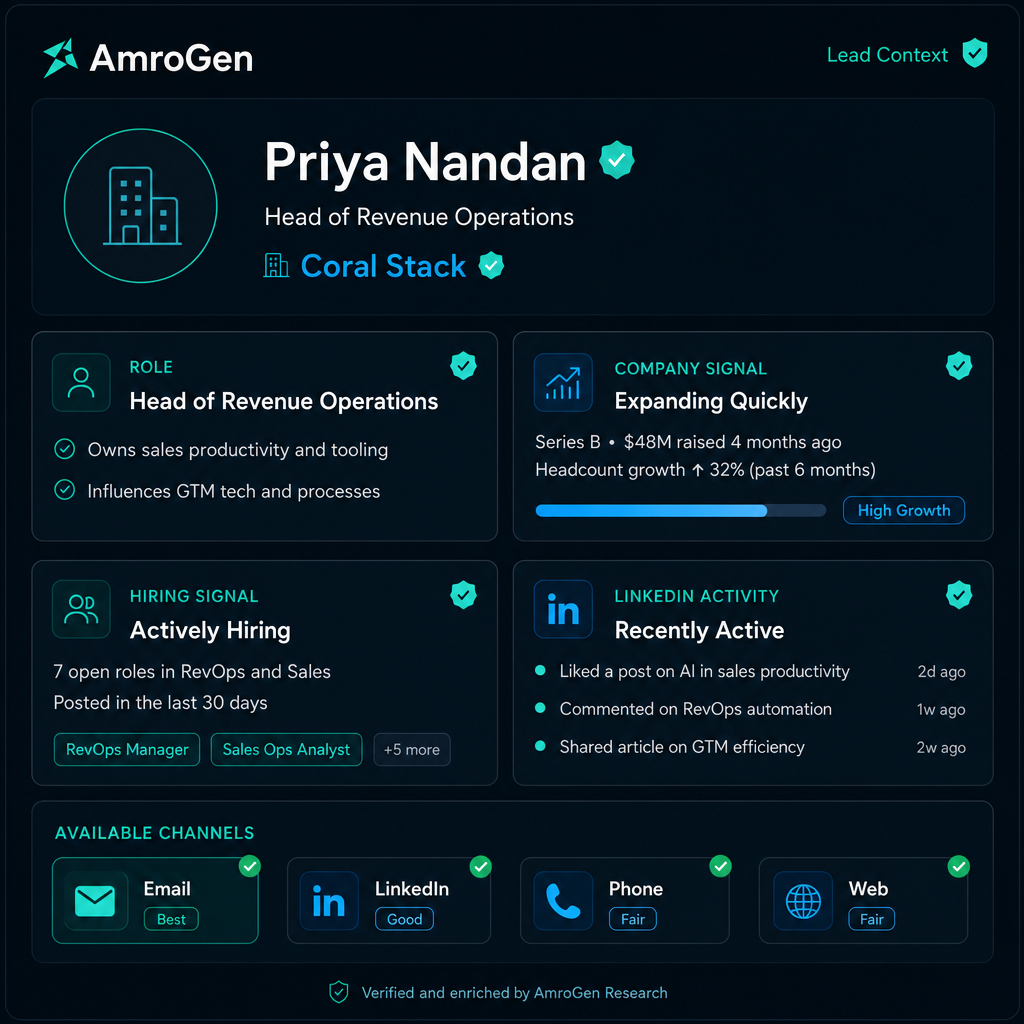
To make this concrete rather than abstract, here's a full example. The lead and company below are fictional, built to represent a realistic profile AmroGen's Lead Generator agent might surface and enrich.
Lead: Priya Nandan Title: Head of Revenue Operations Company: Coral Stack (fictional) — Series B SaaS, ~85 employees Context surfaced by the Lead Generator agent: Three open job listings for enterprise AEs posted in the last two weeks. A recent company blog post discussing their expansion into the EU market. LinkedIn activity showing Priya engaging with posts about RevOps tooling consolidation. Channels available: email where available, LinkedIn profile URL, no phone number on file.
Because no phone number was found, the Orchestrator routes this lead to email and LinkedIn only — no SMS step gets generated. This routing decision happens automatically based on what contact data the Lead Generator actually found, not a fixed template applied to every lead regardless of available channels.
Full Sequence: Annotated
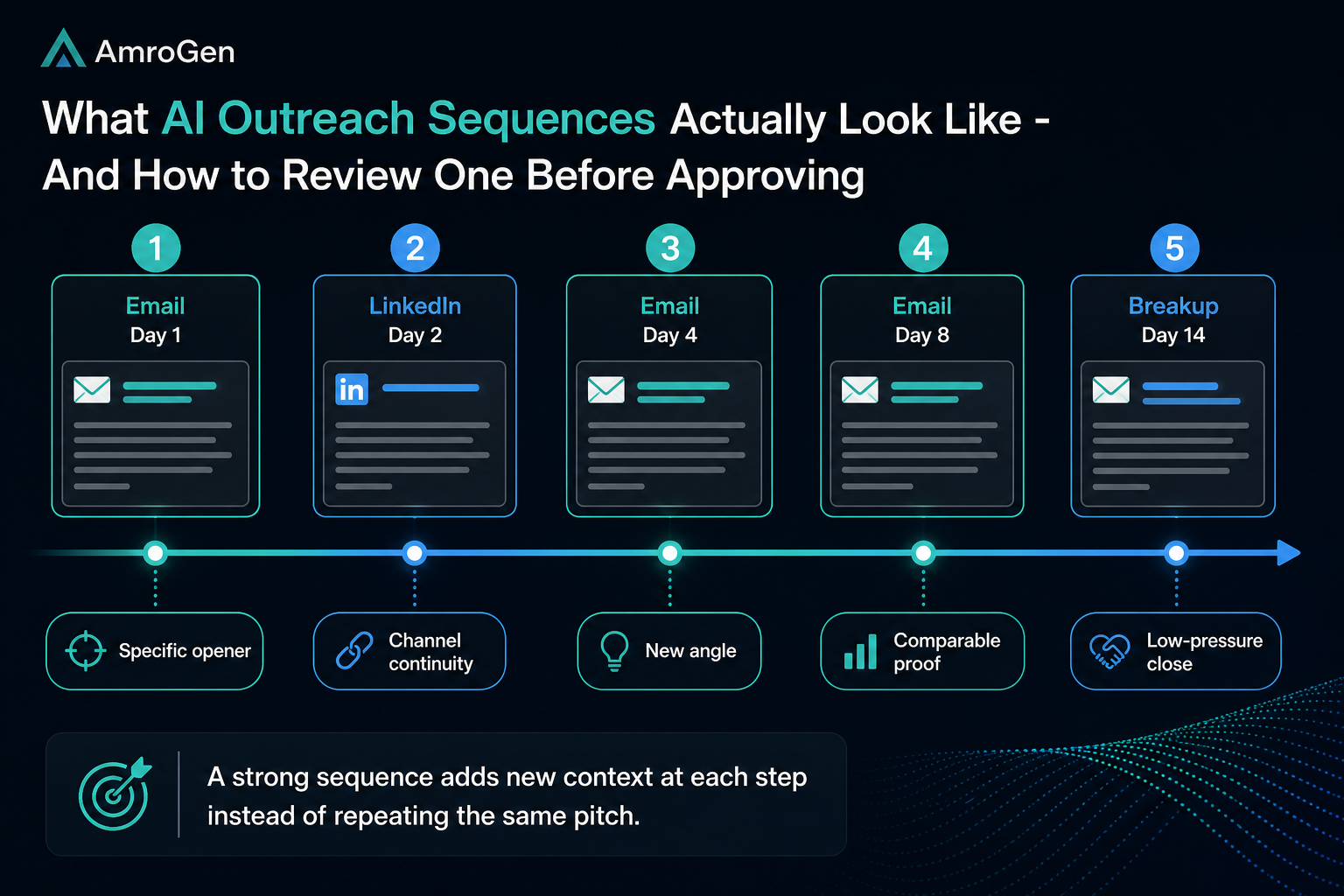
Step 1 — Email, Day 1
Subject: Coral Stack's EU expansion + 3 new AE hires
Hi Priya,
Saw the blog post about Coral Stack's EU expansion, and the three enterprise AE roles you've got open right now — usually means RevOps is about to get stretched managing a bigger, more distributed pipeline without more headcount on your side.
We help RevOps leads at that exact stage consolidate tooling so reporting and forecasting don't break when the team doubles. Worth 20 minutes to see if it's relevant to what you're building?
[Seller Name]
Why this works: The opener references two specific, verifiable facts (the EU expansion post, the three AE listings) and draws an inference connecting them to a likely RevOps pain point — not a generic "saw your profile" opener. The value proposition is framed for Priya's specific role and stage, not a generic pitch that could go to any RevOps title.
Step 2 — LinkedIn connection request, Day 2
Hi Priya — following up from a note I sent about Coral Stack's EU expansion. Would love to connect and share how we've helped similar RevOps teams scale tooling without the reporting headaches.
Why this works: Under 300 characters, references the email already sent (continuity across channels, not a cold restart), no pitch — just a reason to connect that ties back to the same specific context.
Step 3 — Email, Day 4
Subject: Re: Coral Stack's EU expansion + 3 new AE hires
Hi Priya,
Following up — I imagine the AE hiring alone is keeping you busy this week.
One thing that surprised a few RevOps leads we've worked with at a similar stage: the bottleneck usually isn't the CRM itself, it's reconciling forecast data across tools once the team grows past 15-ish reps. If that's on your radar at all, happy to walk through how we've handled it elsewhere.
[Seller Name]
Why this works: A new angle, not a repeat of step 1's pitch — the value proposition shifts from "tooling consolidation" to a more specific operational detail (forecast reconciliation at a particular team size), which signals genuine domain knowledge rather than a single talking point being recycled.
Step 4 — Email, Day 8
Subject: How [Comparable Company] handled the same RevOps stretch
Hi Priya,
A team in a similar spot — Series B, expanding into a new region, scaling the AE team — ran into the exact reporting fragmentation issue I mentioned. Took them about three weeks to fix once they had the right setup.
Happy to share specifics if useful, no pressure either way.
[Seller Name]
Why this works: Social proof framed around a comparable situation (stage, expansion, team growth) rather than a generic "we've helped 500 companies" claim. The closing line lowers pressure rather than escalating the ask, which is the standard pattern for a mid-sequence step rather than a final one.
Step 5 — Email, Day 14 (break-up)
Subject: Last note from me
Hi Priya,
I'll stop following up here — but if the RevOps/reporting friction around the EU expansion becomes more urgent, feel free to reach out anytime.
Good luck with the AE ramp.
[Seller Name]
Why this works: Break-up emails are consistently among the highest-reply steps in a sequence, because they remove pressure and signal the sender respects the recipient's time. Referencing the same specific context (EU expansion, AE ramp) one more time, briefly, keeps it from feeling like a templated sign-off.
What the Quality Review Checks Before You See This
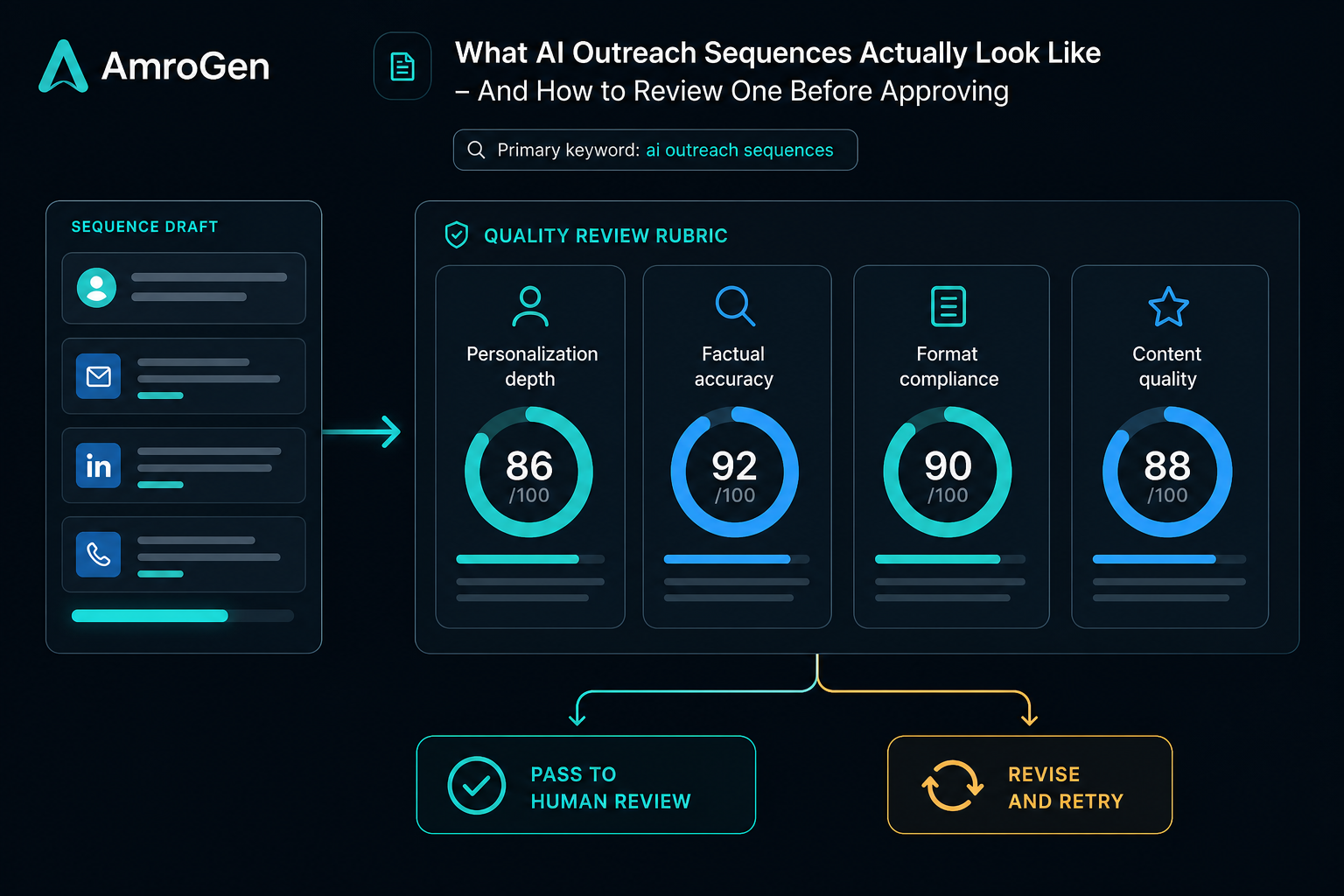
Before any of the five steps above would reach you for approval, AmroGen's Orchestrator agent scores the full sequence against four criteria, and sends it back to the Email and Outreach agents for revision if it falls short.
Personalisation depth. Does each step reference something specific and checkable about Priya's role or company — or could the same message have been sent to any RevOps lead at any Series B company? A sequence that swaps "Coral Stack" for a company name without anything else changing would fail this check.
Factual accuracy. Is the referenced context (the EU expansion post, the job listings) accurate and current as of the campaign run date? A sequence referencing a six-month-old funding round as if it just happened would be flagged.
Format compliance. Subject lines under 50 characters, LinkedIn connection requests under 300 characters — the constraints in this example sequence weren't incidental, they're enforced automatically.
Content quality. Would a thoughtful person actually send this? The Orchestrator is specifically checking for template-sounding openers ("I hope this finds you well," "I wanted to reach out") and generic value propositions that don't reflect anything specific about the lead.
If the sequence above scored below 7/10 on this rubric, it would be regenerated — up to three attempts — before ever reaching a human for review. You're not reviewing a first draft; you're reviewing something that already passed a structured bar.
How Many Steps a Sequence Should Have
The five-email structure above (days 1, 4, 8, 14, 21 — with LinkedIn interleaved) reflects a widely supported pattern across cold outreach research: enough touches to build context across multiple weeks, spaced to avoid feeling like pressure, ending with a low-pressure break-up step that consistently performs well precisely because it doesn't ask for anything new. Sequences shorter than three steps tend to underperform simply because most replies — across every benchmark — come from follow-ups, not the first message. Sequences longer than six or seven steps tend to show diminishing returns and start to read as pestering rather than persistence.
Which Channels to Use and When
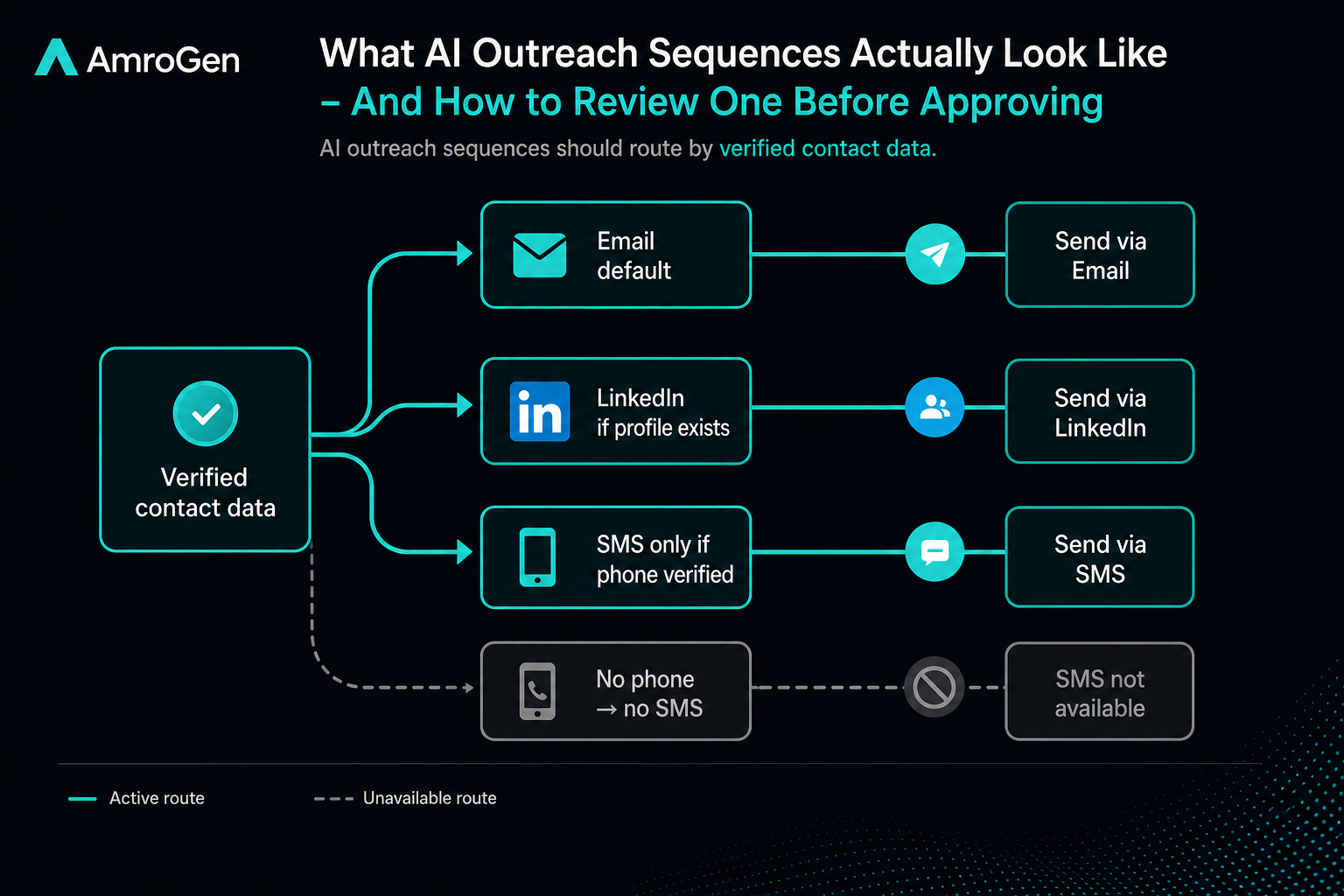
The lead in this example had email and LinkedIn but no phone number, so SMS wasn't generated — that's the routing logic working correctly, not a gap. In general: email is the default channel for nearly every B2B sequence, since it's universal and doesn't require platform-specific automation risk. LinkedIn adds real value when a verified profile is available, because it's a channel decision-makers actually check, and a connection request that references the same context as the email reinforces the message rather than starting cold. SMS is the most situational — it only makes sense when a verified phone number exists and the message can stay extremely short and direct; it should never be the first touch in a sequence, since a cold SMS without prior context reads as far more intrusive than a cold email.
What to Look For When Reviewing a Sequence Yourself
If you're approving AI-generated sequences — from AmroGen or any other tool — before they reach a real inbox, a few quick checks catch the most common failure modes. Read the opening line in isolation: could it have been sent to literally anyone with this job title? If yes, it failed personalisation regardless of how polished the rest of the email reads. Check whether each step in the sequence says something genuinely new, or whether step 3 is just a rephrased version of step 1's pitch. Confirm any referenced fact (a funding round, a job posting, a quote) is actually current — AI-generated content can occasionally surface stale or slightly inaccurate context if the underlying research wasn't current at generation time. And read the whole sequence end to end, not step by step in isolation — a sequence that's individually well-written at each step but doesn't build a coherent narrative across the five touches will underperform a shorter, more cohesive one.
FAQ
What is an AI outreach sequence? A multi-step set of outreach touchpoints — typically email, sometimes including LinkedIn or SMS — generated by AI for a specific lead, spaced across days, with each step adding new context rather than repeating the same message. The strongest examples are written from research about the specific recipient rather than personalised from a fixed template.
How many steps should a cold email sequence have? Most effective sequences run 4–7 touchpoints across roughly three weeks. Shorter sequences underperform because most replies come from follow-ups rather than the first message; longer sequences show diminishing returns and risk reading as excessive.
What channels should a B2B outreach sequence use? Email as the default for every lead. LinkedIn when a verified profile is available, since it reinforces the email's message on a channel the recipient actively checks. SMS only when a verified phone number exists and never as the opening touch, since a cold SMS without prior email context reads as significantly more intrusive.
How long should a cold email sequence be? In terms of timespan, roughly 14–21 days from first touch to final follow-up is the most common effective window — long enough to space touches naturally without feeling rushed, short enough that the context (a funding announcement, a job posting) is still fresh by the final step.
This example sequence uses a fictional company and individual for illustration. Reflects AmroGen's pipeline behaviour as of June 2026.
Internal links: /features/ai-sequences · /features/multi-channel-outreach · /campaigns/new