Stop Buying Stale Lead Lists — Here's How AI Actually Finds B2B Leads in 2026
TL;DR
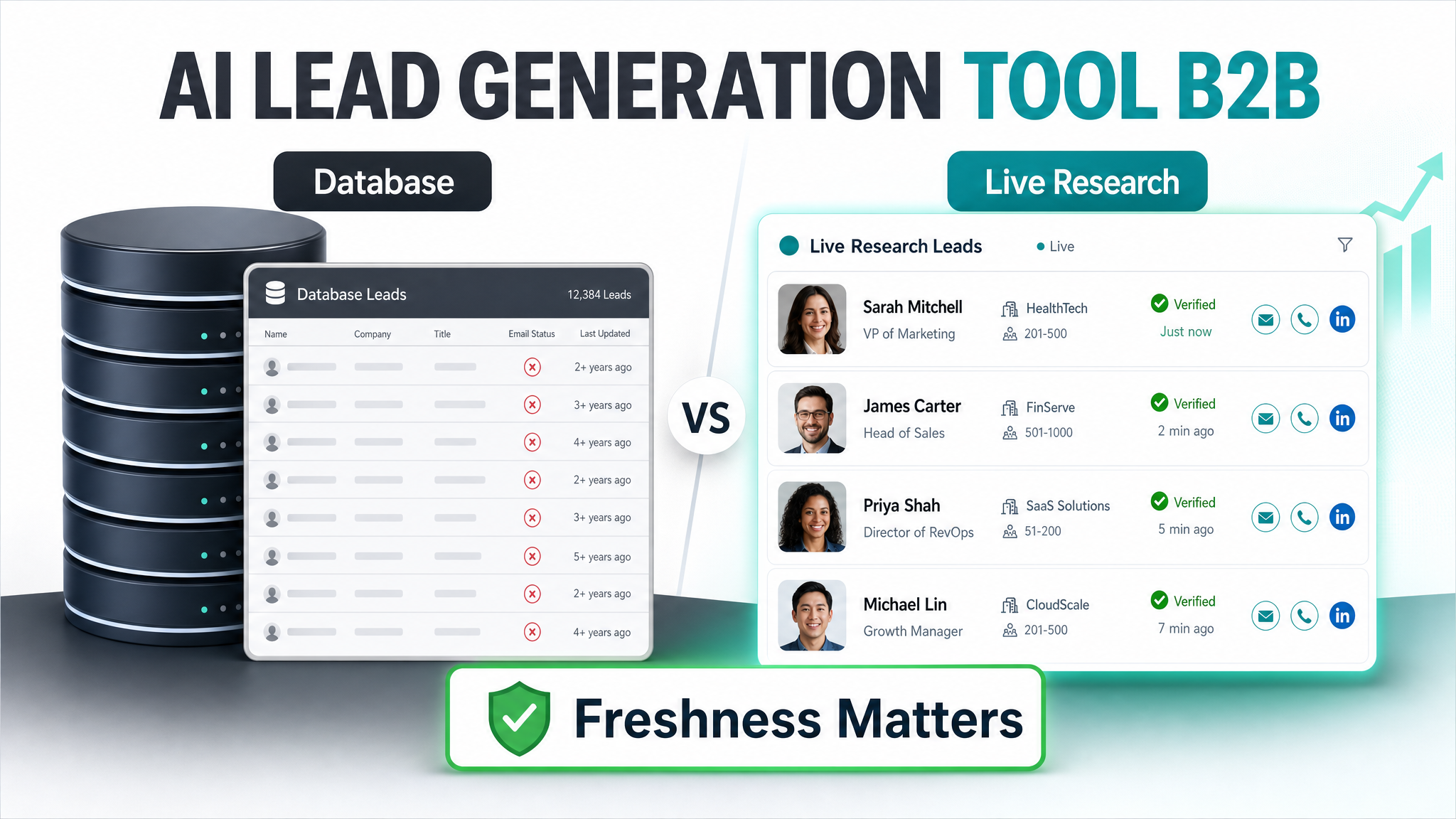
Every major AI lead generation tool in 2026 falls into one of two camps: tools that query a stored database of contacts and tools that research live sources to find contacts as of today. The database camp has the volume. The research-first camp has the freshness. Which matters more depends on your ICP, your target markets, and how much you care about bounce rates. B2B contact data decays at 3.6% per month for email alone — nearly double the rate from two years ago — which means the case for live-research lead generation has never been stronger. This guide breaks down both approaches honestly, shows you where each one wins, and explains why the database-vs-research distinction matters more than any specific feature set.
Table of Contents
- The Problem With How Most AI Lead Generation Tools Work
- The Database Camp: What It Offers and Where It Falls Apart
- The Research-First Camp: What Live Sourcing Actually Means
- Data Decay: Why the Gap Between These Approaches Is Growing
- Side-by-Side Comparison
- The Deliverability Consequence Nobody Talks About
- Which Approach Is Right for Your Team
- FAQ
The Problem With How Most AI Lead Generation Tools Work
The phrase "AI lead generation tool" covers a wide range of things. Some tools use AI to score and rank contacts in a database. Some use AI to write personalised outreach once you've brought them a list. Some use AI to crawl public sources and surface contacts that aren't in any stored database at all.
Most of them — and most of the roundups ranking them — treat "AI lead generation" as a solved problem once you've got a list of contacts with email addresses attached. The question they don't answer is: how fresh is that data, and what happens to your sending reputation when it isn't?
37% of CRM users have directly lost revenue due to poor data quality, according to Validity's 2025 State of CRM Data Management report covering 602 respondents. The average worker spends 13 hours per week just hunting for accurate information in CRM systems — not selling, not calling, hunting. And 91% of CRM data is incomplete, stale, or duplicated according to Salesforce's own research on its user base.
The AI lead generation category has absorbed a lot of investment and marketing spend without squarely addressing the thing that breaks most outbound campaigns before the first email is even written: the data underneath it is wrong.
The Database Camp: What It Offers and Where It Falls Apart
Database-first AI lead generation tools hold large inventories of pre-verified B2B contacts — Apollo has 275M+ researched contacts, ZoomInfo has over 500M — and use AI to filter, score, and prioritise who to contact from within that inventory.
This approach has real advantages:
- Scale. No browsing-based research approach comes close to the raw volume available in a major B2B database.
- Speed. Searching and filtering a stored database is fast. You can export 500 leads in minutes.
- Established integration layers. Apollo, ZoomInfo, and similar tools have mature integrations with every major CRM and sequencing platform. The workflow is familiar and well-documented.
- Intent signals layered on. The better platforms add intent data — which accounts are actively researching relevant topics, which are hiring in relevant roles — on top of the base contact record.
Where it falls apart is freshness. The record you pull from a database was verified at a point in time. That might have been three months ago, or it might have been two years ago. The database doesn't know that the VP of Sales you're about to email became a CRO at a different company six weeks after their record was last refreshed.
The average B2B data provider delivers roughly 50% accuracy across stored records. Top-tier providers with aggressive reverification schedules reach 97%+ on their best-researched contacts — but even at 97%, that's 30 bad records in every thousand, and 30 bounces in a thousand emails is already approaching the threshold where ISPs start flagging your domain.
The Research-First Camp: What Live Sourcing Actually Means
Research-first lead generation tools don't query a stored database. Instead, they use a browsing agent to visit the target company's live digital presence — their website, LinkedIn company page, individual public profiles — and identify contacts at the moment you create the campaign.
The output is narrower per run. You're getting 10–100 contacts from a specific company rather than 10,000 from a segment of a database. But every contact returned reflects who is actually working at that company, in that role, with that email address, as of today.
AmroGen's Lead Generator agent works this way. It reads the target company's website to understand the company's structure and relevant roles, browses LinkedIn and public profiles for currently employed decision-makers, verifies emails via SMTP check at enrichment time rather than against a stored verification record, and returns ICP-scored contacts with verified fields. The data is current because it was collected current.
AI lead generation in 2026 is no longer about finding more leads — it's about deciding who to contact, when to act, and why that moment matters. Research-first tooling aligns with that framing in a way that database tools, which are fundamentally inventory systems, don't.
Data Decay: Why the Gap Between These Approaches Is Growing
The data decay situation in B2B has been getting worse, not better, over the past two years.
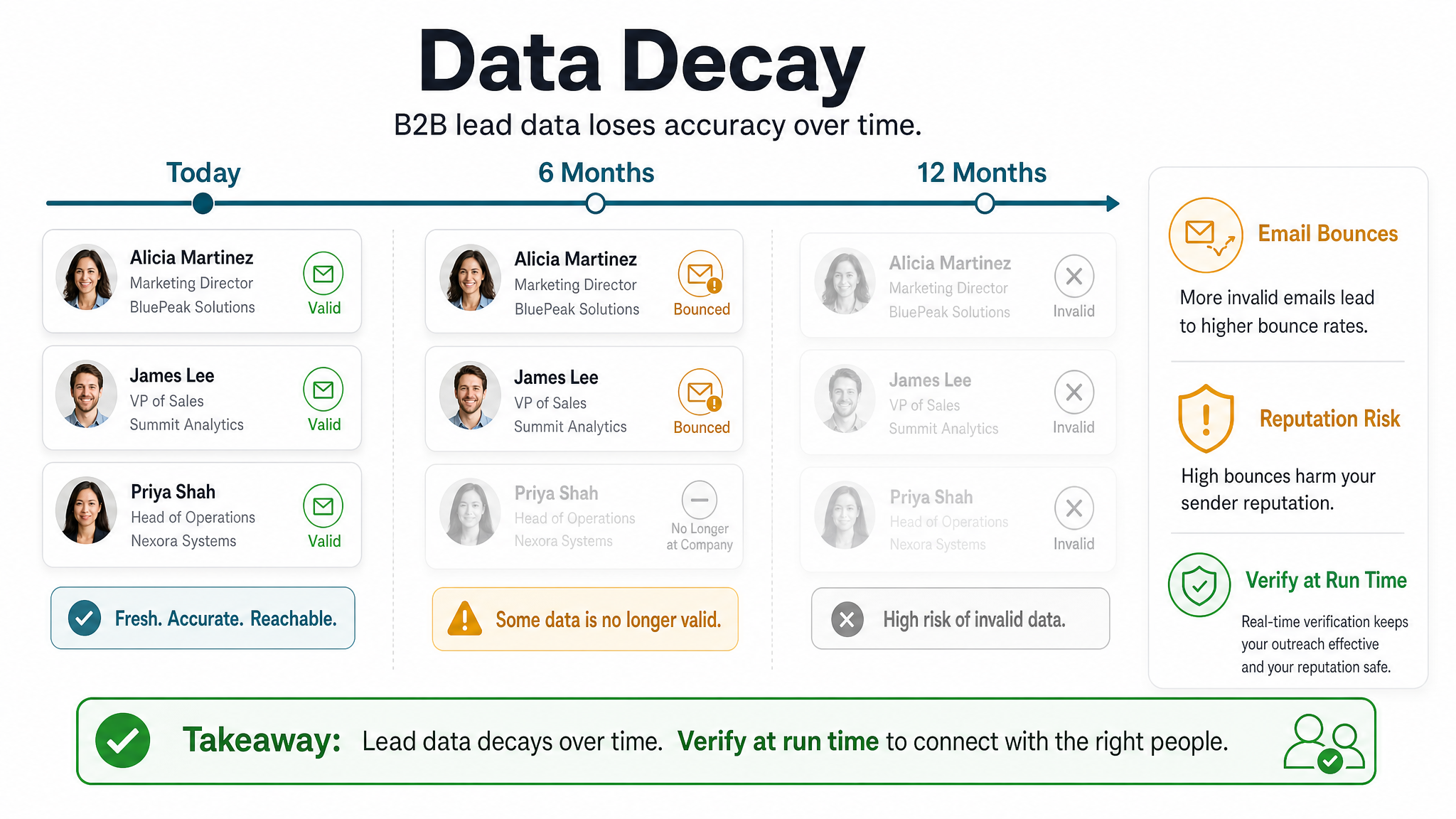
The baseline figure most people cite is 2.1% monthly decay, compounding to about 22.5% annually — meaning roughly one in four contacts in a database becomes unreliable within a year. That's the conservative estimate.
For email specifically, the situation has accelerated. Email decay hit 3.6% per month in November 2024, nearly double the traditional rate, driven by workforce mobility and remote work enabling more frequent job changes. At 3.6% monthly, a list that's six months old has lost roughly 20% of its valid email addresses. At a year, you're past 35%.
The financial consequences are significant. Poor data quality costs U.S. businesses $3.1 trillion annually, and companies lose an average of 16 sales opportunities per quarter from unreliable data — that's 64 missed deals a year before you've written a single word of outreach.
For a database-first tool, these are structural risks. The tool's core asset is a stored inventory, and inventory decays. For a research-first tool, the data freshness problem is substantially reduced because the contacts are sourced at campaign time rather than months earlier.
Side-by-Side Comparison
| Criterion | Database-first (Apollo, ZoomInfo) | Research-first (AmroGen) |
|---|---|---|
| Contact volume per run | Hundreds to thousands | 10–100 |
| Data freshness | Verified at a point in time; 2.1% decay/month | Sourced at campaign time |
| Email accuracy | ~50% average across database; 97%+ at top-tier | Real-time SMTP verified |
| Coverage for US mid-market | Strong | Variable (browses whatever is public) |
| Coverage for international / small companies | Thins significantly | Works anywhere with a web presence |
| Setup required | Database subscription + filter configuration | URL input |
| Best use case | High-volume outbound across many companies | Targeted outbound into specific accounts |
| Intent signal data | Often included (ZoomInfo, 6sense) | Not currently — sourced from public signals only |
| Deliverability risk from stale data | Higher — stored records decay | Lower — contacts verified at run time |
The Deliverability Consequence Nobody Talks About
Most AI lead generation content focuses on reply rates and pipeline. Almost none of it addresses what happens to your domain reputation when your lead data is stale.
Every bounced email is a signal to inbox providers that your sending behaviour doesn't match what a legitimate sender looks like. Google's own Email Sender Guidelines set a spam complaint rate ceiling at 0.30% — beyond that, your deliverability starts degrading. The recommended target is below 0.10%. A list with 3–5% stale emails doesn't just waste those sends; it pushes your overall deliverability below the threshold, meaning your valid emails start landing in spam too.
This is the compounding consequence Salesmotion describes as decay compounding on itself: the emails that bounce damage the reputation, the damaged reputation reduces inbox placement, reduced inbox placement hurts the emails that would have landed — and now your sequence is underperforming even for the contacts whose data was correct.
Using research-first lead generation, where contacts are SMTP-verified at campaign time, substantially reduces this risk. You're not sending into a database record that was validated under different standards, at a different time, for a different campaign.
AmroGen specifically addresses the second half of this problem by sending from your own Gmail account rather than a separate cold sending domain — which means your established sender reputation protects the campaign from day one, and bounces don't accumulate against a domain you're still trying to warm.
Which Approach Is Right for Your Team
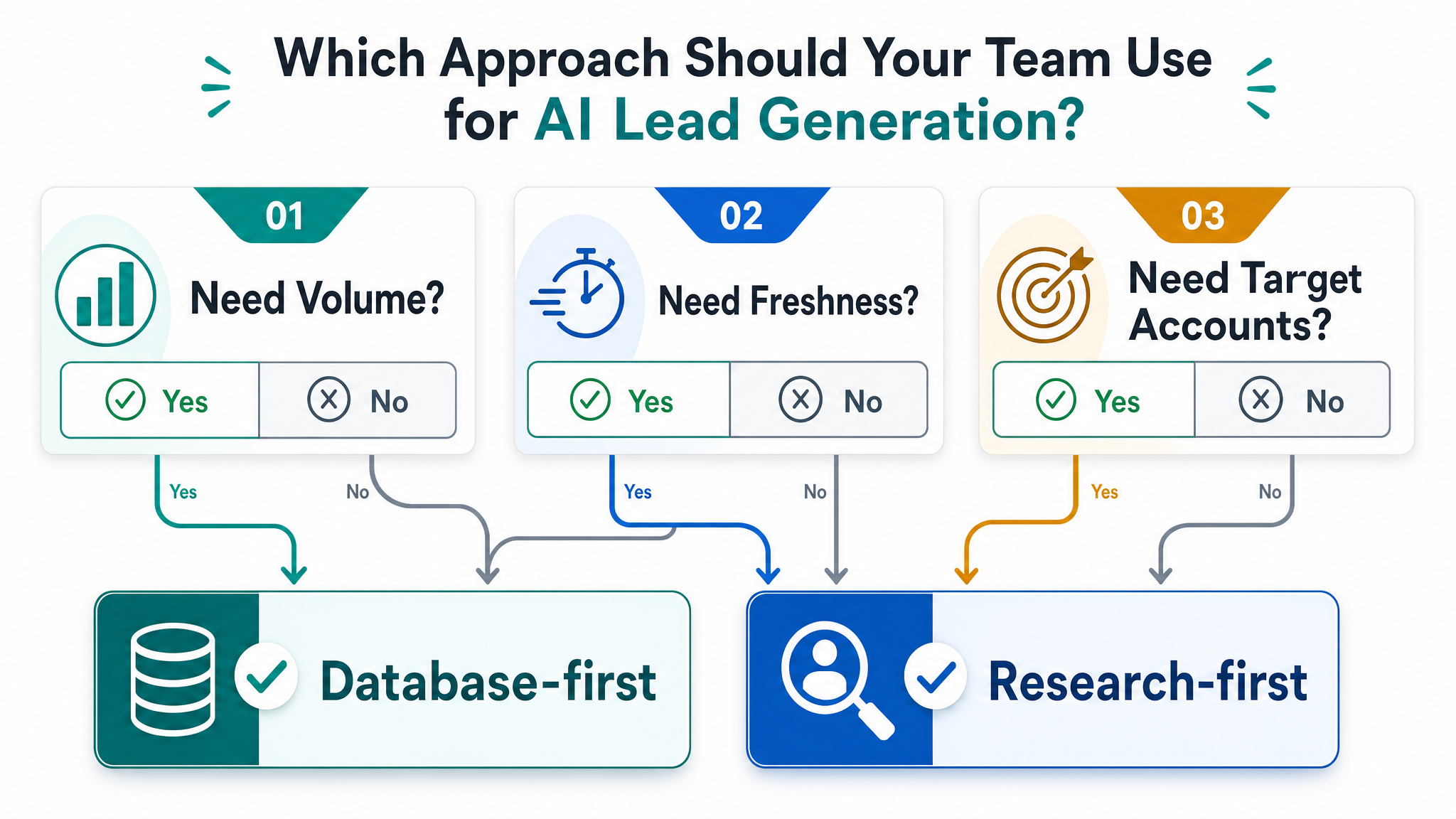
The honest answer is that it depends on three things: how many companies you're targeting, how critical data freshness is for your specific ICP, and whether you have a pre-existing database infrastructure to plug into.
Use a database-first tool if:
- You're prospecting across hundreds or thousands of companies and need volume at scale
- Your ICP is US-based mid-market or enterprise, where Apollo and ZoomInfo have the strongest coverage
- You have an existing CRM and sequencing workflow built around a database tool
- Intent signal data is a core part of your targeting logic
Use a research-first tool like AmroGen if:
- You're running targeted, account-specific outbound into 5–50 companies at a time
- Your targets include international companies, smaller businesses, or niche markets with thin database coverage
- Data freshness matters more than raw volume — you'd rather have 25 researched contacts than 200 with 25% bounce risk
- You don't have a lead list and don't want to build one before starting outreach
- You want one tool to handle lead discovery, outreach writing, quality review, and sending — rather than assembling a stack
Most teams doing serious outbound in 2026 end up using both in some form. Clay's own guide to AI lead generation describes the strongest stacks as layering multiple approaches — a database for volume prospecting, live research for key accounts where freshness is critical. AmroGen is built for the latter half of that equation.
FAQ
What is the best AI tool for B2B lead generation? It depends on your use case. For high-volume outbound from a large database, Apollo and ZoomInfo dominate on coverage. For targeted, account-specific outbound where data freshness matters, research-first tools like AmroGen produce higher-quality lists because contacts are verified at campaign time rather than from a stored snapshot.
How does AI generate leads? AI lead generation tools either query stored contact databases and use AI to score and filter results, or use browsing agents to research live sources and surface current contacts. The first approach is faster and higher volume; the second is fresher and better for targeted outbound into specific accounts.
Is AI lead generation better than cold calling? Better at scale, and complementary rather than competing at the individual account level. AI tools handle research, verification, scoring, and outreach at a volume no human team can match — but the highest-performing outbound teams combine AI handling the volume with humans focusing on high-value conversations rather than replacing the human layer entirely.
How much does AI lead generation cost? Costs vary widely by tool and approach. Database subscriptions (Apollo, ZoomInfo) typically run $49–99+/user/month. Research-first pipeline tools like AmroGen charge per campaign run — roughly $2.80 per run of 25 leads at pay-as-you-go rates, or from $29/month on a subscription.
Can AI find emails for B2B outreach? Yes, with varying accuracy depending on the method. Database tools pull email addresses from stored, periodically verified records — average accuracy across the database is roughly 50%, rising to 97%+ at top-tier providers on their best-researched contacts. Research-first tools verify email addresses via SMTP check at the time of the campaign, producing accuracy that reflects the email's validity today rather than the last time the database was refreshed.
What fields does an AI lead generation tool return? A well-structured tool returns: full name, current job title, current employer, verified email address, LinkedIn profile URL, direct phone number where available, location, and an ICP fit score. Some tools also include firmographic data (company size, industry, revenue range), technographic data (technology stack), and intent signals (indicating active research behaviour).
Reflects publicly available data and research as of June 2026.
Internal links: /features/lead-generation · /alternatives/apollo-alternative · /ai-sdr-tools