How We Research Up to 100 B2B Leads From a Single URL (No Database Needed)
TL;DR
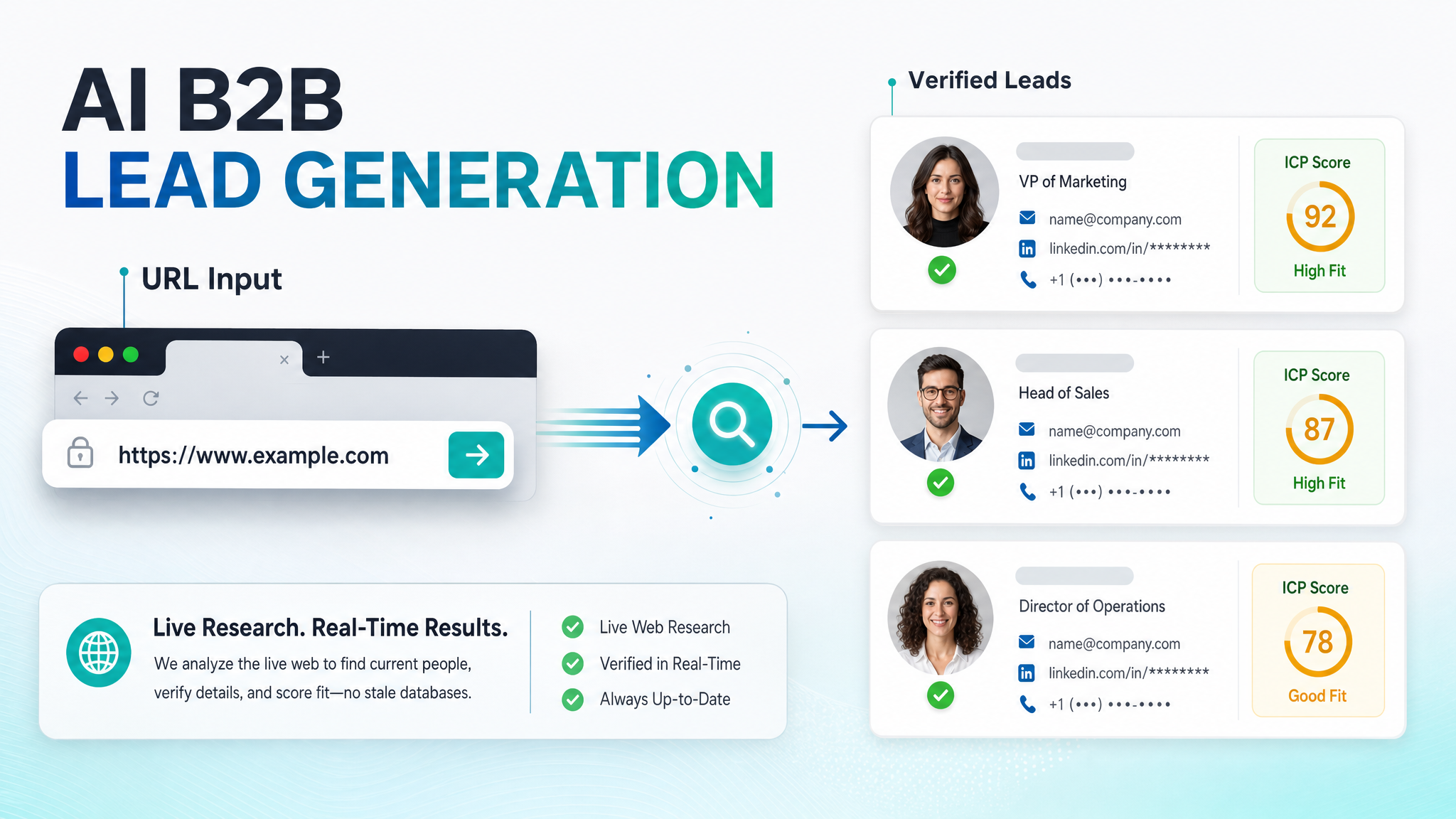
Most AI B2B lead generation still means one of two things: querying a database of contacts that was verified months ago, or scraping LinkedIn until someone notices. Both have the same problem — B2B contact data decays at roughly 2.1% per month, compounding to about 22.5% annually. A list that looks clean in January is throwing one in four contacts by December. AmroGen takes a different approach: instead of pulling from a stored database, the Lead Generator agent browses the target company's live website, LinkedIn, and public data sources at the moment you create a campaign. The output is a set of verified, enriched contacts — name, title, company, email, LinkedIn URL, phone, location, and ICP fit score — built from current information rather than a snapshot taken months earlier. This guide explains how that pipeline works, what it produces, and when it makes more sense than a database-first approach.
Table of Contents
- Why AI B2B Lead Generation Usually Still Has a Data Problem
- What Research-First Lead Generation Actually Looks Like
- The Five Things a Good AI Lead Generator Should Return
- Step by Step: What Happens When You Run AmroGen on a URL
- Sample Output: What an Enriched Lead Looks Like
- Database vs Research-First: When Each One Wins
- Common Use Cases
- FAQ
Why AI B2B Lead Generation Usually Still Has a Data Problem
B2B lead generation has been transformed by AI in two ways that get a lot of attention — personalised outreach at scale, and intent signal scoring — and one way that doesn't: the underlying data quality problem is worse than it's ever been.
B2B contact data decays at 2.1% per month, compounding to roughly 22.5% annually. That's the often-cited baseline. The more alarming figure is that email decay specifically hit 3.6% per month in November 2024 — nearly double the traditional rate — driven by workforce mobility, remote work normalising more frequent job changes, and company restructuring happening faster than database refresh cycles can track. By some measures, 70.8% of all business contacts have at least one field change within 12 months.
What this means practically: poor data quality costs U.S. businesses $3.1 trillion annually, and companies lose an average of 16 sales opportunities per quarter from unreliable data alone. But the damage isn't just the lost opportunity cost — it's the domain reputation cost. When sequences bounce because an email address went stale three months ago, your domain reputation takes the hit. Deliverability drops. Good emails start landing in spam. The decay compounds.
The standard AI lead generation stack — query a database, score for ICP fit, export to a sequence tool — doesn't touch this problem. It automates the outreach layer on top of the same stale data that existed before AI entered the picture.
Research-first lead generation starts differently. Instead of asking "who in my database matches this profile," it asks "who is actually working at this company right now, in this role, with this contact information, as of today."
What Research-First Lead Generation Actually Looks Like
The distinction sounds straightforward, but the implementation requires a fundamentally different architecture than a standard enrichment workflow.
In a database-first approach, your tool queries a stored contact record. Apollo, ZoomInfo, and similar platforms hold hundreds of millions of contacts, periodically reverified against public sources. The data is real, and for US-based mid-market and enterprise contacts, accuracy rates at the top providers can be high — but even top-tier providers deliver 97%+ accuracy only on their best-case verified records, while the average across the database sits closer to 50%. The verification was done at a point in time, and the record you pull today may not reflect a job change from three weeks ago.
In a research-first approach, a browsing agent visits the company's own digital presence — their website, their LinkedIn company page, the LinkedIn profiles of people listed there, and relevant public directories — at the time you create the campaign. The agent is reading live data, not a stored snapshot. Someone who joined a company last month shows up. Someone who left two weeks ago doesn't.
AmroGen's Lead Generator agent works this way. It doesn't pull from a proprietary database. It browses, reads, reasons, and enriches — one campaign at a time, from sources that are current as of when the pipeline runs.
The Five Things a Good AI Lead Generator Should Return
Before evaluating any AI lead generation approach, it's worth being specific about what "a useful outreach lead" actually means. The minimum useful output for a B2B outreach lead includes:
1. A verified email address. Not a pattern-guessed one (first.last@domain.com) — a verified one with SMTP confirmation. The average data provider delivers roughly 50% accuracy on email records. High-quality, real-time verification puts accuracy rates in the high nineties.
2. A confirmed current title and company. Given that 70.8% of business contacts have changed something within 12 months, "confirmed current" is not the same as "in the database." It means checked against the person's LinkedIn profile and the company's own website as of the campaign run date.
3. A LinkedIn profile URL. For any multichannel outreach that includes LinkedIn steps, a confirmed profile URL is not optional.
4. A phone number where available. Direct dials and mobile numbers for decision-makers are harder to surface than email addresses, but they matter for SMS and call workflows.
5. An ICP fit score. Not just "this person has the right title" — a composite score that reflects how well the lead's role, seniority, company size, industry, and available signal data align with the ideal customer profile you've defined for this campaign.
Step by Step: What Happens When You Run AmroGen on a URL
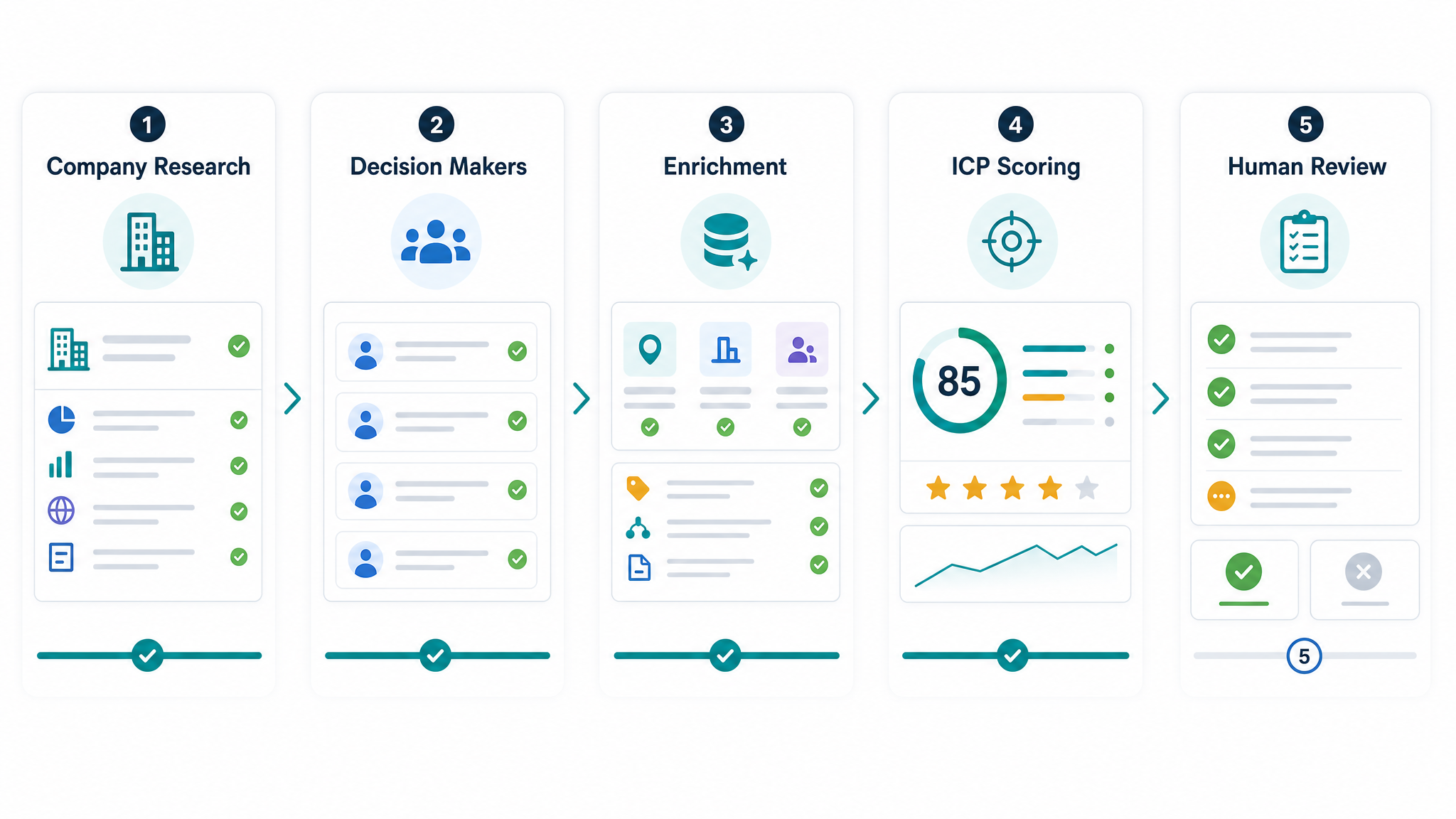
This is the actual pipeline AmroGen's Lead Generator agent runs when you enter a target company URL. Understanding what happens at each step is useful both for evaluating the output quality and for setting expectations about what the agent will and won't return.
Step 1 — Company intelligence gathering. The agent reads the target company's website: what they make or sell, how their team is structured, which departments are prominent, any public data about company size, recent hires, or strategic direction. This feeds the ICP scoring logic and the personalisation context that later agents use when writing outreach.
Step 2 — Decision-maker identification. Using the company intelligence gathered in Step 1, the agent identifies which job functions are relevant for your ICP — typically founders, C-suite executives, VPs, and heads of department depending on your target. It then browses for currently employed people in those roles at that company, cross-referencing the company's own website with LinkedIn company pages and public profiles.
Step 3 — Contact enrichment. For each identified decision-maker, the agent enriches: business email address (verified via SMTP check), LinkedIn profile URL, direct phone number where available, current title, company, location, and any relevant signal data.
Step 4 — ICP scoring. Each enriched lead gets scored against the ICP criteria you set for the campaign: role seniority, department fit, company size and industry match, and any signal-specific criteria. Leads are returned ranked High / Medium / Low.
Step 5 — Human review. Before any outreach is generated, you see the full lead list — every contact, every field — and can remove or add leads. The pipeline doesn't move to outreach until you've reviewed and confirmed.
Sample Output: What an Enriched Lead Looks Like
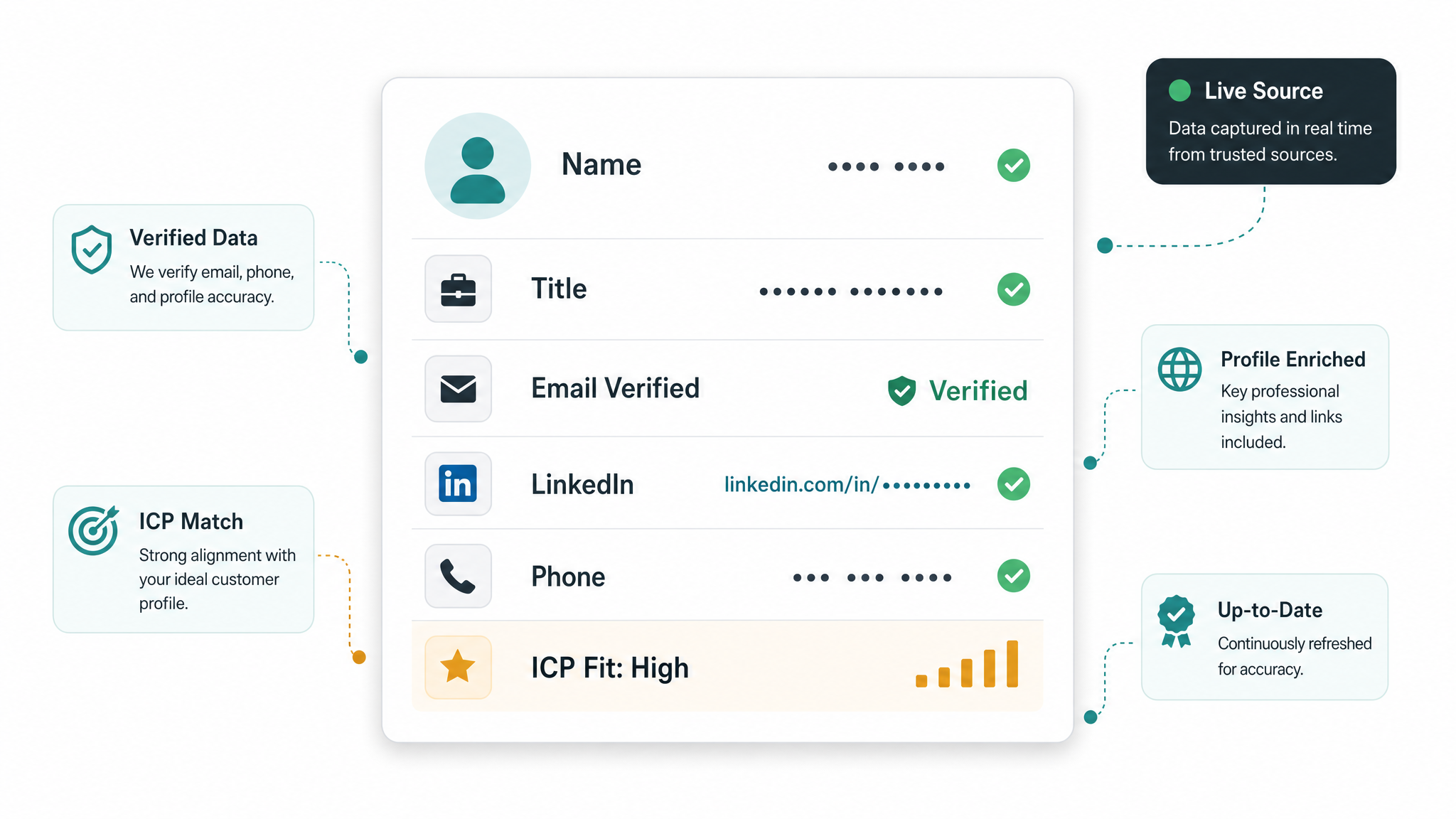
Below is an anonymised example of the output AmroGen's Lead Generator returns for a single lead. Real campaigns return up to 100 leads per run in this format.
| Field | Example value |
|---|---|
| Name | Alex Chen |
| Title | VP of Sales |
| Company | [Target Company] |
| a.chen@[domain].com (verified) | |
| LinkedIn URL | linkedin.com/in/alex-chen-[id] |
| Phone | +1 (415) 555-0192 |
| Location | San Francisco, CA |
| ICP Fit Score | High |
When this lead moves into the outreach pipeline, the Orchestrator and specialist agents use all of this context — not just the name and company — to write the sequence. "VP of Sales at a Series B SaaS company that just expanded into APAC" produces a different email than the same title at a bootstrapped 10-person agency. That's the difference between research-first enrichment and a database pull.
Database vs Research-First: When Each One Wins
This isn't a question with a single right answer. Database-first and research-first approaches are better suited to different situations.
| Situation | Better approach | Why |
|---|---|---|
| You need 10,000+ contacts across many companies at once | Database-first (Apollo, ZoomInfo) | Scale that research-first browsing can't match per run |
| You're targeting a specific set of 5–20 companies | Research-first (AmroGen) | Depth and freshness that static databases can't guarantee |
| Your target company isn't in any major database | Research-first | URL-based browsing finds contacts where database coverage is thin |
| You need US mid-market contacts fast | Database-first | Coverage and accuracy tend to be strong here |
| You're targeting international markets or smaller companies | Research-first | Database coverage outside US mid-market degrades significantly |
| You want the most current contact data possible | Research-first | Data decays 2.1% per month; live research beats a quarterly refresh cycle |
| You need to fit into an existing CRM/Apollo workflow | Database-first | Integration layer is mature; research-first requires a different architecture |
AI lead generation in 2026 is less about finding more leads and more about deciding who to contact, when to act, and why that moment matters. Both approaches can get you a list. The research-first approach tends to produce a shorter list with fresher data — which, if you're measuring campaign performance rather than list size, is usually the list you actually want.
Common Use Cases
New vertical or market entry. When you're going into a market you haven't touched before, you often don't have a qualified list — you have a hypothesis. Give AmroGen a URL of a company in that vertical, or a list of 10 target companies. The Lead Generator maps their decision-maker structure and returns a ranked lead set in a full agent run, without a database subscription for that segment.
Account-based marketing. You have five dream accounts you want to be in. AmroGen builds a complete contact map of each — every stakeholder, every relevant role, with contact details where available — without a researcher or an Apollo export that may be months out of date.
Conference and event follow-up. After a conference, you have a list of companies whose logos were on the wall. Run each company URL through AmroGen and you have decision-maker contacts — with emails and LinkedIn — for personalised follow-up, in the same afternoon.
Competitive displacement. You know who your competitor's customers are. Run their websites. The Lead Generator identifies who the right person to contact would be — and the outreach agents write sequences calibrated for someone who's already committed to a competing product.
Filling gaps in an existing database. Apollo and ZoomInfo have gaps — smaller companies, international markets, recent hires. Run the target companies through AmroGen's URL-based research and fill in contacts that your existing database subscription missed.
FAQ
What is AI B2B lead generation? AI B2B lead generation uses artificial intelligence to automate the process of finding, verifying, and enriching potential business customers — handling the research, scoring, and data collection that a human SDR would otherwise do manually. The best tools go beyond querying a stored database and use live research to surface contacts that are current as of the campaign date.
How does AI find B2B leads? Database-first tools search stored contact records filtered by firmographic criteria. Research-first tools — like AmroGen's Lead Generator agent — browse the target company's live digital presence to identify who currently works there in relevant roles, then enrich each contact with email where available, LinkedIn, phone, and ICP data.
Is AI lead generation accurate? It depends on the approach. Stored databases deliver roughly 50% accuracy on average, with top-tier providers reaching 97%+ on their best-verified records. Research-first approaches use live sources and real-time email verification, which produces higher accuracy for the contacts found — but with a narrower breadth of coverage per run.
What data does AI collect on leads? A well-structured AI lead generator returns: full name, current job title, current employer, business email where available address, LinkedIn profile URL, direct phone number where available, location, and an ICP fit score. AmroGen returns all of these fields for every lead it surfaces.
How do you generate B2B leads automatically? Enter a target company URL. AmroGen's Lead Generator agent runs the research, enrichment, and scoring pipeline automatically — returning a ranked, researched lead list for your review. You confirm the leads, the outreach pipeline starts, and specialist agents write personalised sequences for each contact.
Which AI tool finds the most B2B leads? In terms of raw volume, database tools like Apollo (275M+ contacts) and ZoomInfo (500M+ contacts) have the largest inventories. In terms of quality and freshness per campaign, research-first tools that browse live sources at campaign time have an advantage — especially for smaller companies, international markets, and contacts who changed roles recently.
Can AI find decision-maker email addresses? Yes. AmroGen's Lead Generator agent browses live sources and verifies email addresses in real time via SMTP checks, rather than pulling from a stored database that may have decayed. The verification runs at the time of the campaign, not months earlier.
Data reflects publicly available sources as of June 2026.
Internal links: /features/lead-generation · /ai-sdr-tools · /alternatives/apollo-alternative